Many English learners and even native speakers often confuse “since” and “sense.” While these words may sound somewhat similar, their meanings and uses are entirely different. Choosing the wrong word can change the meaning of a sentence, leading to misunderstandings.
For instance, someone might write: “I haven’t seen him since 2019” instead of “since 2019.” Small mistakes like this are common in emails, social media posts, and even professional writing. People search for “since or sense” to clarify when to use each word and improve their writing accuracy.
This guide will provide a quick explanation, origins, British vs American usage, common mistakes, and practical examples to help you confidently choose between since and sense every time.
Since or Sense – Quick Answer
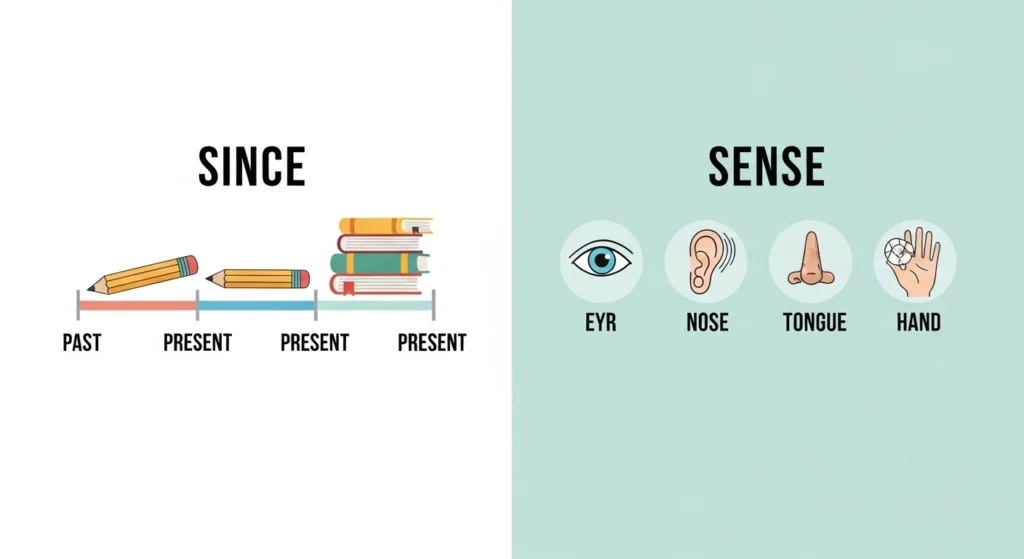
- Since – Refers to a point in time or reason.
- Example (time): “I have lived here since 2015.”
- Example (reason): “Since it’s raining, take an umbrella.”
- Sense – Refers to perception, understanding, or feeling.
- Example: “She has a good sense of humor.”
- Example: “I can sense danger nearby.”
Quick Tip: If you’re talking about time or reason → use since. If it’s about feeling or perception → use sense.
The Origin of Since or Sense
- Since comes from Old English “siththan”, meaning “after that time”. It evolved to indicate time and cause.
- Sense comes from Latin “sensus”, meaning “perception” or “feeling”. It entered English via Old French.
The different origins explain why these words have different meanings despite sounding similar.
British English vs American English Spelling
Both since and sense are spelled the same in British and American English. Unlike words such as color/colour, there’s no variation here.
| Word | British English | American English | Meaning |
| Since | since | since | Time or reason |
| Sense | sense | sense | Perception, feeling, or understanding |
Key Takeaway: No spelling differences exist. The challenge is in correct usage, not spelling.
Which Spelling Should You Use?
Since and sense are universal in English. No matter your audience—US, UK, or Commonwealth—stick to the standard spelling. The focus should always be contextual correctness:
- Use since for time or cause.
- Use sense for understanding, perception, or intuition.
Common Mistakes with Since or Sense
- ❌ “I haven’t seen him sense Monday.”
✅ “I haven’t seen him since Monday.” - ❌ “She has a strong since of direction.”
✅ “She has a strong sense of direction.” - ❌ “Since of humor is important.”
✅ “Sense of humor is important.”
Tip: Read your sentence aloud. If it refers to time, since is correct. If it refers to feeling, understanding, or perception, sense is correct.
Since or Sense in Everyday Examples
Emails:
- “Since you requested it, I’ve attached the report.” ✅
- “I have a strong sense of urgency about this task.” ✅
Social Media:
- “I haven’t posted since last month.” ✅
- “She has a great sense of style.” ✅
News Writing:
- “The policy has been in effect since January.” ✅
- “Experts sense a change in public opinion.” ✅
Since or Sense – Google Trends & Usage Data
According to Google Trends, “since” is more commonly searched than “sense” when people confuse the words. Countries like the US, UK, and India show high search volumes for clarifying “since vs sense” in English learning contexts.
Keyword Variations Comparison Table
| Variation | Meaning / Usage | Example |
| Since | Time or reason | “I’ve lived here since 2010.” |
| Sense | Perception, understanding, feeling | “He has a strong sense of responsibility.” |
| Since or Sense? | Clarification question | “Should I use since or sense here?” |
FAQs
1. Can “since” mean “because”?
Yes. “Since you are tired, take a rest.”
2. Can “sense” be used as a verb?
Yes. “I can sense something wrong.”
3. Are these words interchangeable?
No. They have completely different meanings.
4. How do I remember the difference?
Think: since = time/cause, sense = feeling/understanding.
5. Is there a spelling difference in British vs American English?
No. Both are spelled the same.
6. Can “sense” refer to the five senses?
Yes. “Humans have five senses: sight, hearing, taste, touch, and smell.”
7. Is “since” only used in past tense?
No. It’s used with present perfect to show duration from a past point. “I have known him since 2010.”
Conclusion
Understanding since and sense is crucial for clear writing. While they sound similar, they serve very different purposes: since relates to time or reason, and sense relates to perception or understanding. Both words are spelled the same in British and American English, so focus on context rather than spelling.
Use this guide to avoid common mistakes, apply the words correctly in emails, social media, and professional writing, and confidently answer “since or sense” whenever you encounter it. Correct usage improves clarity, professionalism, and reader comprehension.

Hi, I’m Henry James, the author behind GrammarTribe.com. I’m passionate about the English language and specialize in grammar, helping readers understand complex rules in a simple, clear way. Over the years, I’ve dedicated myself to creating content that makes learning grammar practical, fun, and accessible for everyone. If you’re a student, professional, or language enthusiast.
Through GrammarTribe.com, I share tips, guides, and examples to help people write confidently and correctly. My goal is to make grammar less intimidating and more useful in everyday writing, emails, social media, and professional communication. Writing and teaching grammar isn’t just my profession — it’s my passion.
When I’m not writing, I enjoy reading, exploring language trends, and discovering new ways to make English learning engaging and easy. My mission is to empower readers to communicate clearly and confidently, one grammar tip at a time.