
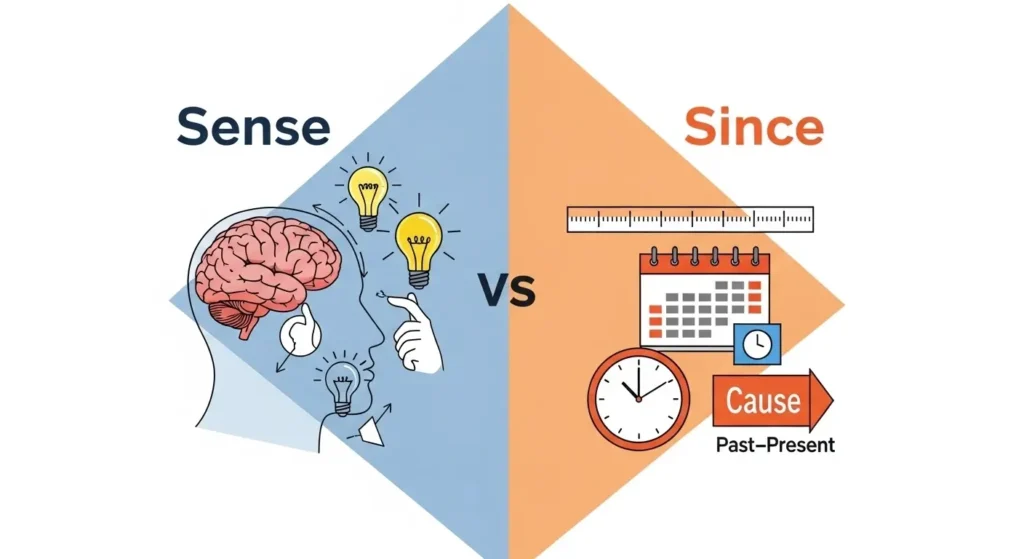
Many English learners often get confused between sense or since because the two words look similar but have completely different meanings. This confusion is one of the most common grammar mistakes in writing, speaking, emails, and exams.
People frequently search for “sense or since” when they are unsure whether a sentence is correct, such as “I didn’t call you since yesterday” or “It makes no sense.” The keyword sense or since is often searched because both words sound similar in fast speech and are easy to mix up.
The confusion usually happens because sense is related to meaning, feeling, or logic, while since is related to time or reason. However, learners often swap them accidentally, which changes the entire meaning of a sentence. Understanding the difference between sense or since helps improve grammar accuracy, writing clarity, and communication skills. This article will clearly explain both words, their usage, origin, differences, and real-life examples so you never confuse them again.
Sense or Since – Quick Answer
- Sense = meaning, feeling, or logical understanding
- Example: It makes no sense.
- Example: She has a good sense of humor.
- Since = time (from a point in the past) or reason (because)
- Example: I have lived here since 2010.
- Example: Since you are here, let’s start.
👉 Quick trick:
If it relates to meaning or logic → sense
If it relates to time or reason → since
The Origin of Sense and Since
- Sense
- Comes from Latin “sensus” meaning feeling or perception.
- I entered English through Old French.
- Originally used for physical feeling and later expanded to logic and meaning.
- Since
- Comes from Old English “siththan” meaning “from then on.”
- Evolved into Middle English as “sithens,” later shortened to “since.”
- Used for time reference and cause/reason.
British English vs American English Spelling
Good news: sense and since do not have spelling differences in British and American English.
They are spelled the same in both.
However, usage style may differ slightly:
- British English: more formal phrasing in writing
- American English: more direct and simplified usage
Comparison Table
| Word | British English | American English | Meaning |
| Sense | sense | sense | meaning/feeling |
| Since | since | since | time/reason |
Which Should You Use?
- Use “sense” when talking about:
- Meaning
- Understanding
- Feelings or logic
- Use “since” when talking about:
- Time (starting point in past)
- Reason (because)
Global Advice
- US learners: Focus on “since” for time expressions in daily speech
- UK learners: Use both formally and informally
- Global learners: Learn both meanings clearly to avoid confusion in exams and writing
Common Mistakes with Sense or Since
❌ Wrong: It makes since.
✔ Correct: It makes sense.
❌ Wrong: I didn’t see you sense Monday.
✔ Correct: I didn’t see you since Monday.
❌ Wrong: Since of your help, I succeeded.
✔ Correct: Because of your help, I succeeded.
Sense or Since in Everyday Examples
Emails
- It makes sense to schedule the meeting earlier.
- Since you are available, please confirm the time.
News Writing
- The decision makes sense for economic growth.
- Since the announcement, markets have reacted strongly.
Social Media
- This meme makes no sense
- Since yesterday, I’ve been so tired.
Formal Writing
- It makes sense to adopt new policies.
- Since the data is incomplete, results may vary.
Sense or Since – Google Trends & Usage Data
- “sense” is more commonly used in general writing and conversation
- “since” is heavily used in grammar questions and time-based sentences
- Countries with highest searches:
- India 🇮🇳
- Pakistan 🇵🇰
- Bangladesh 🇧🇩
- United States 🇺🇸
- United Kingdom 🇬🇧
Most searches happen during:
- Exam preparation
- English grammar learning
- IELTS/TOEFL study
Comparison Table: Sense vs Since
| Feature | Sense | Since |
| Type | Noun/Verb | Conjunction/Preposition |
| Meaning | Logic, feeling | Time, reason |
| Example | It makes sense | I lived here since 2020 |
| Function | Understanding | Connection |
| Usage Error | “since” used incorrectly | “sense” used incorrectly |
FAQs
1. What is the main difference between sense and since?
Sense means meaning or logic, while since refers to time or reason.
2. Can sense and since be used in the same sentence?
Yes. Example: It makes sense since you explained it clearly.
3. Why do people confuse sense and since?
Because they sound similar in fast speech.
4. Is “since” only for time?
No, it can also mean “because.”
5. What is a simple trick to remember them?
Sense = think/logic, Since = time/reason.
6. Are they interchangeable?
No, using them incorrectly changes the meaning.
7. Which is more common in English?
“Since” is more common in grammar and time expressions.
Conclusion
Understanding the difference between sense or since is essential for clear and correct English communication. Although the words sound similar, they serve completely different purposes in grammar.
Sense is used when talking about meaning, understanding, or logic, while since is used for time references or reasons. Many learners confuse these words because of pronunciation and fast speech, but learning their correct usage helps improve writing accuracy and speaking confidence.
By practicing simple examples and remembering their core meanings, you can easily avoid mistakes. Whether you are writing emails, preparing for exams, or speaking in daily life, mastering sense or since will make your English more professional and error-free.

Hi, I’m Henry William, the author of GrammarTribe.com. I’m passionate about the English language and have dedicated my career to helping people master grammar, spelling, and effective writing. Over the years, I’ve guided learners, writers, and professionals in understanding common mistakes, tricky rules, and nuances of English grammar in a simple and easy-to-follow way.
Through GrammarTribe.com, I aim to make grammar approachable and enjoyable for everyone. My work focuses on providing clear explanations, practical tips, and examples that readers can apply in everyday writing, whether it’s emails, essays, social media, or professional documents. I believe that strong grammar skills empower people to communicate confidently and professionally.
When I’m not writing or researching grammar, I enjoy reading, exploring language trends, and creating educational content that simplifies complex concepts. I’m committed to helping my audience write better, understand English deeply, and avoid common pitfalls, all while making learning grammar a fun and rewarding journey.