Many English learners and even native speakers often wonder: should I say saw or seen? This confusion happens because both words are past forms of the verb see, but they are used in different contexts. Using the wrong form can make sentences sound awkward or grammatically incorrect.
If you’ve ever written, “I have saw that movie” or “I seen him yesterday,” you’re not alone. These mistakes are common in casual conversations, emails, social media posts, and even formal writing. Understanding the difference between saw and seen helps you speak and write confidently.
This guide will give you a quick answer, explain the origins of these words, compare British and American usage, highlight common mistakes, and show practical examples. By the end, you’ll know exactly when to use each form of see and avoid embarrassing errors.
Saw or Seen – Quick Answer
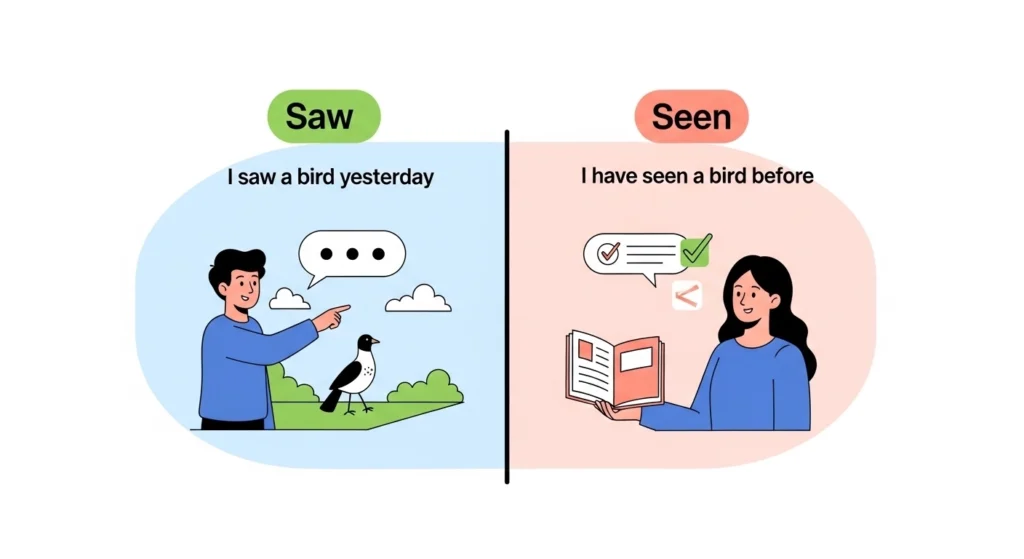
- Saw → Past simple form of see. Use it when the action happened in the past and does not use an auxiliary verb.
Example: I saw a rainbow yesterday. - Seen → Past participle of see. Use it with have/has/had (perfect tenses).
Example: I have seen that movie twice.
Rule of Thumb: If there’s no have/has/had, use saw. If there is, use seen.
The Origin of Saw or Seen
Both saw and seen come from Old English:
- Saw comes from seah, the simple past of seon (to see).
- Seen comes from geseon, the past participle.
This historical distinction explains why English kept two forms: one for simple past (saw) and one for perfect tenses (seen). Over time, some dialects mixed them, which led to common errors today.
British English vs American English Spelling
The usage of saw and seen is identical in British and American English. There’s no spelling difference; the difference is purely grammatical.
| Form | British English Usage | American English Usage |
| saw | I saw him yesterday. | I saw him yesterday. |
| seen | I have seen that film. | I have seen that film. |
Both UK and US speakers follow the same grammar rules. Confusion usually comes from informal speech, not regional spelling.
Which Spelling Should You Use?
- US Audience: Follow standard grammar. Use saw for past simple, seen with perfect tenses.
- UK/Commonwealth Audience: Same rule applies. Grammar, not spelling, is key.
- Global Audience: Always use saw for simple past and seen with have/has/had. This works for all English learners worldwide.
Common Mistakes with Saw or Seen
- Incorrect: I have saw that movie.
Correct: I have seen that movie. - Incorrect: I seen him at the party.
Correct: I saw him at the party. - Incorrect: She has saw the results.
Correct: She has seen the results. - Incorrect: We seen that yesterday.
Correct: We saw that yesterday.
Tip: Check if your sentence has have/has/had. If yes → seen. If no → saw.
Saw or Seen in Everyday Examples
- Emails: I have seen your report. Please review.
- News Headlines: Witnesses saw unusual activity near the park.
- Social Media: “Just saw the new trailer! 🔥”
- Formal Writing: The committee has seen improvements in performance.
Using the correct form improves clarity and professionalism.
Saw or Seen – Google Trends & Usage Data
Google searches for “saw or seen” spike during school semesters and around writing exam seasons.
Popularity by country:
- India, Pakistan, UK, and the US have the highest search interest.
- Contexts: grammar questions, online quizzes, and English learning resources.
This shows learners everywhere struggle with past forms of see.
Keyword Comparison Table
| Form | Type | Use Case | Example |
| saw | Past Simple | Action happened in the past | I saw a car accident. |
| seen | Past Participle | Used with have/has/had | I have seen that movie. |
FAQs – Saw or Seen
1. Can I say “I have saw it”?
No. Correct form: I have seen it.
2. Is “seen” ever used alone?
No. It must follow have/has/had.
3. Can “saw” be used in perfect tenses?
No. Use seen for perfect tenses.
4. Which is more common in spoken English?
Both are common, but errors like I seen are frequent in casual speech.
5. How do I remember the difference?
Check for have/has/had: yes → seen, no → saw.
6. Is this rule same in British and American English?
Yes, the rule is consistent worldwide.
7. Can children mix up saw and seen?
Yes, it’s a common learning stage. Repetition helps.
Conclusion
Understanding the difference between saw and seen is essential for proper English grammar. Saw is for simple past actions, while seen always needs have/has/had. This distinction helps you write professionally, speak clearly, and avoid embarrassing mistakes.
Whether in emails, social media posts, formal reports, or casual conversation, using the correct form ensures your message is understood. Remember, British and American English follow the same rules. For learners, practice with real-life examples and check for auxiliary verbs. Mastering saw vs seen may seem small, but it greatly improves your English confidence.

I am James Wilson, an author at GrammarTribe.com, specializing in English grammar and clear communication.
I create expert, reliable content to help learners write with confidence and accuracy.