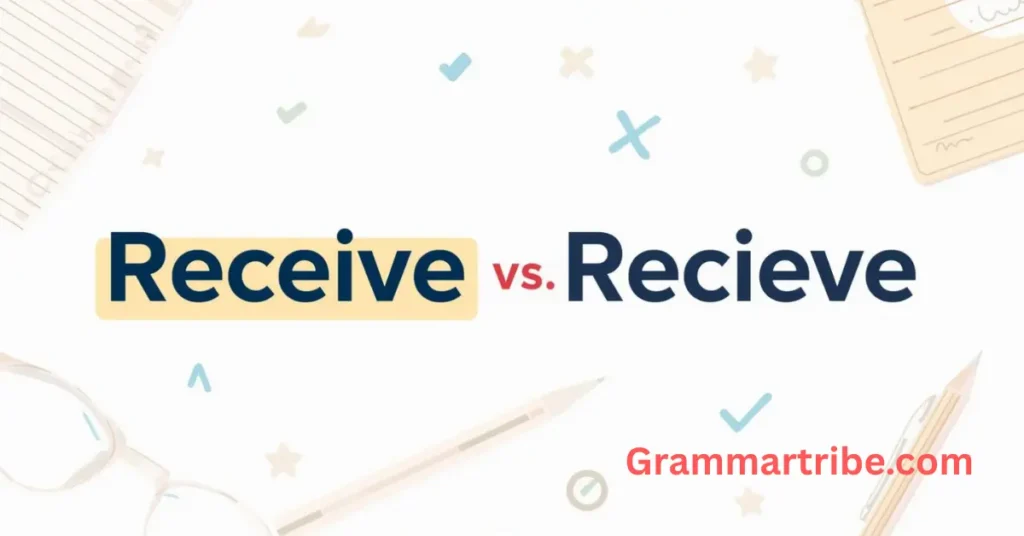
Have you ever typed “recieve” and wondered if it’s right? Many people search for “recieve / receive” because it’s a commonly misspelled word in English. The confusion arises because the letters “i” and “e” appear together, making people unsure which comes first.
Getting it right matters in emails, essays, business documents, and social media posts, as spelling mistakes can make writing look unprofessional.
This article clears the confusion, explains why both spellings exist, and guides you on which version to use depending on your audience. If you are writing in American English or British English, we’ll show quick rules, examples, and tips to always spell it correctly. By the end, you’ll confidently know when to write “receive” and why “recieve” is considered wrong.
Receive / Recieve – Quick Answer
The correct spelling is received.
- ✅ Example: I always receive emails from my manager on time.
- ❌ Incorrect: I always recieve emails from my manager on time.
Rule tip: Follow “i before e except after c”, which explains why it’s receive (after “c”) and not recieve.
The Origin of Receive / Recieve
The word “receive” comes from Latin “recipere”, meaning “to take back” or “accept.” Over time, English borrowed the Latin form and adapted it to its spelling rules.
The common confusion comes from the i before e rule: most English words put i before e (like “believe”), but when the letters follow c, it becomes e before i — hence receive.
Recieve is a frequent typo, but it has no historical or accepted usage in standard English.
British English vs American English Spelling
Both British and American English agree on “receive”. Unlike words such as “colour/color” or “centre/center,” there is no alternative spelling accepted in either variant.
| Spelling | English Type | Correct? | Example |
| receive | US & UK | ✅ Yes | I will receive your letter tomorrow. |
| recieve | US & UK | ❌ No | I will recieve your letter. |
Key takeaway: There’s no British or American difference here—receive is correct everywhere.
Which Spelling Should You Use?
Always use receive. There is no audience or region where recieve is correct.
- US: receive ✅
- UK & Commonwealth: receive ✅
- Global English: receive ✅
Remember: using recieve may appear careless in professional writing, emails, or school assignments.
Common Mistakes with Receive
- Recieve – ❌ Wrong → Correct: receive
- Forgetting the “c” → ❌ Wrong: reive → Correct: receive
- Confusing with “perceive” → ❌ Wrong: I will percieve your message → Correct: I will receive your message
Tip: Use the mnemonic “i before e except after c” to avoid errors.
Receive in Everyday Examples
- Email: I will receive your application by Friday.
- News: The charity will receive donations online this year.
- Social Media: Can’t wait to receive my package today!
- Formal Writing: Candidates are expected to receive feedback within two weeks.
Receive – Google Trends & Usage Data
According to Google Trends, searches for “recieve” spike due to spelling confusion, but “receive” dominates professional and educational content.
- Top countries searching “receive”: USA, UK, India, Canada
- Context: Emails, business writing, school assignments, and online forms
Comparison Table
| Variation | Correct? | Use Case |
| receive | ✅ Yes | All English writing |
| recieve | ❌ No | Typo, avoid in professional writing |
| recive | ❌ No | Common misspelling |
| recieved | ✅ Yes | Past tense of receive |
| recived | ❌ No | Typo for past tense |
FAQs
1. Is “recieve” ever correct?
No, it is always a misspelling. Use receive.
2. Why do people type “recieve”?
Because of the common “i before e” rule, people reverse the letters after “c” by mistake.
3. What is the rule for spelling receive?
Remember: i before e except after c. Since “c” comes first, it’s receive.
4. Is “receive” American or British spelling?
It is correct in both American and British English.
5. How do you remember the correct spelling?
Use the mnemonic: “i before e except after c” → receive.
6. What is the past tense of receive?
The past tense is received.
7. Can “recieve” appear in formal writing?
No, it’s considered a typo and should always be corrected to receive.
Conclusion
The word receive is simple but often mistyped as recieve. Remembering the rule “i before e except after c” solves this confusion instantly. Both American and British English use receive, so there is no regional difference. Avoid recieve, recived, or other typos in professional emails, essays, and social media posts. Always double-check your spelling to maintain credibility. With the quick tips and examples above, you’ll confidently spell receive correctly in any context.
Correct spelling shows professionalism, improves readability, and avoids common errors that distract your reader. Stick with the recipe, and you’ll never go wrong.

Hi, I’m Henry James, the author behind GrammarTribe.com. I’m passionate about the English language and specialize in grammar, helping readers understand complex rules in a simple, clear way. Over the years, I’ve dedicated myself to creating content that makes learning grammar practical, fun, and accessible for everyone. If you’re a student, professional, or language enthusiast.
Through GrammarTribe.com, I share tips, guides, and examples to help people write confidently and correctly. My goal is to make grammar less intimidating and more useful in everyday writing, emails, social media, and professional communication. Writing and teaching grammar isn’t just my profession — it’s my passion.
When I’m not writing, I enjoy reading, exploring language trends, and discovering new ways to make English learning engaging and easy. My mission is to empower readers to communicate clearly and confidently, one grammar tip at a time.