
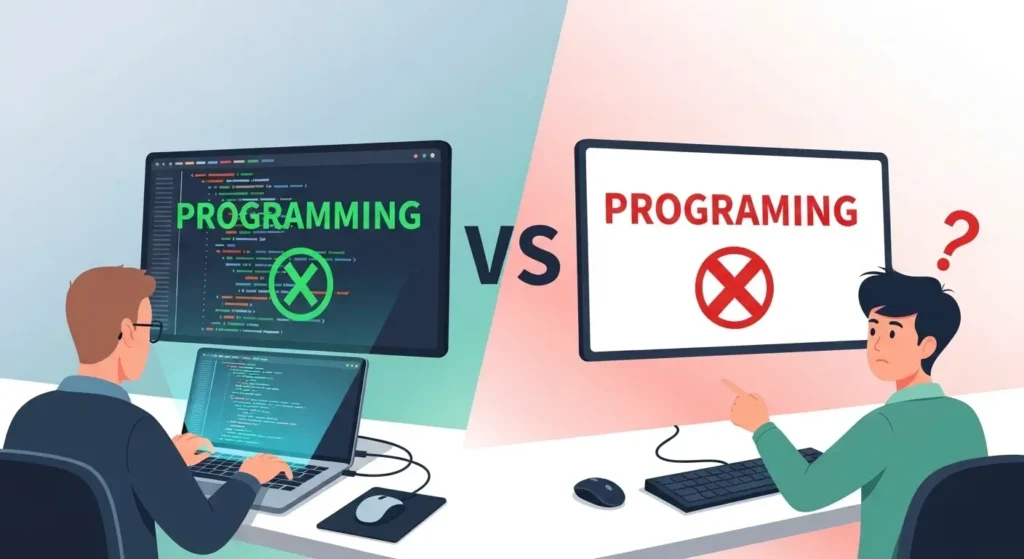
Many people search for “programing or programming” because they are unsure which spelling is correct. You may see both versions online, in books, or even in social media posts. This creates confusion, especially for students, writers, and beginners in computer science.
The main question is simple: should it be written with one “m” or two? The answer matters in exams, job applications, coding documents, and professional writing. A small spelling difference can make your writing look incorrect or less polished.
This article will clearly explain the correct spelling, why the confusion exists, and how English rules affect it. You will also learn where each spelling is used, how English variants differ, and what professionals prefer today. By the end, you will never feel confused about programing or programming again.
Programing or Programming – Quick Answer
The correct spelling is “programming” with double “m.”
“Programing” with one “m” is considered a misspelling in modern English.
Examples:
- ✔ Correct: I am learning programming.
- ✔ Correct: Software programming is a valuable skill.
- ❌ Incorrect: I am learning programing.
“Programming” is used in all major contexts:
- Computer science
- Software development
- Coding languages like Python, Java, C++
Salvadoran or Salvadorian: Which Spelling Is Correct ?
The Origin of Programing or Programming
The word comes from “program”, which entered English in the 19th century.
Later, the verb “programming” was formed by adding:
- “program” + “-ming” (verb form ending)
The double “m” appears because English often doubles consonants when adding suffixes:
- run → running
- begin → beginning
- program → programming
The single “m” form “programing” likely appeared due to typing errors or simplified spelling habits, but it is not standard.
Separate or Seperate: Which Spelling Is Correct ?
British English vs American English Spelling
Both British and American English use “programming” for computers.
However, differences exist in related words:
| Word Type | British English | American English |
| Noun | programme | program |
| Verb (computers) | programming | programming |
| Daily use | programme (TV show) | program (TV show) |
Key Point:
- In technology, both UK and US English use programming
Which Spelling Should You Use?
Use “programming” in almost all cases.
Recommended usage:
- ✔ Students → programming
- ✔ Developers → programming
- ✔ Exams → programming
- ✔ Professional writing → programming
Avoid:
- ❌ programing (looks incorrect in formal English)
Even in British English, “programming” is the standard for computing.
Common Mistakes with Programing or Programming
1. Missing double “m”
- ❌ programing
- ✔ programming
2. Mixing noun and verb forms
- ❌ I like programming languages programing
- ✔ I like programming languages
3. Overcorrecting spelling
Some users try to change it to:
- “programmings” ❌ (wrong plural form)
4. Using “programme” in coding context
- ❌ computer programme (old style)
- ✔ computer program / programming
Programming in Everyday Examples
Email Example:
I am currently learning programming to improve my job skills.
Social Media Example:
Just started Python programming today! 🚀
News Example:
Schools are adding programming classes for students.
Formal Writing Example:
Programming skills are essential in modern software development.
Programming – Google Trends & Usage Data
Search trends show:
- “programming” → very high global usage
- “programing” → very low usage, mostly errors
- Highest searches come from:
- United States
- India
- United Kingdom
- Pakistan
- Philippines
Why “programming” dominates:
- Used in textbooks
- Used in coding platforms
- Standard in academic writing
- Accepted worldwide in tech industry
Comparison Table: Programing vs Programming
| Feature | Programing | Programming |
| Correct spelling | ❌ No | ✔ Yes |
| Usage in books | Rare | Common |
| Used in coding | No | Yes |
| Academic acceptance | No | Yes |
| Professional use | No | Yes |
FAQs about Programming or Programing
1. Is “programing” correct?
No. It is a common spelling mistake.
2. Why do people write “programing”?
Because of typing errors or confusion with word formation rules.
3. What is the correct spelling in English?
The correct spelling is programming.
4. Is “programming” British or American English?
It is used in both British and American English.
5. Can I use “programing” in exams?
No. It may be marked incorrect.
6. Why is there a double “m”?
Because English doubles consonants when adding suffixes like “-ing.”
7. What field uses programming?
Computer science, software engineering, AI, web development, and data science.
Conclusion
The confusion between programing or programming is common, but the answer is simple. The correct spelling is programming with two “m” letters. The single “m” version is not accepted in modern English and is considered a spelling mistake.
Whether you are a student, developer, or writer, always use “programming” in exams, emails, and professional work. This spelling is standard in both British and American English, especially in technology-related fields.
Understanding this small detail improves your writing accuracy and makes your communication more professional. English spelling can be tricky, but once you learn the rule, it becomes easy to avoid common mistakes like this one.

Hi, I’m Henry William, the author of GrammarTribe.com. I’m passionate about the English language and have dedicated my career to helping people master grammar, spelling, and effective writing. Over the years, I’ve guided learners, writers, and professionals in understanding common mistakes, tricky rules, and nuances of English grammar in a simple and easy-to-follow way.
Through GrammarTribe.com, I aim to make grammar approachable and enjoyable for everyone. My work focuses on providing clear explanations, practical tips, and examples that readers can apply in everyday writing, whether it’s emails, essays, social media, or professional documents. I believe that strong grammar skills empower people to communicate confidently and professionally.
When I’m not writing or researching grammar, I enjoy reading, exploring language trends, and creating educational content that simplifies complex concepts. I’m committed to helping my audience write better, understand English deeply, and avoid common pitfalls, all while making learning grammar a fun and rewarding journey.