Many English learners search for the phrase “pass or past” because these two words look similar but have completely different meanings. This confusion is very common in writing, exams, emails, and social media posts. A small spelling mistake can change the meaning of a sentence entirely. For example, “I will pass the exam” is correct, but “I will past the exam” is wrong.
People often search pass or past when they are unsure about grammar rules, pronunciation, or spelling in British and American English. This keyword also appears frequently in Google searches from students, job seekers, and content writers who want to improve their English accuracy.
The confusion between pass or past usually comes from their similar pronunciation in fast speech and their overlapping usage in time-related expressions. However, both words belong to different grammar categories and serve different purposes. Understanding this difference helps you write clearly, avoid mistakes, and communicate more professionally in everyday English.
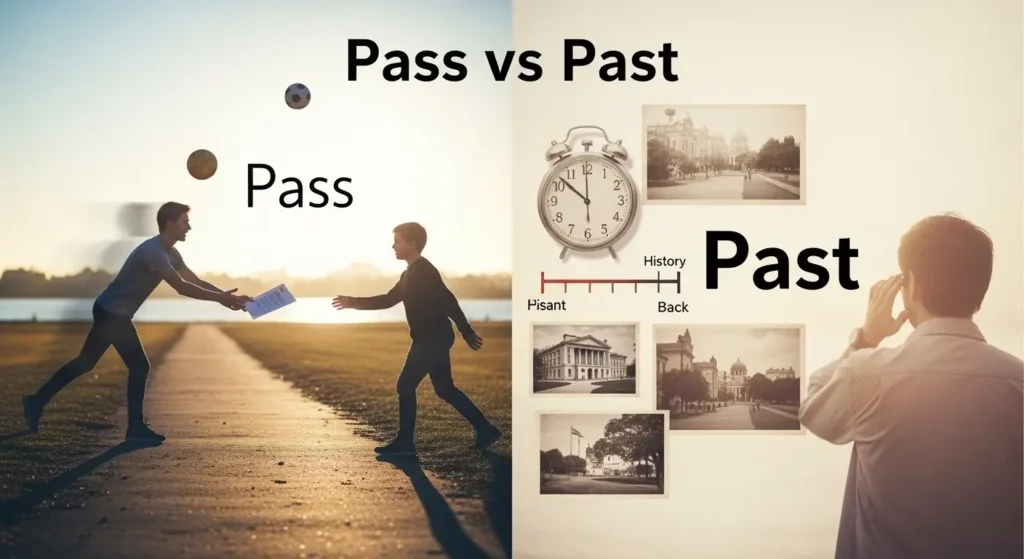
Pass or Past – Quick Answer
- Pass = a verb meaning to go, move, succeed, or hand something over
- Example: Please pass me the water.
- Example: She will pass the test.
- Past = a noun, adjective, adverb, or preposition meaning before now or earlier time
- Example: In the past, life was harder.
- Example: He walked past the shop.
👉 Simple rule: Pass = action | Past = time or position
The Origin of Pass or Past
- Pass comes from Old French passer, meaning “to go through or cross.”
- Past comes from Latin passus, meaning “step” or “movement through time.”
Over time, English adopted both words but gave them different roles. “Pass” became action-based, while “past” became time-related. Their similarity in spelling and pronunciation leads to confusion today.
British English vs American English Spelling
The confusion between pass or past is not about UK vs US spelling differences because both forms are used in both regions. However, usage frequency and sentence style can differ slightly.
| Feature | Pass | Past |
| Meaning | Action (give, move, succeed) | Time or position |
| Part of Speech | Verb | Noun, adjective, preposition |
| Usage | Instruction, action sentences | Time references |
| Example (US/UK) | Pass the salt | In the past decade |
👉 No spelling variation exists between US and UK for these words.
Which Should You Use?
- Use Pass when talking about:
- Actions (pass the exam, pass the ball)
- Movement or transfer
- Approval or success
- Use Past when talking about:
- Time before now
- Something that has already happened
- Position (walk past, go past)
👉 Global rule: Meaning decides usage, not region.
Common Mistakes with Pass or Past
❌ I will past the exam.
✔ I will pass the exam.
❌ He walk pass the house yesterday.
✔ He walked past the house yesterday.
❌ The past me the book.
✔ Please pass me the book.
👉 Mistakes usually happen due to pronunciation confusion and fast typing.
Pass or Past in Everyday Examples
- Emails:
Please pass this message to your manager. - News Writing:
In the past decade, technology has changed rapidly. - Social Media:
Time flies so fast, don’t dwell on the past. - Formal Writing:
Students must pass all required exams.
Pass or Past – Google Trends & Usage Data
Search trends show:
- High usage of “pass or past” in India, Pakistan, and Bangladesh
- Strong interest among students and ESL learners
- Common searches peak during exam seasons
- Lower confusion in native English-speaking countries but still used in grammar checks
👉 Most searches come from educational intent and grammar clarification.
Comparison Table: Pass vs Past
| Feature | Pass | Past |
| Function | Action word | Time/position word |
| Grammar Type | Verb | Noun/Adjective/Preposition |
| Meaning | To give, move, succeed | Before now, earlier time |
| Example | Pass the test | In the past |
| Common Error | Confusing with past | Using “past” as verb |
FAQs About Pass or Past
1. What is the main difference between pass and past?
Pass is an action word, while past refers to time or position.
2. Can I use “past” instead of “pass”?
No, it changes the meaning and becomes grammatically incorrect.
3. Why do people confuse pass and past?
Because they sound similar in fast speech and typing.
4. Is “pass” a verb or noun?
Pass is mainly a verb.
5. Is “past” only about time?
No, it can also show position (walk past).
6. Do British and American English use them differently?
No, both use them the same way.
7. What is an easy trick to remember?
Pass = action, Past = time.
Conclusion
Understanding the difference between pass or past is essential for clear and correct English communication. Although the two words look and sound similar, their meanings are completely different. “Pass” is used for actions like giving, moving, or succeeding, while “past” refers to time or position.
Many learners confuse them due to pronunciation and typing errors, but the rule is simple once understood. By practicing real examples, you can easily avoid mistakes in exams, emails, and daily conversations.
Mastering pass or past improves both writing accuracy and confidence in English. Whether you are a student, professional, or content creator, using these words correctly helps you communicate more clearly and professionally. Keep practicing, and soon this common confusion will disappear from your writing.

Hi, I’m Henry James, the author behind GrammarTribe.com. I’m passionate about the English language and specialize in grammar, helping readers understand complex rules in a simple, clear way. Over the years, I’ve dedicated myself to creating content that makes learning grammar practical, fun, and accessible for everyone. If you’re a student, professional, or language enthusiast.
Through GrammarTribe.com, I share tips, guides, and examples to help people write confidently and correctly. My goal is to make grammar less intimidating and more useful in everyday writing, emails, social media, and professional communication. Writing and teaching grammar isn’t just my profession — it’s my passion.
When I’m not writing, I enjoy reading, exploring language trends, and discovering new ways to make English learning engaging and easy. My mission is to empower readers to communicate clearly and confidently, one grammar tip at a time.