
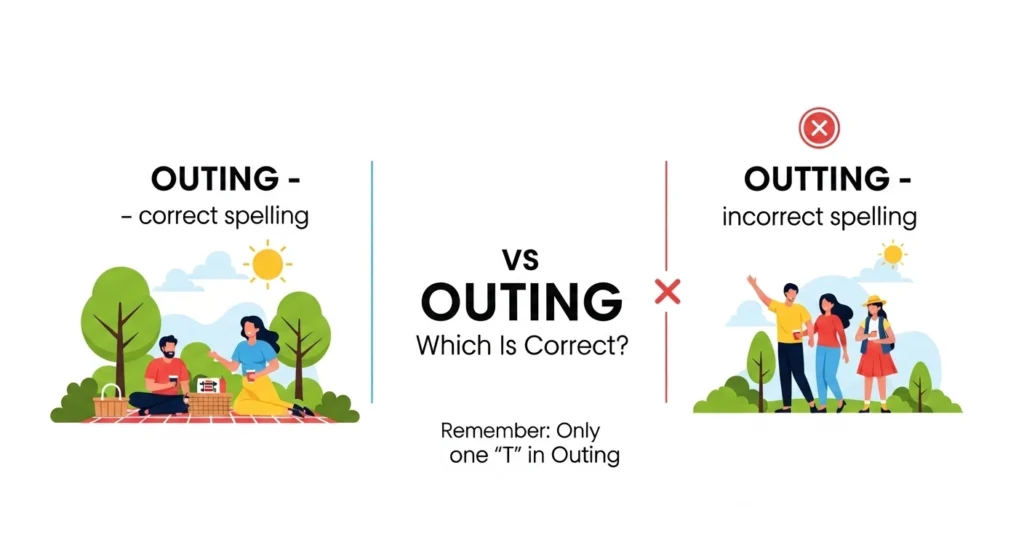
Have you ever paused while writing an email, social media post, or school assignment, wondering whether it should be “outting” or outing”? You are not alone. Many English speakers stumble over this because English often has words that look similar but differ in spelling and meaning.
Some may even assume “outting” is the correct form because it seems like a verb formed from “out,” but is it really?
Understanding the correct spelling matters in both casual and professional writing. Using the wrong form can confuse readers or make your text seem unpolished. People frequently search for this keyword to clarify which spelling is standard, especially in digital communication, academic writing, or travel-related contexts.
This article will clear the confusion by explaining the meaning, origin, and proper usage of outing, provide guidance for British vs American English, highlight common mistakes, and offer real-world examples.
Outting or Outing – Quick Answer
The correct spelling is “outing.”
- Outing is a noun that refers to a short trip or excursion.
- Example: “We went on a school outing to the museum.”
- Outting with double “t” is generally considered incorrect in standard English.
Summary: Always use outing for trips, events, or excursions.
The Origin of Outing
The word outing comes from the late 18th century, derived from the verb “to out,” meaning to go out. Over time, it evolved to describe short recreational trips or excursions.
The confusion with “outting” arises because some English verbs form present participles by doubling the consonant (e.g., “run → running”), but “outing” does not follow this pattern. Therefore, outing with a single “t” is historically and grammatically correct.
British English vs American English Spelling
The spelling outing is consistent in both British and American English. Unlike words such as “travelling” (UK) vs “traveling” (US), outing does not change between regions.
| Feature | British English | American English | Notes |
| Correct Spelling | outing | outing | No double “t” |
| Common Mistake | outting | outting | Avoid using double “t” |
| Usage | School trips, day trips | Day trips, excursions | Same meaning globally |
Key Takeaway: No regional variation exists. The single “t” form is always correct.
Which Spelling Should You Use?
- US audience: Always use outing.
- UK/Commonwealth: Use outing.
- Global writing: Stick to outing to avoid mistakes.
Even if your readers are international, “outing” is universally accepted and clear.
Common Mistakes with Outing
- Outting – ❌ Incorrect, avoid doubling the “t.”
- Confusing outing with “outing someone” (revealing personal info) – context matters.
- Misusing outing as a verb – it is primarily a noun.
Correct Usage Tips:
- Noun for trips: “Our family had a lovely outing.”
- Verb context (rare): Use “go out” instead of “outing.”
Outing in Everyday Examples
- Email: “Looking forward to our team outing next Friday.”
- News headline: “School organizes nature outing for students.”
- Social media: “Had an amazing outing at the beach today!”
- Formal writing: “The company arranged an educational outing for employees.”
Outting – Google Trends & Usage Data
According to Google Trends:
- Outing is consistently searched worldwide, particularly in the US, UK, Canada, and Australia.
- Outting shows negligible searches, mainly typos or spelling errors.
- Contexts include schools, corporate events, travel, and leisure.
Tip: Using the correct spelling improves search engine visibility and credibility.
Keyword Comparison Table
| Variation | Correct? | Usage Notes |
| outing | ✅ Correct | Standard spelling for trips and excursions |
| outting | ❌ Incorrect | Often a typo; should be avoided |
FAQs About Outting or Outing
- Is “outting” ever correct?
No, it is a spelling mistake in the context of trips or excursions. - Can “outing” be used as a verb?
Rarely. Use “go out” instead in most cases. - Does UK English spell it differently?
No, both UK and US English use outing. - What is an example of an outing?
A school picnic, museum visit, or day trip counts as an outing. - Can outing mean revealing personal information?
Yes, in social contexts “outing someone” can mean revealing secrets, but this is separate from trips. - Is “outing” formal enough for business writing?
Yes, when referring to planned excursions or team events. - How do I avoid confusing “outing” with “outting”?
Remember: single “t” is always correct unless used metaphorically in very specific contexts.
Conclusion
The correct spelling is outing, and it refers to a short trip, excursion, or organized event. Avoid outting with double “t,” as it is a common typo and not recognized in standard English. The word’s meaning is consistent across British and American English, making it universally acceptable.
Using the correct spelling ensures clarity in emails, social media, news, and formal writing. If you are describing a school trip, team-building activity, or leisure excursion, outing is the word to use. Remembering the historical origin and context will help prevent mistakes and improve professional communication.

Hi, I’m Henry James, the author behind GrammarTribe.com. I’m passionate about the English language and specialize in grammar, helping readers understand complex rules in a simple, clear way. Over the years, I’ve dedicated myself to creating content that makes learning grammar practical, fun, and accessible for everyone. If you’re a student, professional, or language enthusiast.
Through GrammarTribe.com, I share tips, guides, and examples to help people write confidently and correctly. My goal is to make grammar less intimidating and more useful in everyday writing, emails, social media, and professional communication. Writing and teaching grammar isn’t just my profession — it’s my passion.
When I’m not writing, I enjoy reading, exploring language trends, and discovering new ways to make English learning engaging and easy. My mission is to empower readers to communicate clearly and confidently, one grammar tip at a time.