When it comes to eye care, many people get confused between an optometrist and an ophthalmologist. Both are eye specialists, but their roles, training, and services differ.
This confusion is common because the words are long, technical, and often used interchangeably. People search for “optometrist or ophthalmologist” to understand which specialist to visit for routine eye exams, vision problems, or eye diseases.
Choosing the right specialist can save time, prevent health issues, and ensure proper treatment. This guide explains the difference clearly, with simple examples, spelling origins, and practical tips. Whether you are booking your first eye check-up or advising a family member, knowing the distinction will help you make informed decisions.
Optometrist or Ophthalmologist – Quick Answer
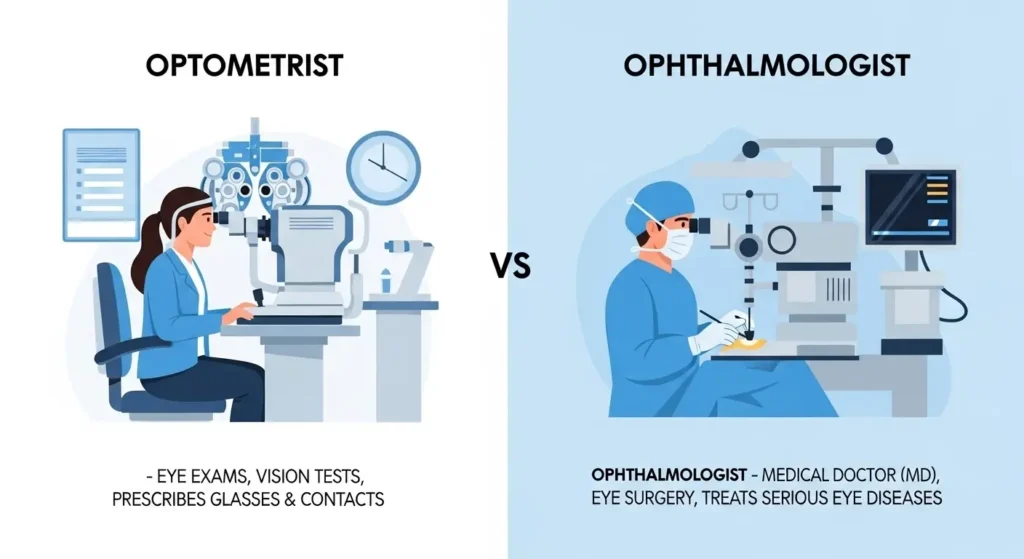
- Optometrist: A healthcare professional who performs eye exams, prescribes glasses or contact lenses, and detects vision problems. They do not perform major surgeries.
Example: You notice blurry vision; an optometrist can check your eyesight and prescribe corrective lenses. - Ophthalmologist: A medical doctor who specializes in eye surgery, disease management, and medical treatment. They can perform procedures like cataract surgery.
Example: If you have glaucoma or need eye surgery, you should see an ophthalmologist.
Quick Tip: For routine eye care → optometrist. For medical or surgical issues → ophthalmologist.
The Origin of Optometrist and Ophthalmologist
- Optometrist: From Greek optos (seen) + metron (measure) → literally “measure vision.” The term became popular in the early 20th century.
- Ophthalmologist: From Greek ophthalmos (eye) + logia (study) → “study of the eye.” The title has been used since the 19th century in medical literature.
Understanding the origin helps clarify why these professions focus on different aspects of eye care.
British English vs American English Spelling
Both words are generally the same in UK and US English, but minor spelling or pronunciation differences exist in medical writing.
| Term | US English | UK English | Notes |
| Optometrist | Optometrist | Optometrist | No difference; commonly used worldwide. |
| Ophthalmologist | Ophthalmologist | Ophthalmologist | No difference; formal medical term. |
Tip: Use the standard spelling regardless of region, as both are internationally recognized.
Which Spelling Should You Use?
- US Audience → Both spellings are standard; no change needed.
- UK/Commonwealth Audience → Same as US; use ophthalmologist and optometrist.
- Global Audience → Stick to the original spelling for clarity.
In short, there is no regional spelling variation; focus on the audience’s understanding instead.
Common Mistakes with Optometrist or Ophthalmologist
- Mixing roles: Thinking optometrists perform surgery. Correction: Only ophthalmologists perform surgical procedures.
- Misspelling: “opthalmologist” (incorrect) → Correct: ophthalmologist.
- Assuming optometrists treat eye diseases → Only minor issues; serious conditions need an ophthalmologist.
- Overusing abbreviations: O.D. (Doctor of Optometry) vs M.D. (Medical Doctor) → Use full titles for clarity.
Optometrist or Ophthalmologist in Everyday Examples
- Email: “I need to book an appointment with an ophthalmologist for my cataract surgery.”
- News Article: “Optometrists report a rise in digital eye strain cases.”
- Social Media: “Just saw my optometrist; time for new glasses!”
- Formal Writing: “Ophthalmologists specialize in diagnosing and treating complex eye conditions.”
Optometrist or Ophthalmologist – Google Trends & Usage Data
Search data shows:
- US: “Optometrist” searches peak during back-to-school season.
- UK: “Ophthalmologist” searches rise in relation to medical news or surgeries.
- Global: Users often search for symptoms first, then the specialist.
Trend Tip: People mostly search “optometrist or ophthalmologist” when deciding who to consult first for eye issues.
Keyword Comparison Table
| Feature | Optometrist | Ophthalmologist |
| Training | Doctor of Optometry (O.D.) | Medical Doctor (M.D.) + Residency |
| Can perform surgery | ❌ | ✅ |
| Prescribe glasses | ✅ | ✅ |
| Treat eye diseases | Limited | ✅ |
| Typical visit reason | Routine eye exam, vision correction | Surgery, serious eye disease |
FAQs
1. Can an optometrist treat eye diseases?
They can detect some diseases but cannot perform surgery. Serious conditions require an ophthalmologist.
2. Which eye doctor should I see first?
Start with an optometrist for routine checks. If a medical issue is found, they will refer you to an ophthalmologist.
3. Are optometrists considered doctors?
Yes, they hold a Doctor of Optometry (O.D.) degree.
4. Is ophthalmologist more specialized than optometrist?
Yes, they have medical training and can perform surgeries and treat complex eye conditions.
5. Do both prescribe glasses?
Yes, both can prescribe glasses and contact lenses.
6. How often should I see each?
Optometrist: Every 1–2 years for routine exams. Ophthalmologist: As needed for disease or surgery.
7. Are there insurance differences?
Some insurance plans cover optometrist visits for routine exams but may have different coverage for ophthalmologist services.
Conclusion
Understanding the difference between optometrists and ophthalmologists is crucial for effective eye care. Optometrists focus on vision correction and routine exams, while ophthalmologists manage eye diseases and perform surgeries. Both professions play complementary roles. Using the correct term ensures clarity in communication, especially in medical contexts.
For everyday purposes, an optometrist is your go-to for glasses and minor vision problems, while an ophthalmologist is essential for serious conditions like glaucoma, cataracts, or eye surgery. Remember, spelling remains consistent globally, so your choice should be based on the type of care needed, not region. Proper understanding prevents confusion and helps you get the right care promptly.

I am James Wilson, an author at GrammarTribe.com, specializing in English grammar and clear communication.
I create expert, reliable content to help learners write with confidence and accuracy.