
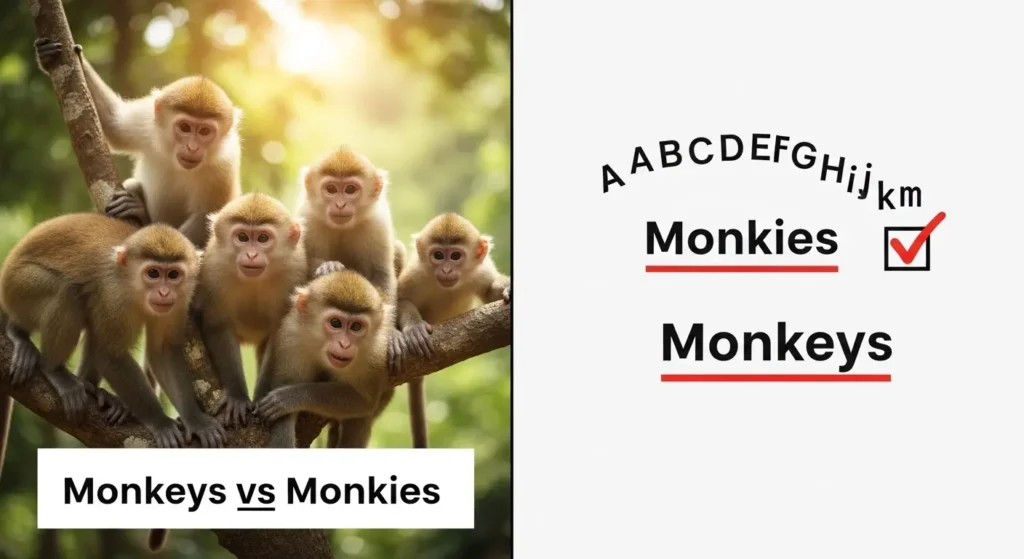
Have you ever typed “monkeys” and then paused, thinking, “Should it be monkies instead?” You are not alone. Many people search “monkeys or monkies” because English spelling rules can be confusing, especially when words end in “y.”
The keyword monkeys or monkies is popular among students, writers, and even professionals who want to avoid simple grammar mistakes. The confusion comes from similar words like “babies” or “cities,” where “y” changes to “ies.” So naturally, people wonder if “monkey” follows the same rule.
Understanding monkeys or monkies helps you write correctly in emails, exams, and online content. In this guide, you will get a quick answer, learn the rule behind it, and see real examples. By the end, you will never be confused about monkeys or monkies again.
Monkeys or Monkies – Quick Answer
✅ Correct spelling: Monkeys
❌ Incorrect spelling: Monkies
👉 Example:
- Correct: I saw monkeys in the zoo.
- Incorrect: I saw monkies in the zoo.
Rule: If a word ends in a vowel + “y”, just add “s”.
The Origin of Monkeys or Monkies
The word monkey comes from old European languages, possibly from a German word “Moneke.”
Plural rules in English depend on how the word ends:
- If a word ends with consonant + y → change “y” to “ies” (baby → babies)
- If a word ends with vowel + y → just add “s” (monkey → monkeys)
Since “monkey” has a vowel before “y,” the correct plural is monkeys.
British English vs American English Spelling
There is no difference between British and American English here.
| Feature | American English | British English |
| Correct plural | Monkeys | Monkeys |
| Incorrect form | Monkies | Monkies |
👉 Both regions follow the same grammar rule.
Which Spelling Should You Use?
- Always use monkeys
- Never use monkies in formal or informal writing
👉 Audience tip:
- US, UK, global → All use monkeys
Consistency is simple here—only one correct option exists.
Common Mistakes with Monkeys or Monkies
❌ Writing “monkies”
✔ Correct: monkeys
❌ Applying wrong rule (baby → babies)
✔ Remember: monkey has a vowel before “y”
❌ Overthinking spelling
✔ Keep it simple: monkey + s
Monkeys or Monkies in Everyday Examples
Emails:
- We studied monkeys in biology class.
News:
- Monkeys were seen near the forest area.
Social Media:
- These monkeys are so funny 😂
Formal Writing:
- Monkeys are intelligent animals found in many regions.
Monkeys or Monkies – Google Trends & Usage Data
- “Monkeys” has very high search usage worldwide
- “Monkies” appears mostly in mistakes or typo searches
- Popular in:
- USA
- UK
- India
- Pakistan
👉 Insight:
People search this keyword mainly to confirm the correct spelling.
Comparison Table (Keyword Variations)
| Word | Correct? | Reason | Example |
| Monkeys | ✅ Yes | Vowel + y rule | Monkeys are playful |
| Monkies | ❌ No | Incorrect spelling | ❌ Not valid |
FAQs
1. Is monkies ever correct?
No, it is always incorrect.
2. Why is it monkeys and not monkies?
Because the word ends with a vowel + “y”.
3. What is the rule for plural words ending in y?
Consonant + y → ies, vowel + y → s.
4. Is monkeys used worldwide?
Yes, it is correct in all English forms.
5. Can I use monkies in informal writing?
No, it is still incorrect.
6. Are there similar words like monkeys?
Yes: toys, keys, boys follow the same rule.
7. Is this a common mistake?
Yes, many learners confuse it.
Conclusion
The confusion between monkeys or monkies is very common, but the answer is simple. The correct spelling is always monkeys. This is because the word “monkey” ends with a vowel before the letter “y,” so we just add “s” to make it plural.
Many people make mistakes because they apply the wrong rule from words like “baby” or “city.” However, once you understand the basic grammar rule, the confusion disappears. There is no difference between British and American English in this case, which makes it even easier.
Whether you are writing an email, a school assignment, or a blog post, always use “monkeys.” Avoid “monkies” completely, as it is incorrect in all contexts.
In short, remember this simple rule: vowel + y = add s. This will help you not only with monkeys but with many other similar words.

Hi, I’m Henry James, the author behind GrammarTribe.com. I’m passionate about the English language and specialize in grammar, helping readers understand complex rules in a simple, clear way. Over the years, I’ve dedicated myself to creating content that makes learning grammar practical, fun, and accessible for everyone. If you’re a student, professional, or language enthusiast.
Through GrammarTribe.com, I share tips, guides, and examples to help people write confidently and correctly. My goal is to make grammar less intimidating and more useful in everyday writing, emails, social media, and professional communication. Writing and teaching grammar isn’t just my profession — it’s my passion.
When I’m not writing, I enjoy reading, exploring language trends, and discovering new ways to make English learning engaging and easy. My mission is to empower readers to communicate clearly and confidently, one grammar tip at a time.