
Many English learners and even native speakers often get confused between “losses” and “losses.” At first glance, they look similar, but they are used in completely different situations. This small spelling difference can change the meaning of a sentence and sometimes make writing look incorrect or unprofessional.
That is why people frequently search for “losses or loses” on Google to understand which word is correct in grammar, business writing, sports reports, and everyday English.
This confusion usually happens because both words come from similar root ideas related to “losing.” However, their grammar roles are not the same. One is a noun, and the other is a verb. If you mix them up, your sentence can lose clarity.
In this article, you will learn the clear difference between “losses” and “loses,” their origin, correct usage, common mistakes, and real-life examples. By the end, you will never confuse them again in writing or speaking.
Losses or Loses – Quick Answer
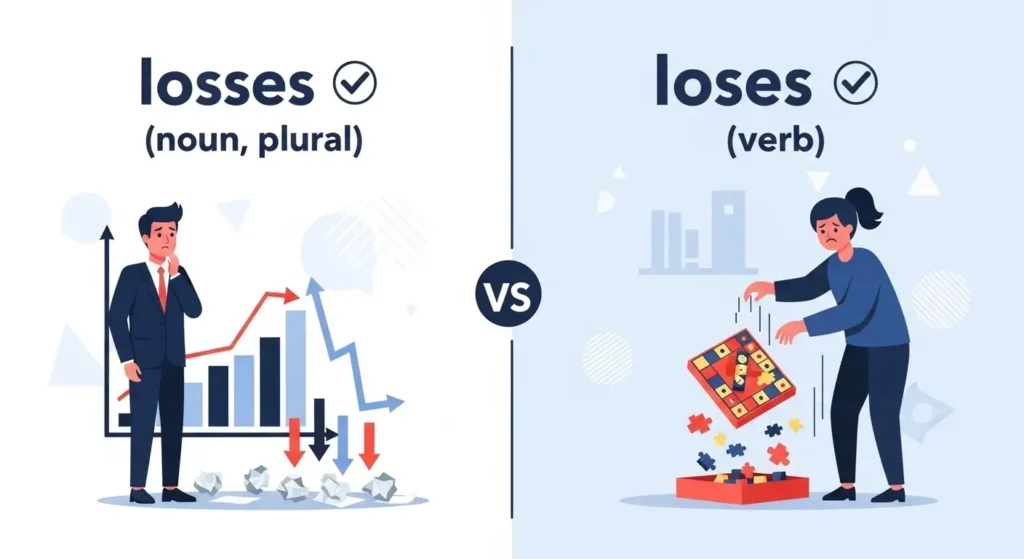
“Losses” and “loses” are not spelling variations of the same word—they are different forms with different meanings.
- Losses (noun, plural): refers to things that are lost or reduced.
- Loses (verb): third-person singular form of “lose.”
Examples:
- The company reports heavy losses this year.
- He always loses his keys.
Skied or Skiied: Which Spelling Is Correct and Why?
Simple Rule:
- Use losses = things or amounts lost
- Use loses = action of losing
The Origin of Losses and Loses
Both words come from the Old English word “losian”, meaning “to perish or be destroyed.”
- Lose (verb): developed from Middle English “losen”
- Loss (noun): came from Old English “los,” meaning destruction or ruin
- Losses: plural form of “loss”
- Loses: modern verb form of “lose”
Over time, English separated noun and verb forms clearly. That is why today we have two similar-looking but grammatically different words.
British English vs American English Spelling
Good news: “losses” and “loses” are spelled the same in both British and American English.
The difference is not spelling style—it is grammar usage only.
Skis or Skiis: Which Spelling Is Correct and Why It Matters?
Comparison Table
| Word | Type | Meaning | Example Sentence |
| losses | noun | things lost or reduced | The team suffered losses. |
| loses | verb | action of losing | She loses focus easily. |
Which Spelling Should You Use?
Your choice depends on grammar, not region:
- US English: Same rule applies (losses = noun, loses = verb)
- UK English: Same rule applies
- Global English: No difference in spelling rules
Simple Guide:
- Writing about money, damage, or failure → use losses
- Talking about someone failing to keep something → use loses
Common Mistakes with Losses or Loses
1. Mixing noun and verb
❌ The company loses were high
✔ The company’s losses were high
2. Wrong subject-verb use
❌ He losses his phone
✔ He loses his phone
3. Confusing plural form
❌ Many lose in business
✔ Many losses in business
4. Using “losses” as a verb
❌ She losses every match
✔ She loses every match
Losses or Loses in Everyday Examples
Business Writing:
- The startup reported major losses in Q2.
Sports News:
- The team loses again in the final match.
Emails:
- We regret the financial losses this quarter.
Social Media:
- He always loses at chess but keeps trying!
Formal Writing:
- Economic losses increased due to inflation.
Losses or Loses – Google Trends & Usage Data
Search trends show that “losses or loses” is commonly searched in:
- 🇮🇳 India
- 🇵🇰 Pakistan
- 🇧🇩 Bangladesh
- 🇺🇸 United States
Why people search it:
- Grammar confusion in exams
- Business writing errors
- ESL (English as Second Language) learning
- Academic assignments
“Loses” is more commonly searched in daily grammar queries, while “losses” appears more in business and finance contexts.
Comparison Table: Losses vs Loses
| Feature | Losses | Loses |
| Word type | Noun (plural) | Verb |
| Base word | Loss | Lose |
| Meaning | Things lost | Action of losing |
| Usage context | Money, damage, stats | Actions, behavior |
| Example | Financial losses | He loses games |
FAQs
1. What is the main difference between losses and loses?
“Losses” is a noun, while “loses” is a verb.
2. Can I use losses instead of loses?
No. They have different grammar roles.
3. Is “he losses” correct?
No. The correct form is “he loses.”
4. Is “losses” plural or singular?
It is the plural form of “loss.”
5. Why do people confuse losses and loses?
Because they look similar and come from the same root word.
6. Are losses and loses pronounced the same?
No. “Losses” ends with /ɪz/, while “loses” has a softer verb ending.
7. Is this difference important in exams?
Yes, it is commonly tested in grammar sections.
Conclusion
Understanding the difference between “losses” and “loses” is simple but very important for clear English writing. Many learners confuse them because they look similar, but they belong to different grammar categories. “Losses” is always a noun used for things that are lost, especially in finance, sports, or general damage. On the other hand, “loses” is a verb that describes the action of losing something.
Once you remember this basic rule, your writing becomes more accurate and professional. This small grammar point is especially useful in exams, business communication, emails, and news writing. If you are an English learner, practicing with real-life examples will help you avoid mistakes in the future.
Always check whether you are describing a thing (losses) or an action (loses). That simple habit will make your English much stronger and clearer in every situation.

Hi, I’m Henry James, the author behind GrammarTribe.com. I’m passionate about the English language and specialize in grammar, helping readers understand complex rules in a simple, clear way. Over the years, I’ve dedicated myself to creating content that makes learning grammar practical, fun, and accessible for everyone. If you’re a student, professional, or language enthusiast.
Through GrammarTribe.com, I share tips, guides, and examples to help people write confidently and correctly. My goal is to make grammar less intimidating and more useful in everyday writing, emails, social media, and professional communication. Writing and teaching grammar isn’t just my profession — it’s my passion.
When I’m not writing, I enjoy reading, exploring language trends, and discovering new ways to make English learning engaging and easy. My mission is to empower readers to communicate clearly and confidently, one grammar tip at a time.