Confused about whether to write licence or license? You are not alone. Many English learners, writers, and professionals search for this because both spellings exist, but they are used differently depending on where you are. This small difference can cause mistakes in documents, emails, legal texts, or social media posts.
Understanding the correct usage not only helps you write accurately but also ensures your writing looks professional. In this guide, we’ll explain the quick answer, the origin of the word, British vs American spelling, common mistakes, and practical examples.
By the end, you’ll know exactly when to use licence or license and avoid confusion in all forms of writing.
Licence or License – Quick Answer
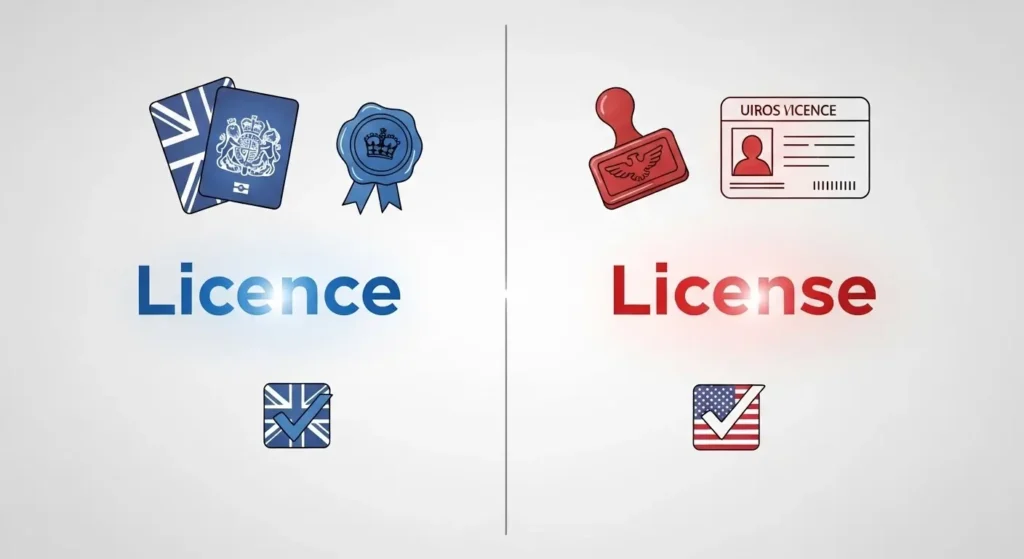
- Licence → Noun (British English)
Example: I need a driving licence to drive in the UK. - License → Verb (British & American English) or Noun (American English)
Examples:- British verb: The government will license new businesses next year.
- American noun: You need a business license to operate legally.
Quick Tip: If you’re in the US, license works for both noun and verb. In the UK, licence is for the noun, license for the verb.
The Origin of Licence or License
The word comes from Latin licentia, meaning “freedom” or “permission.” Over centuries, English adapted it into Middle English as licence. The spelling license became popular in American English due to Noah Webster’s 19th-century reforms to simplify British spellings. The historical divergence explains why both forms are correct depending on region and context.
British English vs American English Spelling
| Usage Type | British English | American English | Example Sentence |
| Noun | licence | license | I renewed my licence/license today. |
| Verb | license | license | Authorities will license new drivers. |
Key Rule:
- UK → noun = licence, verb = license
- US → noun & verb = license
Which Spelling Should You Use?
- United States: Always use license for both noun and verb.
- UK & Commonwealth countries: Use licence for nouns, license for verbs.
- Global audience: If writing for a mixed audience, consider adding a note or using context to clarify.
Common Mistakes with Licence or License
- Writing license as a noun in UK English → ❌ Wrong: I got my license. ✅ Correct: I got my licence.
- Using licence as a verb in UK English → ❌ Wrong: The council will licence the shop. ✅ Correct: The council will license the shop.
- Confusing US and UK audiences → Ensure you know your reader’s location.
Licence or License in Everyday Examples
Emails:
- UK: Please attach a copy of your driving licence.
- US: Please attach a copy of your driver’s license.
News Articles:
- “The city council will license more taxis next month.”
Social Media:
- “Just got my new gaming license online!”
Formal Writing:
- UK contracts: “All employees must hold a valid work licence.”
Licence or License – Google Trends & Usage Data
Google Trends shows:
- US searches → overwhelmingly license
- UK searches → majority licence, but license appears in verb contexts
- Commonwealth countries (Australia, Canada, India) → follow UK usage with noun/verb distinction
Comparison Table: Licence vs License
| Feature | Licence (UK noun) | License (US noun & verb / UK verb) |
| Noun | ✔ Yes | ✔ Yes (US) |
| Verb | ❌ No | ✔ Yes |
| Region Preference | UK & Commonwealth | US & global verb |
| Example | Driving licence | Authorities will license cars |
FAQs
1. Can I use license in the UK?
Yes, but only as a verb. Noun should be licence.
2. Is licence wrong in the US?
Yes, Americans generally use license for both noun and verb.
3. Why are there two spellings?
It’s a historical difference. British English kept the noun/verb distinction; American English simplified it.
4. How do I remember?
UK: Noun = licence, Verb = license. US: license for both.
5. Can I use licence in emails to US clients?
Yes, but US readers might notice the spelling difference. Use license for clarity.
6. Is there any other difference in meaning?
No, meaning stays the same: official permission to do something.
7. What about plural forms?
- UK: licences (nouns), licenses (verbs)
- US: licenses (both nouns & verbs)
Conclusion
Choosing between licence and license depends on your audience. Use licence as a noun in UK English and license for verbs. In the US, license works for both forms. Understanding this small difference ensures professionalism in emails, reports, and legal writing.
Always consider your reader’s location and context. Following these rules will eliminate common mistakes and help you write confidently in any English variant.

Hi, I’m Henry James, the author behind GrammarTribe.com. I’m passionate about the English language and specialize in grammar, helping readers understand complex rules in a simple, clear way. Over the years, I’ve dedicated myself to creating content that makes learning grammar practical, fun, and accessible for everyone. If you’re a student, professional, or language enthusiast.
Through GrammarTribe.com, I share tips, guides, and examples to help people write confidently and correctly. My goal is to make grammar less intimidating and more useful in everyday writing, emails, social media, and professional communication. Writing and teaching grammar isn’t just my profession — it’s my passion.
When I’m not writing, I enjoy reading, exploring language trends, and discovering new ways to make English learning engaging and easy. My mission is to empower readers to communicate clearly and confidently, one grammar tip at a time.