Choosing between JPG or PNG can be confusing for beginners and professionals alike. Both are popular image formats, but they serve different purposes depending on your needs.
Many people search for this keyword because they want to know which format works best for websites, social media, emails, or printing. Using the wrong format can result in blurry images, slow-loading web pages, or large file sizes.
In this article, we’ll break down the differences between JPG and PNG, explain when to use each, and give practical examples. By the end, you’ll understand which format to choose for your images without second-guessing. Whether you’re a blogger, designer, or just someone sharing pictures online, this guide will make your choice simple and stress-free.
JPG or PNG – Quick Answer
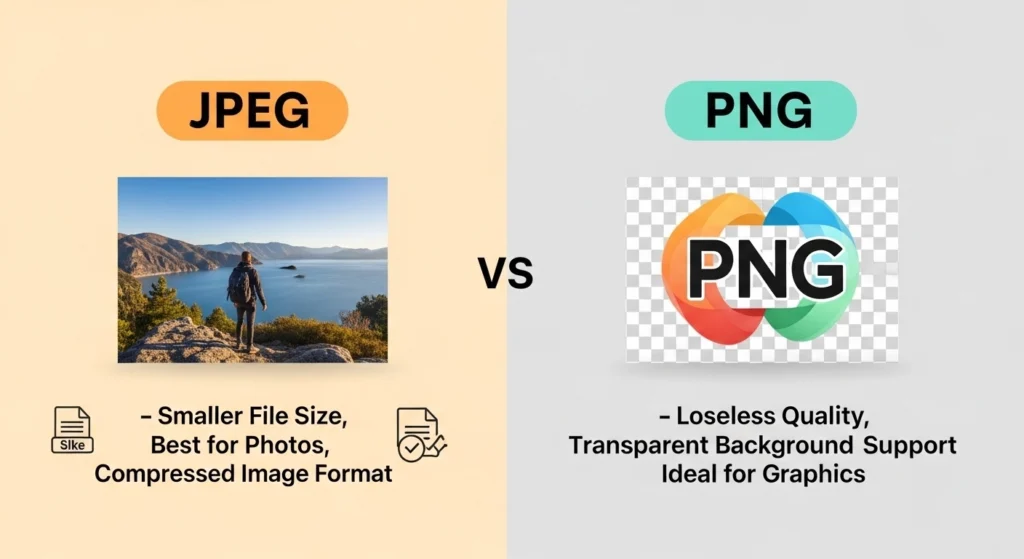
JPG (or JPEG) is best for photographs and images with gradients. It compresses file size but loses some quality (lossy compression).
PNG is ideal for graphics, logos, and images with transparent backgrounds. It keeps quality high (lossless compression) but results in larger files.
Example:
- JPG: A family photo uploaded to Instagram.
- PNG: A company logo with a transparent background for a website.
The Origin of JPG or PNG
- JPG (Joint Photographic Experts Group): Introduced in 1992, designed to compress large images efficiently.
- PNG (Portable Network Graphics): Developed in 1996 as an improved, patent-free alternative to GIFs, supporting transparency and lossless compression.
Both formats became standard due to their balance of quality, compatibility, and file size.
British English vs American English Spelling
While JPG and PNG are universal abbreviations, the usage of “JPEG” is sometimes spelled differently.
| Format | US English | UK English |
| JPG / JPEG | JPG or JPEG | JPG or JPEG |
| PNG | PNG | PNG |
| Usage | More common in tech articles, social media, web design | Same as US, with minor stylistic preferences in formal writing |
Note: Spelling differences are minimal for these acronyms, but understanding them helps in international communication.
Which Format Should You Use?
- US audience: JPG for photos, PNG for logos or transparent images.
- UK / Commonwealth audience: Same rules apply. Professional emails and websites often use PNG for graphics.
- Global audience: JPG is widely compatible for all devices, PNG is preferred for quality-sensitive visuals.
Tip: Use JPG for speed and PNG for precision.
Common Mistakes with JPG or PNG
- Using JPG for logos → Can create blurry edges.
- Using PNG for photographs → Large file sizes, slow-loading websites.
- Confusing JPG and JPEG → They are the same; JPEG is just the extended name.
- Ignoring transparency needs → JPG doesn’t support transparency; PNG does.
JPG or PNG in Everyday Examples
- Emails: PNG logos, JPG photographs.
- Social media: JPG photos for faster loading, PNG for graphics.
- News websites: JPG for article images, PNG for charts and icons.
- Formal documents: PNG for diagrams, JPG for inserted photos.
JPG or PNG – Google Trends & Usage Data
According to Google Trends:
- JPG remains more searched globally due to photography and social media usage.
- PNG spikes in searches for web design, graphics, and logos.
- Top countries searching for JPG or PNG: United States, India, UK, Canada, Australia.
| Format | Popular Use | File Size | Quality | Transparency |
| JPG | Photos | Smaller | Lossy | No |
| PNG | Logos/Graphics | Larger | Lossless | Yes |
FAQs
1. Can I convert JPG to PNG?
Yes, but converting JPG to PNG doesn’t improve quality. Use PNG for original images needing transparency.
2. Is JPG better than PNG for websites?
Use JPG for photographs to reduce file size; PNG is better for logos and graphics.
3. Do PNG files take longer to load?
Yes, because PNG files are larger due to lossless quality.
4. Can I use PNG for social media?
Yes, especially for graphics, but JPG is preferred for photos due to faster loading.
5. Are JPG and JPEG the same?
Yes, JPEG is just the full name; JPG is the shortened file extension.
6. Which format should I use for printing?
PNG for logos or graphics, JPG for photographs.
7. Does transparency affect JPG or PNG?
Yes, PNG supports transparency; JPG does not.
Conclusion
Choosing between JPG or PNG depends on your purpose. Use JPG for photographs and images where file size matters. Opt for PNG when you need high-quality graphics, logos, or transparent backgrounds. Remember:
JPG is faster for web use, while PNG ensures crisp, clear visuals. Knowing the differences will save you from common mistakes like using JPG for logos or PNG for photos. By understanding your audience and purpose, you can confidently choose the right format for emails, websites, social media, and printing. Mastering JPG and PNG ensures your images always look professional and load efficiently.
I

Hi, I’m Henry James, the author behind GrammarTribe.com. I’m passionate about the English language and specialize in grammar, helping readers understand complex rules in a simple, clear way. Over the years, I’ve dedicated myself to creating content that makes learning grammar practical, fun, and accessible for everyone. If you’re a student, professional, or language enthusiast.
Through GrammarTribe.com, I share tips, guides, and examples to help people write confidently and correctly. My goal is to make grammar less intimidating and more useful in everyday writing, emails, social media, and professional communication. Writing and teaching grammar isn’t just my profession — it’s my passion.
When I’m not writing, I enjoy reading, exploring language trends, and discovering new ways to make English learning engaging and easy. My mission is to empower readers to communicate clearly and confidently, one grammar tip at a time.