
Have you ever typed “imput” and wondered if it’s correct? You’re not alone. Many people confuse “input” vs “imput”, especially when writing quickly or using digital tools. This confusion often comes from pronunciation, typing habits, or simple spelling mistakes.
People search for this keyword because they want a clear answer: Is “imput” a real word, or just a typo? This question is common among students, writers, and professionals who want to avoid errors in emails, reports, or online content.
In today’s digital world, using the correct spelling is important. A small mistake can affect your credibility, especially in formal writing. This article will give you a quick answer, explain the origin, compare usage, and show real-life examples. By the end, you’ll know exactly when and how to use the correct term confidently.
Input or Imput – Quick Answer
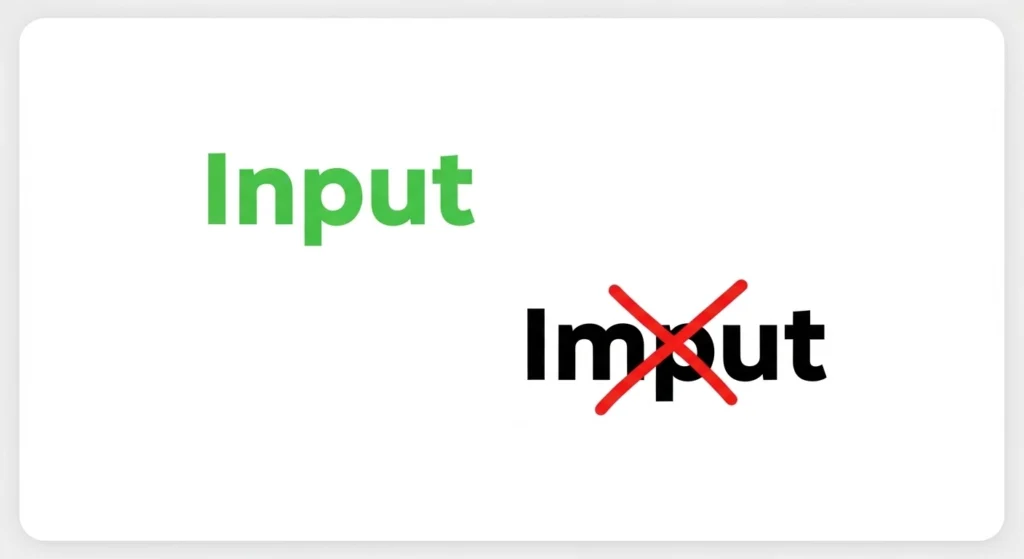
“Input” is the correct spelling. “Imput” is incorrect.
- ✅ Correct: Please input your data into the system.
- ❌ Incorrect: Please imput your data into the system.
“Input” means to enter data, information, or energy into a system.
“Imput” is simply a misspelling and not recognized in standard English.
The Origin of Input or Imput
The word “input” comes from two parts:
- “In” (into)
- “Put” (to place)
So, “input” literally means to put something in.
It became popular in the 20th century with the rise of computers and technology. People used it to describe entering data into machines.
“Imput” has no historical origin. It likely appears because:
- “n” and “m” are close on the keyboard
- Some accents make “input” sound like “imput”
British English vs American English Spelling
There is no difference between British and American English for this word. Both use “input.”
| Feature | British English | American English |
| Correct spelling | Input | Input |
| Incorrect spelling | Imput ❌ | Imput ❌ |
| Usage | Common in tech & writing | Common in tech & writing |
Unlike words like “colour/color,” “input” stays the same worldwide.
Which Spelling Should You Use?
Always use “input.”
- USA: Input ✅
- UK & Commonwealth: Input ✅
- Global writing: Input ✅
There is no situation where “imput” is correct. If you use it, it will be seen as a mistake.
Common Mistakes with Input or Imput
Here are common errors people make:
- ❌ Imput data into the form
✅ Input data into the form - ❌ Your imput is valuable
✅ Your input is valuable - ❌ System requires user imput
✅ System requires user input
Tip: Always double-check spelling when typing fast.
Input or Imput in Everyday Examples
Emails:
- We need your input before the meeting.
News:
- Experts gave input on the new policy.
Social Media:
- Drop your input in the comments!
Formal Writing:
- The study relies on user input for accurate results.
In all cases, only “input” is correct.
Input or Imput – Google Trends & Usage Data
Search data shows that:
- “Input” is widely used worldwide
- “Imput” appears mainly as a typo
Countries like the USA, UK, India, and Pakistan all use “input” correctly in education, business, and technology.
“Imput” gets searches mostly from people checking if it’s correct—which proves the confusion.
Comparison Table: Input vs Imput
| Feature | Input | Imput |
| Correct spelling | ✅ Yes | ❌ No |
| Meaning | Enter data or information | No meaning |
| Dictionary status | Accepted | Not recognized |
| Usage | Global | Typo only |
| Example | Input your password | Imput your password ❌ |
FAQs
1. Is “imput” ever correct?
No, “imput” is always incorrect.
2. Why do people write “imput”?
It’s usually a typing mistake or pronunciation confusion.
3. Is “input” a noun or verb?
It can be both.
- Noun: Your input matters.
- Verb: Please input the data.
4. Is there a British spelling of “input”?
No, it’s the same in British and American English.
5. How can I remember the correct spelling?
Think: “Put something IN” → input.
6. Is “inputted” correct?
Yes, but “input” is more commonly used as the past tense.
7. Where is “input” commonly used?
In computing, business, education, and everyday communication.
Conclusion
The confusion between “input” and “imput” is simple to solve once you know the rule. Only “input” is correct, and it is used worldwide in both British and American English. The word has a clear origin—to put something in—which makes it easy to remember.
“Imput,” on the other hand, is just a typing mistake. It has no meaning and should never be used in formal or informal writing. Whether you are writing emails, reports, or social media posts, using the correct spelling helps you look more professional and clear.
The key takeaway is simple: always double-check your spelling, especially when typing fast. By sticking to “input,” you avoid confusion and communicate more effectively. Over time, this small habit will improve your writing quality and confidence.

Hi, I’m Henry James, the author behind GrammarTribe.com. I’m passionate about the English language and specialize in grammar, helping readers understand complex rules in a simple, clear way. Over the years, I’ve dedicated myself to creating content that makes learning grammar practical, fun, and accessible for everyone. If you’re a student, professional, or language enthusiast.
Through GrammarTribe.com, I share tips, guides, and examples to help people write confidently and correctly. My goal is to make grammar less intimidating and more useful in everyday writing, emails, social media, and professional communication. Writing and teaching grammar isn’t just my profession — it’s my passion.
When I’m not writing, I enjoy reading, exploring language trends, and discovering new ways to make English learning engaging and easy. My mission is to empower readers to communicate clearly and confidently, one grammar tip at a time.