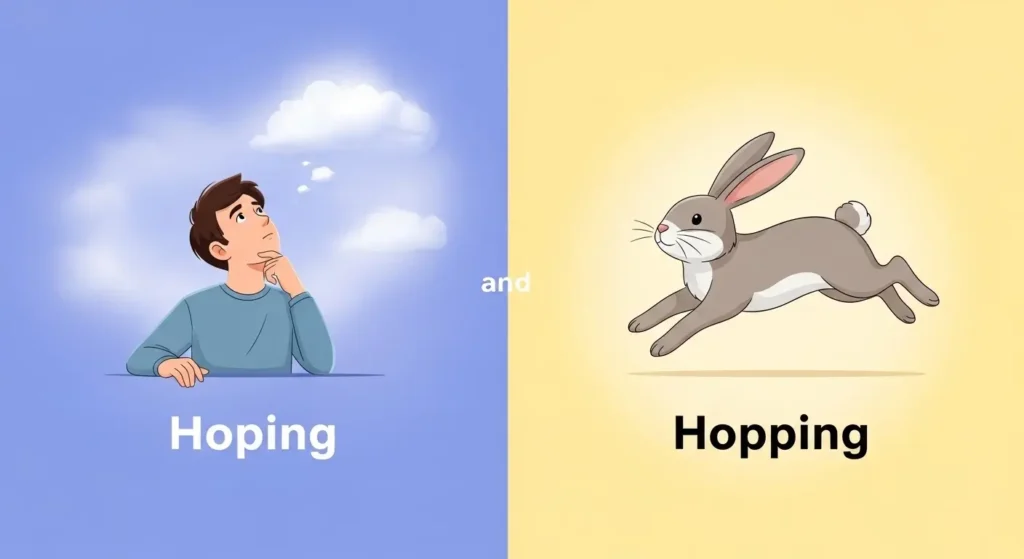
Many English learners and writers often get confused between “hoping” and “hopping.” While these words look similar, they carry completely different meanings. “Hoping” is linked to expectation or desire, while “hopping” relates to jumping or moving quickly. This confusion often appears in writing emails, social media posts, and formal documents.
People search for this keyword because choosing the wrong word can change the meaning of a sentence entirely. In this guide, we’ll explain the difference, explore their origins, compare UK and US usage, highlight common mistakes, and give clear advice on which spelling to use. By the end, you’ll confidently know when to use hoping versus hopping and avoid embarrassing errors.
Hoping or Hopping – Quick Answer
- Hoping – The present participle of hope, meaning to desire or wish for something.
Example: “I am hoping for good weather tomorrow.” - Hopping – The present participle of hop, meaning to jump or move quickly.
Example: “The rabbit was hopping across the garden.”
Quick tip: If it’s about wishing or expecting, use hoping. If it’s about jumping, use hopping.
The Origin of Hoping or Hopping
- Hoping comes from Old English hopian, meaning “to trust or expect.”
- Hopping comes from Old English hoppian, meaning “to leap or spring.”
These words evolved differently despite their similar spelling. English speakers often confuse them because adding -ing makes both words look almost identical.
British English vs American English Spelling
Both hoping and hopping are spelled the same in British and American English. The difference in spelling mainly appears in verbs ending with a consonant where doubling occurs (hop → hopping, but hope → hoping).
| Word Form | British English | American English | Rule |
| Hop → Hopping | hopping | hopping | Double consonant when a short vowel is followed by a consonant |
| Hope → Hoping | hoping | hoping | Do not double consonant after a long vowel or silent ‘e’ |
The key difference is not regional but follows standard spelling rules.
Which Spelling Should You Use?
- Use “hoping” when expressing desire, expectation, or optimism. Suitable for emails, formal writing, and casual conversation globally.
- Use “hopping” when describing physical movement like jumping. Common in storytelling, sports writing, and informal posts.
Audience advice: In professional writing, double-check context. Using “hopping” instead of “hoping” in an email can make your message confusing.
Common Mistakes with Hoping or Hopping
- ❌ “I am hopping you have a great day.” → Incorrect
- ✅ “I am hoping you have a great day.” → Correct
- ❌ “The kids were hoping across the yard.” → Incorrect
- ✅ “The kids were hopping across the yard.” → Correct
Tip: Always read the sentence aloud to see if it makes sense with expectation (hoping) or action (hopping).
Hoping or Hopping in Everyday Examples
Emails: “I am hoping to meet you next week.”
News: “The kangaroo was hopping across the field.”
Social Media: “Hoping everyone has a great weekend!”
Formal Writing: “We are hoping for successful project completion.”
Hoping or Hopping – Google Trends & Usage Data
- “Hoping” is more frequently searched globally, especially in the US, UK, and India.
- “Hopping” sees spikes in contexts like sports, animals, or dance.
Usage patterns indicate “hoping” dominates professional and casual online communication, while “hopping” is context-specific.
Comparison Table: Hoping vs Hopping
| Word | Meaning | Example | Usage Context |
| Hoping | To desire or expect | “I am hoping for good results.” | Emails, formal writing, daily conversation |
| Hopping | To jump or move quickly | “The frog was hopping on the lily pads.” | Stories, sports, informal writing |
FAQs about Hoping or Hopping
1. Can I use “hopping” to mean expecting something?
No. “Hopping” only refers to jumping or quick movement. Use “hoping” instead.
2. Is “hoping” formal or informal?
It is suitable for both formal and informal writing.
3. Do British and American English spell these words differently?
No, both spellings are the same; only spelling rules for doubling consonants apply.
4. How can I remember the difference?
Think: Hope → Hoping (wish), Hop → Hopping (jump).
5. Can “hopping” be used metaphorically?
Yes, e.g., “She was hopping from one idea to another,” but not for wishing.
6. Is “hoping” ever used in idioms?
Yes, e.g., “Hoping against hope” means wishing despite unlikely odds.
7. Which word is more common online?
“Hoping” is far more common due to its frequent use in communication and writing.
Conclusion
Understanding the difference between hoping and hopping is essential for clear and professional communication. Hoping relates to expectations, desires, or optimism, making it suitable for emails, social media, and formal writing. Hopping, on the other hand, describes physical movement like jumping or quick action, appearing more in storytelling or informal contexts.
Remember the spelling rules: hope → hoping (don’t double the consonant) and hop → hopping (double after a short vowel). By following these simple guidelines, you can avoid common mistakes and write confidently in both personal and professional settings. The key is context—if your sentence involves wishing or expecting, it’s hoping; if it involves movement, it’s hopping. Clear understanding will make your writing precise, polished, and error-free.

Hi, I’m Henry William, the author of GrammarTribe.com. I’m passionate about the English language and have dedicated my career to helping people master grammar, spelling, and effective writing. Over the years, I’ve guided learners, writers, and professionals in understanding common mistakes, tricky rules, and nuances of English grammar in a simple and easy-to-follow way.
Through GrammarTribe.com, I aim to make grammar approachable and enjoyable for everyone. My work focuses on providing clear explanations, practical tips, and examples that readers can apply in everyday writing, whether it’s emails, essays, social media, or professional documents. I believe that strong grammar skills empower people to communicate confidently and professionally.
When I’m not writing or researching grammar, I enjoy reading, exploring language trends, and creating educational content that simplifies complex concepts. I’m committed to helping my audience write better, understand English deeply, and avoid common pitfalls, all while making learning grammar a fun and rewarding journey.