The term Hispanic or Latino is widely used in news, government reports, education, and everyday conversation. Yet many people still feel confused about what it actually means. Some assume it refers to race, while others think it is a nationality. This confusion leads to frequent searches for “hispanic or latino” to understand identity, culture, and proper usage.
In simple terms, Hispanic or Latino refers to people with cultural or ancestral ties to Spanish-speaking countries or Latin American regions. However, the two words are not identical, and they are not always interchangeable. This is why the keyword “hispanic or latino” is often searched together to clarify differences, usage, and correct context.
People also search this term when filling out forms, reading census data, or studying social science topics. Governments, especially in the United States, use these labels for demographic classification, which adds to the confusion. Understanding “hispanic or latino” helps avoid mistakes in communication, research, and identity labeling.
Hispanic or Latino – Quick Answer
Hispanic or Latino refers to people connected to Spanish-speaking countries (Hispanic) or Latin American origin (Latino).
- Example (Hispanic): A person from Spain or Mexico who speaks Spanish.
- Example (Latino): A person from Brazil, Mexico, or Argentina (Latin America).
👉 Key point:
- Hispanic = language-based (Spanish-speaking background)
- Latino = geography-based (Latin America)
The Origin of Hispanic or Latino
The word Hispanic comes from “Hispania,” the ancient Roman name for the Iberian Peninsula (modern Spain and Portugal). It later evolved in English to describe Spanish-speaking cultures.
The word Latino comes from “Latin America,” a term used for countries in the Americas where Romance languages (Spanish, Portuguese, French) are spoken.
The difference in usage developed mainly in the United States during census classification in the 20th century. Over time, both terms became social identifiers rather than strict linguistic or geographic definitions.
British English vs American English Usage
Unlike spelling differences, Hispanic or Latino does not change between British and American English spelling rules. However, usage frequency and context differ.
- In the United States, these terms are widely used in government and media.
- In the United Kingdom, they are less common and usually replaced with “Latin American” or “Spanish-speaking communities.”
Comparison Table
| Aspect | US Usage | UK Usage |
| Common Term | Hispanic or Latino | Latin American |
| Context | Census, identity, media | Geography, migration studies |
| Formal Use | Very common | Less common |
| Informal Use | Widely used | Rare |
Which Term Should You Use?
The choice depends on your audience:
- US Audience: Use “Hispanic” or “Latino” depending on context or official classification.
- UK/Commonwealth Audience: Prefer “Latin American” or “Spanish-speaking communities.”
- Global Academic Writing: Define both terms clearly before use.
👉 Tip: Always respect how individuals personally identify, as usage can vary.
Common Mistakes with Hispanic or Latino
- Treating them as races (they are cultural/ethnic terms).
- Using them interchangeably without context.
- Assuming all Spanish speakers are Hispanic (Brazil is Latino but not Hispanic).
- Ignoring personal identity preference.
- Using outdated terms like “Spanish race.”
Hispanic or Latino in Everyday Examples
- Email (formal):
“The report includes demographic data on Hispanic or Latino populations in the region.” - News writing:
“Hispanic or Latino communities showed significant growth in urban areas.” - Social media:
“Proud of my Hispanic or Latino heritage and culture!” - Academic writing:
“This study examines socioeconomic trends among Hispanic or Latino groups in the United States.”
Hispanic or Latino – Google Trends & Usage Data
Search interest for Hispanic or Latino is highest in:
- United States (highest demand due to census use)
- Mexico
- Puerto Rico
- Spain (mainly “Hispanic” usage)
- Latin American countries (more “Latino” identity searches)
Trends show spikes during:
- Census periods
- Immigration policy debates
- Hispanic Heritage Month (US)
Overall, “Latino” is slightly more popular in casual social media, while “Hispanic” is more common in official documents.
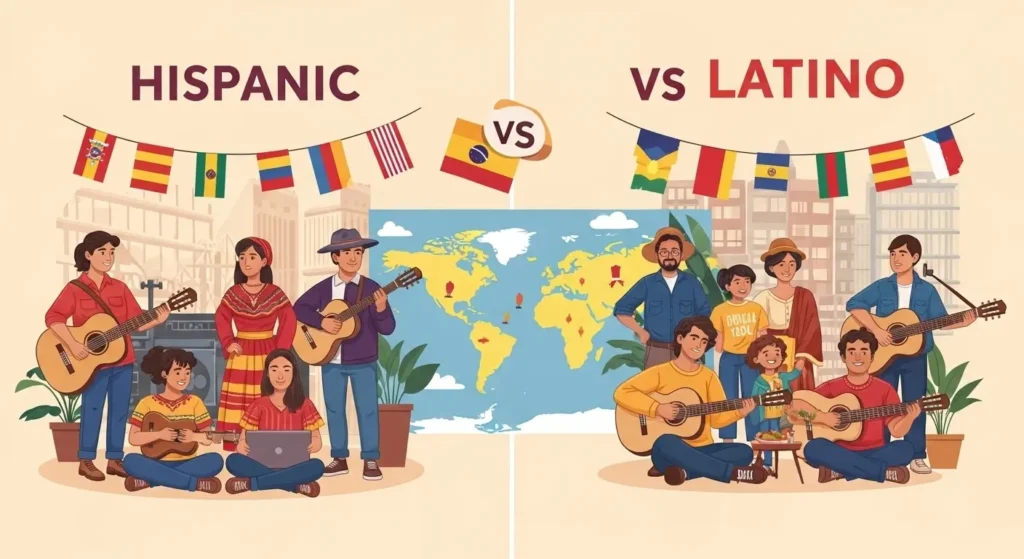
Comparison Table: Hispanic vs Latino
| Feature | Hispanic | Latino |
| Definition | Spanish-speaking origin | Latin American origin |
| Focus | Language | Geography |
| Includes Spain? | Yes | No |
| Includes Brazil? | No | Yes |
| Common Use | US government | Social identity |
| Example Country | Spain, Mexico | Brazil, Argentina |
FAQs about Hispanic or Latino
1. Are Hispanic and Latino the same?
No, Hispanic relates to language, while Latino relates to geography.
2. Is Brazil Hispanic or Latino?
Brazil is Latino but not Hispanic because Portuguese is spoken.
3. Is Spain Hispanic or Latino?
Spain is Hispanic but not Latino.
4. Which term is more correct?
Neither is more correct; it depends on context and identity.
5. Can someone be both Hispanic and Latino?
Yes, many people from Latin America who speak Spanish are both.
6. Why do governments use these terms?
To collect demographic data and understand population diversity.
7. Is it offensive to use these terms?
Not usually, but always respect personal preference.
Conclusion
The terms Hispanic or Latino are often used together, but they are not identical. Hispanic refers mainly to Spanish-speaking heritage, while Latino refers to people from Latin America, regardless of language.
Understanding this difference is important for clear communication, respectful identity use, and accurate data interpretation. In the United States, these terms are widely used in government and media, while other regions may prefer different expressions like “Latin American.”
Knowing when and how to use Hispanic or Latino helps avoid confusion and promotes cultural awareness. It also improves writing accuracy in academic, professional, and everyday contexts.
Most importantly, these labels should always be used with respect, keeping in mind that personal identity may vary. Clear understanding of Hispanic or Latino ensures better communication in an increasingly global and diverse world.

I am James Wilson, an author at GrammarTribe.com, specializing in English grammar and clear communication.
I create expert, reliable content to help learners write with confidence and accuracy.