
Have you ever heard someone say “he did it hisself” and wondered if that’s correct? Many people search for “himself or hisself” because both forms are heard in daily speech. This creates confusion, especially for learners of English and even native speakers. The truth is simple, but the usage can feel tricky.
The keyword “himself or hisself” is often searched by students, writers, and professionals who want to avoid mistakes in formal writing. Some hear “hisself” in casual conversation or regional dialects and assume it might be acceptable. Others want to know if it is ever correct in standard English.
This article will clearly explain “himself or hisself”, where each form comes from, and which one you should use. By the end, you will feel confident using the correct form in both speaking and writing.
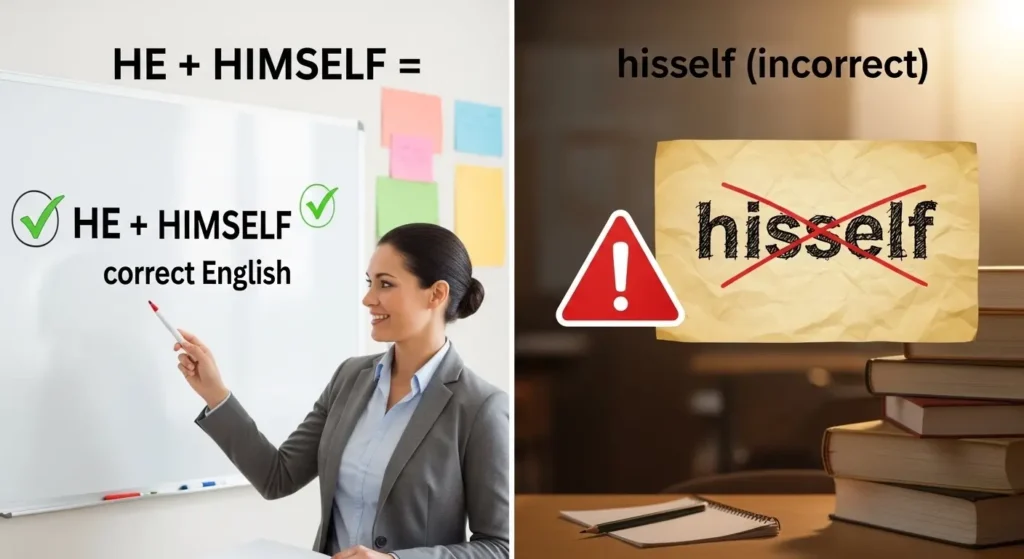
Himself or Hisself – Quick Answer
Correct form: Himself ✅
Incorrect in standard English: Hisself ❌
Examples:
- He hurt himself while playing. ✅
- He hurt hisself while playing. ❌
👉 “Himself” is the proper reflexive pronoun.
👉 “Hisself” is considered nonstandard and informal.
The Origin of Himself or Hisself
The word “himself” comes from Old English. It combines:
- “him” (object pronoun)
- “self” (used for emphasis)
Over time, it became the standard reflexive form.
The form “hisself” developed in spoken English. It follows a pattern similar to:
- myself
- yourself
So, some speakers naturally formed “hisself.” It appears in regional dialects, especially in informal speech.
👉 Important: “Hisself” is not accepted in formal or standard English.
British English vs American English Spelling
There is no difference between British and American English for this keyword.
| Form | British English | American English | Correct? |
| Himself | Yes | Yes | ✅ Correct |
| Hisself | No | No | ❌ Incorrect |
👉 Both UK and US English use “himself” only in formal writing.
Which Spelling Should You Use?
If you are writing for:
- US audience: Use himself
- UK/Commonwealth: Use himself
- Global audience: Use himself
👉 Use “hisself” only in:
- Fiction (to show dialect)
- Dialogue (to reflect real speech)
Avoid it in:
- Academic writing
- Emails
- Professional content
Common Mistakes with Himself or Hisself
Here are common errors people make:
❌ He fixed the car by hisself.
✅ He fixed the car by himself.
❌ The boy blamed hisself.
✅ The boy blamed himself.
❌ She told him to do it hisself.
✅ She told him to do it himself.
👉 Rule: Always use himself in correct English.
Himself or Hisself in Everyday Examples
Email:
- Correct: He completed the task himself.
News:
- The leader addressed the issue himself.
Social Media:
- He built this project himself! 🔥
Formal Writing:
- The author himself approved the document.
Casual Speech (Dialect):
- He did it hisself. (informal, not standard)
Himself or Hisself – Google Trends & Usage Data
Search data shows that “himself or hisself” is popular among:
- English learners
- Students
- Content writers
👉 “Himself” is used worldwide in:
- Education
- Media
- Business writing
👉 “Hisself” appears mostly in:
- Regional speech (US, UK rural dialects)
- Informal conversation
📊 Conclusion: “Himself” dominates global usage.
Comparison Table
| Feature | Himself | Hisself |
| Grammar | Standard | Nonstandard |
| Usage | Formal & informal | Informal only |
| Acceptance | Worldwide | Limited |
| Writing | Yes | No |
| Speaking | Yes | Rare/dialect |
FAQs
1. Is “hisself” ever correct?
No, not in standard English. It is only used in dialects.
2. Why do people say “hisself”?
Because it sounds similar to “myself” and “yourself.”
3. Can I use “hisself” in writing?
Only in dialogue or creative writing.
4. Is “hisself” used in the UK?
Yes, but only in informal or regional speech.
5. What is the correct reflexive pronoun for “he”?
“Himself” is correct.
6. Is “hisself” a slang word?
Yes, it is considered informal or dialectal.
7. Do exams accept “hisself”?
No, always use “himself.”
Conclusion
Understanding “himself or hisself” is simple once you know the rule. The correct and accepted form is “himself.” It is used in both British and American English, in formal and informal contexts. On the other hand, “hisself” is a nonstandard form. It appears in casual speech and some dialects but should be avoided in proper writing.
If you want to communicate clearly and professionally, always choose “himself.” This will help you avoid mistakes in exams, emails, and formal documents. However, if you are writing dialogue or creative content, you may use “hisself” to reflect real-life speech.
In short, when choosing between “himself or hisself,” go with “himself” for correctness and clarity.

Hi, I’m Henry James, the author behind GrammarTribe.com. I’m passionate about the English language and specialize in grammar, helping readers understand complex rules in a simple, clear way. Over the years, I’ve dedicated myself to creating content that makes learning grammar practical, fun, and accessible for everyone. If you’re a student, professional, or language enthusiast.
Through GrammarTribe.com, I share tips, guides, and examples to help people write confidently and correctly. My goal is to make grammar less intimidating and more useful in everyday writing, emails, social media, and professional communication. Writing and teaching grammar isn’t just my profession — it’s my passion.
When I’m not writing, I enjoy reading, exploring language trends, and discovering new ways to make English learning engaging and easy. My mission is to empower readers to communicate clearly and confidently, one grammar tip at a time.