
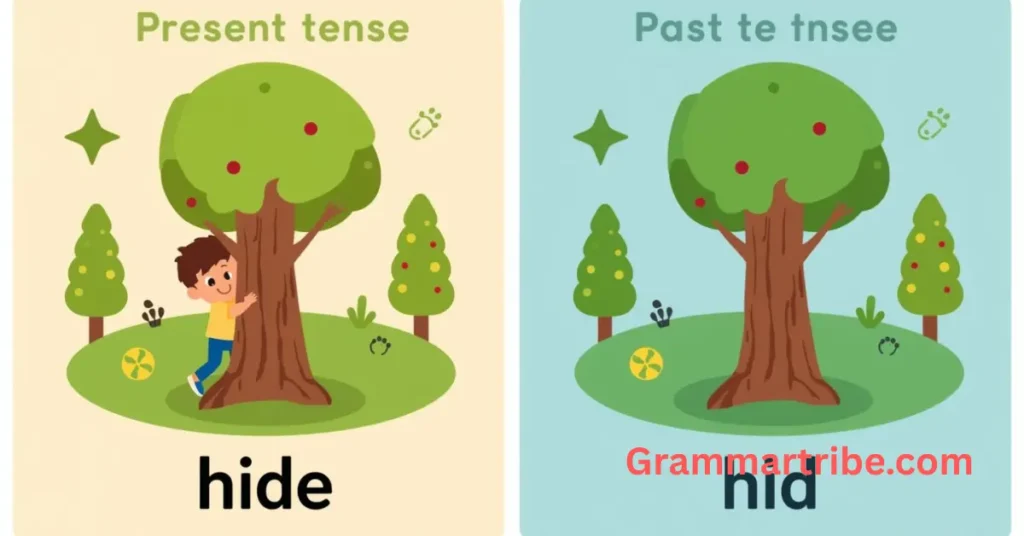
Have you ever paused while writing and wondered: should it be hide or hid? This is a common question for English learners, writers, and even native speakers. Choosing the right word is important because using the wrong form can make sentences grammatically incorrect or confusing.
Many people search for hide or hid because English has irregular verbs, and understanding when to use each form can be tricky. “Hide” is the base form, while “hid” is the simple past tense. Confusion often arises because irregular verbs do not follow typical “-ed” rules for the past tense.
This guide clears up the mystery. You’ll get a quick answer, learn the origin of the word, see real-life examples, understand common mistakes, and know how to use hide and hid correctly. By the end, you’ll feel confident using these verbs in emails, social media posts, essays, or professional writing.
Hide or Hid – Quick Answer
- Hide → Present tense / base form
- I hide my keys in the drawer.
- Hid → Past tense
- Yesterday, I hid the gift under the bed.
Both words are correct, but their use depends on time and context.
The Origin of Hide / Hid
The verb hide comes from Old English “hȳdan”, meaning “to conceal” or “cover.”
- Early English used various past forms like hedd and hidde.
- Over time, hid became the standard simple past.
- English verbs can be regular (add -ed) or irregular, and hide is irregular, so hid is used instead of hided.
British English vs American English Spelling
Unlike words like “color/colour,” there is no difference between British and American English for hide or hid.
- Both hide and hid are standard worldwide.
- Usage rules are based on tense, not region.
Comparison Table
| Word | Type | Example | Notes |
| hide | Present | I hide the money. | Base form, general use |
| hid | Past | She hid the letter yesterday. | Past tense, irregular |
Which Form Should You Use?
- Present / Future Actions: hide
- Past Actions: hid
- Continuous Tense: hiding
- Works for all English varieties (US, UK, Australia, India)
Tip: Always check the tense of your sentence rather than the audience location.
Common Mistakes with Hide / Hid
❌ I hid my keys now. → wrong, should I hide my keys now.
❌ Yesterday, I hide the book. → wrong, should be hid
✔️ Use hide for present/future
✔️ Use hid for past actions
✔️ Use hiding for continuous or progressive forms
Hide / Hid in Everyday Examples
Emails
- Present: Please hide your password from public view.
- Past: I hid the confidential file in a secure folder.
News Headlines
- Politicians hide information from the public.
- Officials hid the documents before the investigation.
Social Media
- I’m hiding my notifications for now.
- She hid her reaction when she saw the surprise.
Formal Writing
- The company hides trade secrets carefully.
- The scientist hid the sensitive data temporarily.
Hide / Hid – Google Trends & Usage Data
- Both words are equally recognized worldwide.
- Searches peak for hide in tutorials, apps, games, and privacy tools.
- Hid appears mostly in past-tense storytelling and literature.
- No regional spelling differences; usage is tense-dependent.
Keyword Comparison Table
| Variation | Correct | Use Case |
| hide | ✅ | Present/future tense |
| hid | ✅ | Past tense |
| hided | ❌ | Incorrect |
| hiding | ✅ | Continuous/progressive |
FAQs – Hide or Hid
1. Is hid correct?
Yes, it is the simple past tense of hide.
2. Can I use hide in the past tense?
No, use hid for past actions.
3. Is hiding different from hide?
Yes, hiding is a continuous/progressive tense.
4. Do British and American English differ?
No, both forms are the same worldwide.
5. Can I write “hided”?
No, it’s incorrect; use hid instead.
6. Which form should I use for stories?
Use hid for past events and hide for present/future narration.
7. Is “hide or hid” a common search term?
Yes, many learners check it to avoid grammatical errors.
Conclusion:
Understanding hide or hid is simple once you know the tense rules. Hide is always the base form used for present or future actions, while hid is the past tense. There are no regional spelling differences, so both American and British English use the same forms. Mistakes usually happen when writers confuse past and present tenses or try to regularize an irregular verb by adding “-ed,” which is incorrect.
Remember these key tips:
- Present/future → hide
- Past → hid
- Continuous → hiding
In practical writing, always check the sentence tense before choosing the word. Emails, formal writing, news, social media posts, and storytelling all follow the same rules. Using hide and hid correctly improves readability, grammar accuracy, and professional appearance. With consistent practice, you’ll never mix up hide or hid again.

Hi, I’m Henry James, the author behind GrammarTribe.com. I’m passionate about the English language and specialize in grammar, helping readers understand complex rules in a simple, clear way. Over the years, I’ve dedicated myself to creating content that makes learning grammar practical, fun, and accessible for everyone. If you’re a student, professional, or language enthusiast.
Through GrammarTribe.com, I share tips, guides, and examples to help people write confidently and correctly. My goal is to make grammar less intimidating and more useful in everyday writing, emails, social media, and professional communication. Writing and teaching grammar isn’t just my profession — it’s my passion.
When I’m not writing, I enjoy reading, exploring language trends, and discovering new ways to make English learning engaging and easy. My mission is to empower readers to communicate clearly and confidently, one grammar tip at a time.