
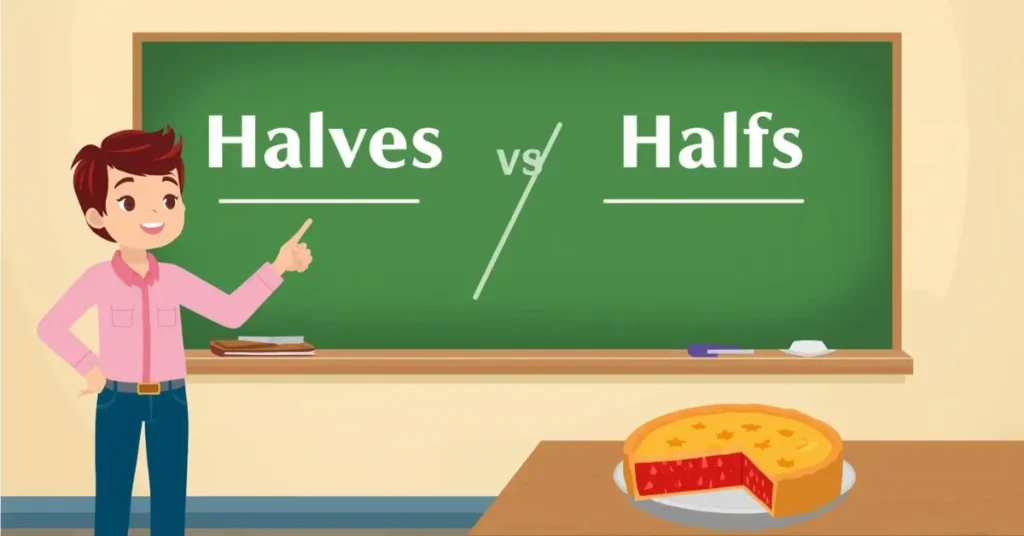
When writing or speaking, many people get confused between “halves” and “halfs.” Is there more than one “half,” or can you simply add an “s” like regular nouns? This question pops up often in classrooms, emails, social media, and even formal writing. Getting it wrong can make your writing look unprofessional or careless.
Understanding the correct spelling not only helps in everyday communication but also clarifies your meaning. Are you talking about two equal parts of something or trying to pluralize a word incorrectly? In this article, we’ll explain the difference, explore the origin of the word, compare British and American usage, show common mistakes, and give practical tips for correct usage. By the end, you’ll know exactly when to use “halves” and avoid the common trap of “halfs.”
Halves or Halfs – Quick Answer
The correct plural of “half” is “halves.”
- ✅ Correct: I ate two halves of a sandwich.
- ❌ Incorrect: I ate two halfs of a sandwich.
Rule: Words ending in f often change to ves in the plural (e.g., leaf → leaves, wolf → wolves).
The Origin of Halves or Halfs
The word “half” comes from the Old English “healf,” meaning “one of two equal parts.”
Historically, English plurals were irregular, and words ending in f or fe often changed to ves. Over centuries, this rule became standard, which is why “halves” is the only correct form.
“Halfs” is considered a misspelling and has no historical basis in English dictionaries.
British English vs American English Spelling
Both British and American English use halves as the plural of half. There is no variation like in some words (e.g., colour vs color).
| Form | British English | American English |
| Singular | half | half |
| Plural | halves | halves |
| Incorrect | halfs | halfs |
✅ Tip: You can safely use halves in any English-speaking country.
Which Spelling Should You Use?
- Use halves in all professional, academic, and casual writing.
- Avoid halfs entirely.
- Global audiences understand halves, so it’s the safest choice for blogs, emails, and social media posts.
Common Mistakes with Halves or Halfs
- Halfs instead of halves – Incorrect pluralization.
- ❌ He divided the cake into three halfs.
- ✅ He divided the cake into three halves.
- Confusing half with halve (verb)
- ❌ I halves the pizza.
- ✅ I halved the pizza.
- Using halves for non-count nouns
- ❌ There are many halves of sugar.
- ✅ There are two halves of the sandwich.
Halves in Everyday Examples
- Email: “Please divide the report into two halves for review.”
- News headline: “Team scores in the first and second halves of the match.”
- Social media: “I can’t eat both halves of this giant burger!”
- Formal writing: “The project was completed in two halves, each with distinct tasks.”
Halves – Google Trends & Usage Data
According to Google Trends:
- Highest search interest: USA, UK, Canada, Australia.
- Common searches: “half or halves,” “halfs vs halves,” “plural of half.”
People mostly search for clarification in writing, education, or recipes.
Keyword Variations Comparison Table
| Variation | Correct? | Notes |
| halves | ✅ Yes | Standard plural of half |
| halfs | ❌ No | Incorrect, do not use |
| halve | ✅ Verb | Means to divide into two parts |
| halfed | ✅ Verb | Past tense of halve |
FAQs about Halves or Halfs
1. Is “halfs” ever correct?
No. The plural of “half” is always halves.
2. What about “halve”?
“Halve” is a verb meaning to divide into two equal parts.
3. Can “halves” be used in financial terms?
Yes, e.g., “The company released its earnings in two halves of the fiscal year.”
4. Is “half” countable?
Yes, one half, two halves.
5. Are there other f→ves words?
Yes, examples include leaf → leaves, wife → wives, wolf → wolves.
6. Can I use “halves” in informal text?
Absolutely. It’s correct in casual messages, social media, and blogs.
7. How do I remember?
Think of the “f → ves” rule for plurals: half → halves.
Conclusion
The plural of “half” is always “halves,” not halfs. This rule is consistent across British and American English, making your writing clear and professional. Remember, halve is a verb, half is singular, and halves is plural. Avoid “halfs” in all contexts.
Whether you’re writing emails, school essays, recipes, or social media posts, using halves correctly ensures your readers understand your meaning. By following the f→ves plural rule and practicing these examples, you can confidently eliminate confusion and improve your English writing.

Hi, I’m Henry James, the author behind GrammarTribe.com. I’m passionate about the English language and specialize in grammar, helping readers understand complex rules in a simple, clear way. Over the years, I’ve dedicated myself to creating content that makes learning grammar practical, fun, and accessible for everyone. If you’re a student, professional, or language enthusiast.
Through GrammarTribe.com, I share tips, guides, and examples to help people write confidently and correctly. My goal is to make grammar less intimidating and more useful in everyday writing, emails, social media, and professional communication. Writing and teaching grammar isn’t just my profession — it’s my passion.
When I’m not writing, I enjoy reading, exploring language trends, and discovering new ways to make English learning engaging and easy. My mission is to empower readers to communicate clearly and confidently, one grammar tip at a time.