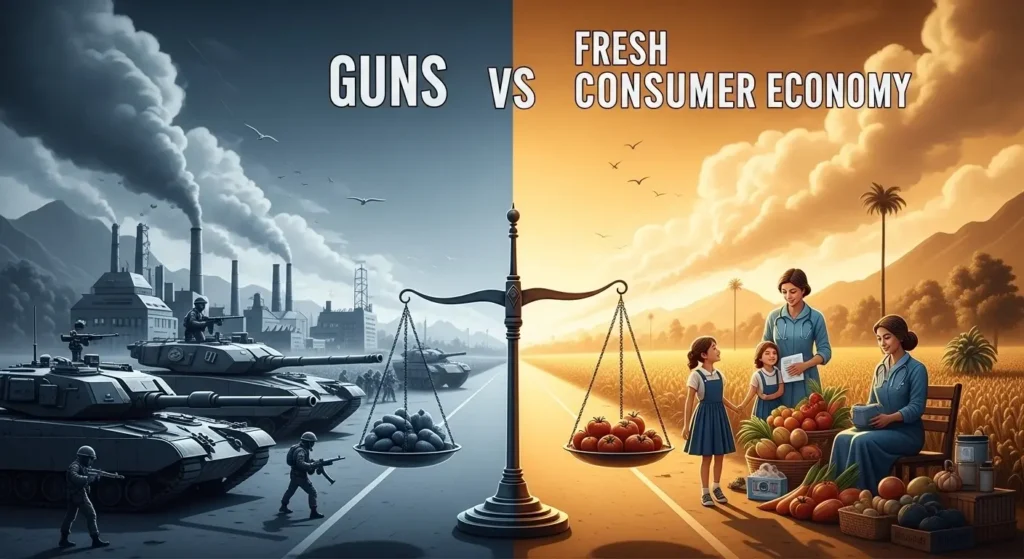
In economics, one of the most famous ideas is the guns or butter concept. It explains how a country must choose between spending on military defense (“guns”) or consumer goods and public welfare (“butter”).
Many students search for guns or butter because it looks simple but represents a deep economic truth. Governments cannot produce everything at the same time because resources like money, labor, and raw materials are limited. This creates confusion: should a country invest more in security or improve living standards?
The idea of guns or butter is widely used in economics lessons, exams, and real-world policy discussions. It helps explain why governments make tough decisions during war, peace, or economic crises.
Understanding guns or butter is important because it shows how opportunity cost works in real life. Every choice has a trade-off, and this concept makes that trade-off clear in a powerful way.
Guns or Butter – Quick Answer
The guns or butter model explains the trade-off between military spending and civilian goods production. A country must choose how to divide limited resources.
Examples:
- More guns → stronger military, less consumer goods
- More butter → better living standards, weaker defense
The Origin of Guns or Butter
The term comes from early economic theory and was widely used during World War-era economics. It represents a simplified model of national resource allocation.
The phrase does not come from spelling differences but from symbolic meaning:
- Guns = military spending
- Butter = civilian goods and food
It became popular in macroeconomics textbooks to explain scarcity and opportunity cost.
British English vs American English Spelling
There is no spelling difference in “guns or butter,” but usage style varies slightly:
| Aspect | British English | American English |
| Usage | Economic theory in policy texts | Economics textbooks, exams |
| Style | Formal academic discussion | Practical teaching examples |
| Preference | “defence spending” | “defense spending” |
Which Spelling Should You Use?
Since guns or butter is a concept, not a spelling variation, your usage depends on audience:
- US Audience: Use “defense spending” and American economic examples
- UK/Commonwealth Audience: Use “defence spending” and policy-based framing
- Global Audience: Use neutral explanation with simple terms
In academic writing, clarity matters more than regional spelling differences.
Common Mistakes with Guns or Butter
- Thinking it is about food and weapons literally
- Confusing it with personal budgeting only
- Assuming countries can produce both equally
- Ignoring the concept of opportunity cost
- Treating it as a real product choice instead of an economic model
Guns or Butter in Everyday Examples
- Emails (Policy):
“The government must decide between guns or butter allocation in the new budget.” - News Writing:
“Economists debate the guns or butter trade-off amid rising defense spending.” - Social Media:
“Do we need more guns or butter in the economy right now?” - Formal Writing:
“The guns or butter model explains national resource distribution choices.”
Guns or Butter – Google Trends & Usage Data
The keyword guns or butter is most commonly searched in:
- United States → economics students, policy debates
- India → competitive exams and academic learning
- UK → university economics courses
It appears mostly in:
- Macroeconomics topics
- Government budgeting discussions
- Educational content and exam preparation
Search interest rises during exam seasons and political budget announcements.
Comparison Table: Guns vs Butter Trade-Off
| Factor | Guns (Military) | Butter (Civil Goods) |
| Purpose | Defense & security | Public welfare |
| Benefit | Protection | Living standards |
| Cost | Less consumer goods | Less military strength |
| Impact | National security | Economic comfort |
FAQs
1. What does guns or butter mean?
It means a country must choose between defense spending and consumer goods.
2. Why are guns or butter important?
It explains scarcity and opportunity cost in economics.
3. Is guns or butter a real policy?
No, it is a theoretical model.
4. Who created the concept?
It is widely used in macroeconomics textbooks, especially during wartime economics studies.
5. Can a country have both guns and butter?
Yes, but not in unlimited amounts due to limited resources.
6. What is the main idea of guns or butter?
Trade-off between military and civilian spending.
Conclusion
The guns or butter concept is a simple but powerful way to understand economic decision-making. It shows that countries cannot produce everything at once because resources are limited. Every government must decide how to balance national defense and public welfare.
While “guns” represent military strength and security, “butter” represents comfort, health, and economic development. Choosing one often means giving up more of the other.
This idea is not only useful in economics classes but also in understanding real-world government budgets and policy decisions. It teaches the importance of opportunity cost in every choice.
In short, the guns or butter model helps explain how nations manage priorities and make tough but necessary decisions.

I am James Wilson, an author at GrammarTribe.com, specializing in English grammar and clear communication.
I create expert, reliable content to help learners write with confidence and accuracy.