Have you ever paused mid-sentence, unsure whether to write fulfil or fulfill? This confusion is common among writers, students, and professionals, especially when switching between British and American English. Choosing the correct spelling is crucial in emails, articles, and official documents, as using the wrong version can seem unprofessional.
People search for “fulfil or fulfill” because both spellings exist, but their usage depends on geography. While the word’s meaning remains consistent“to complete or carry out something”the spelling differences can affect readability and correctness.
In this guide, we’ll provide a quick answer, explain the origin, compare British vs. American English rules, share common mistakes, and offer real-world examples. Whether you’re writing an academic essay, a work email, or social media content, by the end of this article, you’ll know which spelling to use confidently.
Fulfil or Fulfill – Quick Answer
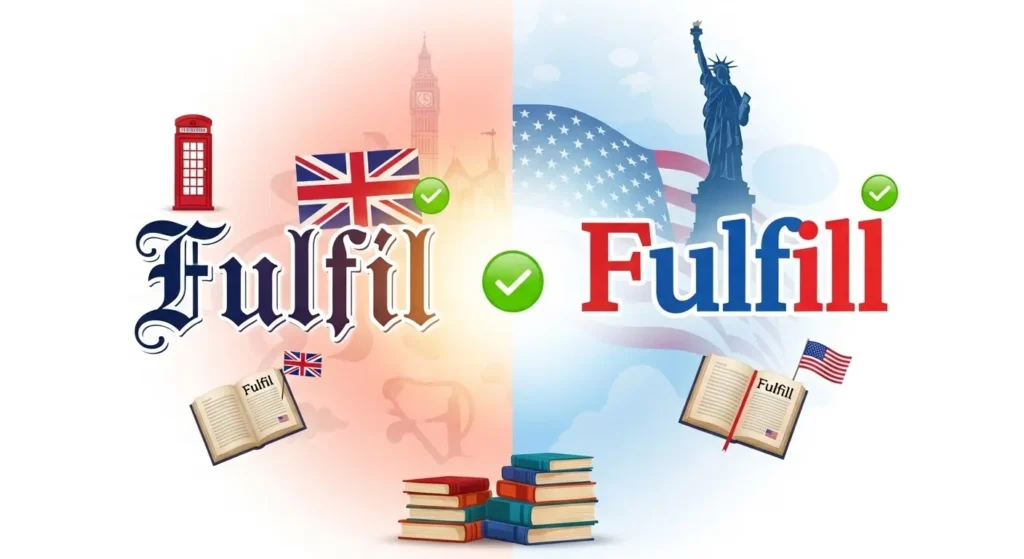
- Fulfil → British English spelling. Example: She wanted to fulfil her lifelong dream of becoming a doctor.
- Fulfill → American English spelling. Example: He worked hard to fulfill all the project requirements.
✅ Both spellings mean the same: to complete or achieve something.
The Origin of Fulfil/Fulfill
The word comes from the Old English “fullfyllan”, which combines “full” and “fyllan” (to fill). Over centuries, British English retained the single “l” form in some cases, while American English standardized the double “l.”
- 14th century: “fulfyllen”
- 18th century: Fulfil common in UK writing
- 19th century: Fulfill popularized in US dictionaries
This explains why the spelling differs despite identical meanings.
British English vs American English Spelling
| Feature | British English | American English |
| Spelling | fulfil | fulfill |
| Verb form | fulfils, fulfilling, fulfilled | fulfills, fulfilling, fulfilled |
| Common regions | UK, Ireland, Australia, New Zealand | USA, Canada |
| Example | She fulfilled her duties → UK prefers: She fulfils her duties | She fulfills her duties |
Rule of thumb: British English often simplifies double letters at the end, while American English standardizes with double “l.”
Which Spelling Should You Use?
- Use “fulfil” if writing for UK, Commonwealth countries, or audiences familiar with British English.
- Use “fulfill” if writing for US readers, American publications, or global audiences accustomed to American spelling.
Pro tip: For global clarity, American English (“fulfill”) is often safer, especially online.
Common Mistakes with Fulfil/Fulfill
- Using fulfil in American English texts. ❌
Incorrect: I hope to fulfil all requirements.
Correct: I hope to fulfill all requirements. - Doubling “l” unnecessarily in British English verbs. ❌
Incorrect: He is fulfilling his duties (UK informal overuse).
Correct: He is fulfilling his duties. - Confusing it with fullfill (wrong spelling). ❌
✅ Always remember: one “l” for UK, double “l” for US.
Fulfil/Fulfill in Everyday Examples
Emails:
- UK: We aim to fulfil your order within three days.
- US: We aim to fulfill your order within three days.
News Headlines:
- UK: Government promises to fulfil campaign pledges.
- US: Government promises to fulfill campaign pledges.
Social Media Posts:
- UK: Excited to fulfil my goals this year!
- US: Excited to fulfill my goals this year!
Formal Writing:
- Ensure your spelling matches the style guide (APA, MLA, or local publication rules).
Fulfil or Fulfill – Google Trends & Usage Data
Google Trends shows:
- Fulfill dominates searches in the US and Canada.
- Fulfil is more searched in the UK, Ireland, and Australia.
- Overall, fulfill has higher global search volume due to US internet dominance.
Keyword Variations Comparison
| Variation | British English | American English |
| Base form | fulfil | fulfill |
| Present tense | fulfils | fulfills |
| Continuous | fulfilling | fulfilling |
| Past tense | fulfilled | fulfilled |
FAQs
1. Are fulfil and fulfill the same?
Yes, they have the same meaning. Spelling depends on British or American English.
2. Which one is correct in the UK?
Fulfil is correct in UK English.
3. Which one is correct in the US?
Fulfill is correct in US English.
4. Can I use “fulfill” in UK writing?
Technically yes, but it may look Americanized.
5. Is there a difference in meaning?
No, only the spelling differs.
6. How do I remember the difference?
UK = single “l”, US = double “l”.
7. Is it okay to mix spellings in one text?
No, consistency is key to professional writing.
Conclusion
Understanding fulfil vs fulfill is simple once you know the regional rules. British English prefers fulfil, while American English standardizes fulfill. Both mean “to complete or carry out,” so context and audience determine your choice.
When writing for international audiences, using fulfill can prevent confusion, while local publications in the UK or Commonwealth countries will expect fulfil. Avoid common mistakes like doubling letters incorrectly or using nonstandard forms like fullfill. By applying these tips and checking your audience, you can write confidently, ensuring clarity, professionalism, and correctness.

Hi, I’m Henry James, the author behind GrammarTribe.com. I’m passionate about the English language and specialize in grammar, helping readers understand complex rules in a simple, clear way. Over the years, I’ve dedicated myself to creating content that makes learning grammar practical, fun, and accessible for everyone. If you’re a student, professional, or language enthusiast.
Through GrammarTribe.com, I share tips, guides, and examples to help people write confidently and correctly. My goal is to make grammar less intimidating and more useful in everyday writing, emails, social media, and professional communication. Writing and teaching grammar isn’t just my profession — it’s my passion.
When I’m not writing, I enjoy reading, exploring language trends, and discovering new ways to make English learning engaging and easy. My mission is to empower readers to communicate clearly and confidently, one grammar tip at a time.