Many English speakers get confused between “fazed” and “phased”. Both words sound the same but have completely different meanings. Choosing the wrong one can make your writing look careless. People search for this keyword to avoid embarrassing mistakes in emails, essays, social media posts, or professional documents.
Understanding the difference is simple once you know their meanings and usage. This article will guide you through the correct spelling, origin, and examples, so you can confidently use fazed and phased in the right context.
Fazed or Phased – Quick Answer
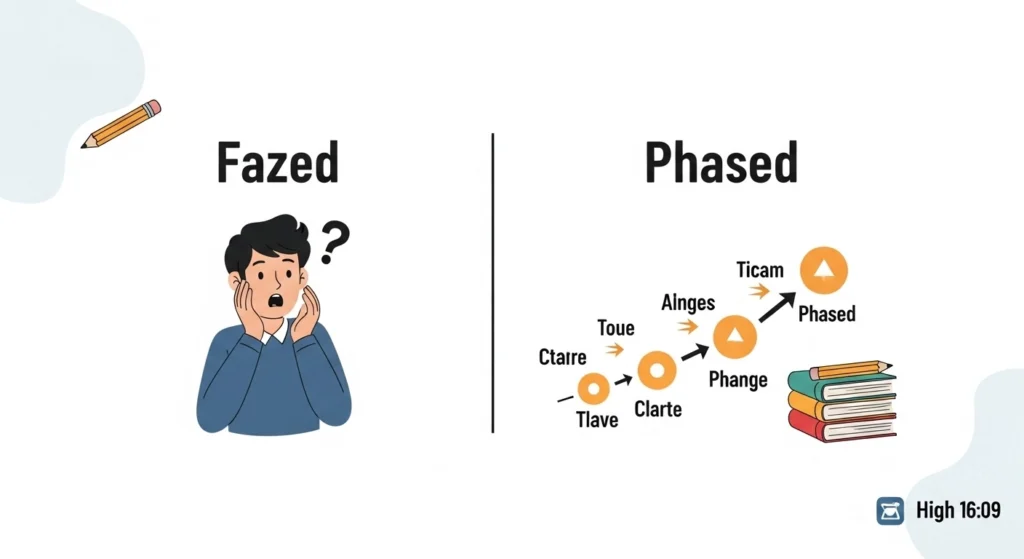
- Fazed → Means disturbed, upset, or thrown off emotionally.
Example: She wasn’t fazed by the criticism. - Phased → Refers to doing something gradually in stages or phases.
Example: The company phased out old software over six months.
✅ Quick Tip: If it’s about emotions, use fazed. If it’s about steps or stages, use phased.
The Origin of Fazed and Phased
- Fazed: Comes from the verb “faze,” dating back to the early 20th century, meaning to disconcert or disturb.
- Phased: Derived from “phase,” which has roots in Greek “phasis,” meaning appearance or stage. This term has been used in English since the 17th century to describe a step-by-step process.
The confusion exists mainly because both words are homophones—they sound the same but differ in spelling and meaning.
British English vs American English Spelling
Both fazed and phased are spelled the same in British and American English. There’s no regional spelling difference for these words. The key is to use the right word based on meaning.
| Word | Meaning | Example (US) | Example (UK) |
| Fazed | Disturbed or unsettled | She wasn’t fazed at all. | He looked fazed by the news. |
| Phased | Done gradually in stages | They phased the plan out. | The rollout was phased over months. |
Which Spelling Should You Use?
- US audience: Use fazed for emotions and phased for stages.
- UK/Commonwealth: Same rules apply; spelling is identical.
- Global writing: Focus on meaning, not spelling, since both are universally recognized.
Common Mistakes with Fazed or Phased
- Using phased instead of fazed when talking about emotions.
❌ Wrong: She wasn’t phased by the noise.
✅ Correct: She wasn’t fazed by the noise. - Using fazed instead of phased for gradual processes.
❌ Wrong: The new system was fazed out slowly.
✅ Correct: The new system was phased out slowly. - Misspelling fazed as “phaisd” or phased as “fazd.” Always stick to standard spelling.
Fazed or Phased in Everyday Examples
- Emails:
“I wasn’t fazed by the delay in response.”
“We will phased the new policy in over three months.” - News Headlines:
“Residents aren’t fazed by the storm warning.”
“City council phased the road closures to avoid traffic chaos.” - Social Media:
“Honestly, I’m not fazed by the haters.”
“The update will be phased gradually.” - Formal Writing:
Academic and business writing usually prefers phased for processes and fazed for psychological reactions.
Fazed or Phased – Google Trends & Usage Data
- Fazed is more commonly used in casual writing and social media.
- Phased appears more in professional, corporate, and technical content.
- US vs UK: Both words show similar trends, but US users search slightly more for fazed.
| Keyword | Popularity (Global) | Context |
| Fazed | Medium | Social, emotional |
| Phased | High | Business, technical |
FAQs – Fazed or Phased
- Can “fazed” be used for processes?
No. Use phased when describing gradual steps. - Are “fazed” and “phased” interchangeable?
No, they have entirely different meanings. - Is there a spelling difference between UK and US?
No, both spellings are the same in English. - Which word is more common online?
Phased appears more in professional contexts; fazed in casual/social contexts. - Can “phased” refer to emotional reactions?
No. Emotions are described using fazed. - Is “faze” a verb?
Yes, it means to disturb or unsettle. - Is “phase” only a noun?
No, “phase” can also be a verb meaning to carry out gradually.
Conclusion
Understanding fazed vs phased is simple once you focus on meaning. Fazed is for emotional responses—when someone is upset or disturbed. Phased relates to processes done step by step. Both spellings are identical in US and UK English, so your priority should always be context.
Avoid mixing them in emails, social media, or professional documents to maintain clarity and professionalism. By following these guidelines, you can confidently write with precision and avoid common mistakes. Remember: sound alike, but meaning matters!

Hi, I’m Henry James, the author behind GrammarTribe.com. I’m passionate about the English language and specialize in grammar, helping readers understand complex rules in a simple, clear way. Over the years, I’ve dedicated myself to creating content that makes learning grammar practical, fun, and accessible for everyone. If you’re a student, professional, or language enthusiast.
Through GrammarTribe.com, I share tips, guides, and examples to help people write confidently and correctly. My goal is to make grammar less intimidating and more useful in everyday writing, emails, social media, and professional communication. Writing and teaching grammar isn’t just my profession — it’s my passion.
When I’m not writing, I enjoy reading, exploring language trends, and discovering new ways to make English learning engaging and easy. My mission is to empower readers to communicate clearly and confidently, one grammar tip at a time.