When it comes to English, words that sound the same but have different meanings often confuse even native speakers. “Fair” and “fare” are classic examples. Many people wonder: which one should I use in a sentence? Should I write “The bus fare is expensive” or “The bus fair is expensive”? Confusing these two can change the meaning of your sentence entirely.
Understanding the difference helps in writing clearly, avoiding mistakes in emails, essays, social media, and professional communication. In this article, we’ll give you a quick, simple guide to choosing the right word. By the end, you’ll know exactly when to use fair and when fare is correct, backed by examples, history, spelling rules, and common mistakes. Whether you are writing for school, work, or social media, this guide is for you.
Fair or Fare – Quick Answer
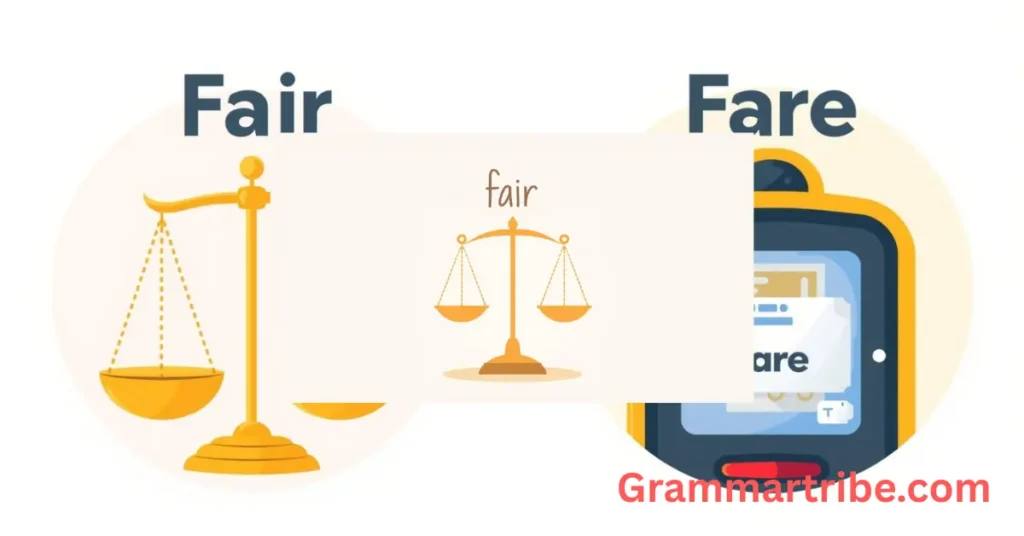
- Fair → Refers to justice, beauty, or events like a festival.
Example: It’s only fair to share the prize equally.
Example: She has fair skin.
Example: We went to the county fair last weekend. - Fare → Refers to the cost of travel or type of food.
Example: The taxi fare is $10.
Example: The restaurant offers Italian fare.
Quick Tip: If you’re talking about money for transport or food, use fare. For justice, beauty, or events, use fair.
The Origin of Fair or Fare
- Fair comes from Old English fæger, meaning beautiful or pleasing. Over centuries, it evolved to include meanings like just, equitable, and festivals.
- Fare comes from Old English faran, meaning to go or travel. Over time, it became associated with the cost of traveling and the food served to travelers.
The different origins explain why these homophones exist. Even though they sound the same, their meanings are distinct, and context decides which one to use.
British English vs American English Spelling
Both fair and fare are spelled the same in British and American English. Unlike words like color/colour, there’s no regional spelling difference. However, usage can slightly vary:
| Word | Meaning | British English Example | American English Example |
| Fair | Just, equitable, festival | It’s only fair to everyone. | It’s only fair to everyone. |
| Fair | Beauty | She has fair hair. | She has fair hair. |
| Fare | Cost of travel | The train fare is £5. | The bus fare is $3. |
| Fare | Type of food | Traditional British fare includes roast beef. | Traditional American fare includes burgers and fries. |
Which Spelling Should You Use?
- Use “fair” when discussing justice, beauty, or events.
- Use “fare” when talking about travel costs or food.
Audience matters: For global readers, these rules stay the same. Both US and UK readers understand these words, so focus on context rather than location.
Common Mistakes with Fair or Fare
- ❌ The bus fair is expensive. → ❌ Incorrect
✅ The bus fare is expensive. → ✅ Correct - ❌ She got a good fare in the competition. → ❌ Incorrect
✅ She got a fair result in the competition. → ✅ Correct - ❌ We enjoyed the food fair at the restaurant. → ❌ Incorrect
✅ We enjoyed the local fare at the restaurant. → ✅ Correct
Tip: If you can replace the word with price or food, it’s fare. If it’s about justice, equality, or beauty, it’s fair.
Fair or Fare in Everyday Examples
Emails:
- It’s only fair to provide feedback to your team.
- The taxi fare to the airport is $25.
News Headlines:
- Local Fair Attracts Thousands of Visitors
- Airline Raises Fare Prices This Summer
Social Media Posts:
- Had a blast at the county fair!
- The restaurant serves amazing Italian fare.
Formal Writing:
- It is fair to assume the project will finish on time.
- The fare for the train journey increased last month.
Fair or Fare – Google Trends & Usage Data
According to Google Trends, searches for “fair or fare” spike in periods of academic exams and when people check spelling or grammar online. Most traffic comes from English learners and writers who want to avoid mistakes. Usage is fairly balanced globally, with slight variations:
- UK & Commonwealth: “fair” used more in cultural or festival contexts, “fare” in travel articles.
- US: Similar pattern; “fare” is heavily used in travel/transport contexts.
Comparison Table
| Keyword | Meaning | Example |
| Fair | Just, beautiful, festival | It’s fair to share the prize. |
| Fare | Travel cost, type of food | Taxi fare is $12. |
| Fair | Event or exhibition | We attended the school fair. |
| Fare | Meal type | Traditional Japanese fare is delicious. |
FAQs
- Is “fair” the same as “fare”?
No, fair is about justice, beauty, or events, while fare is about travel cost or food. - Can I use “fare” in a sentence about fairness?
❌ No, that’s incorrect. Always use fair. - Is “fare” used in British English differently than American English?
Slightly. In both, it’s used for travel cost and food; context determines meaning. - How do I remember the difference?
Think: fare = travel or food, fair = just or beautiful. - Are there phrases with “fair” or “fare”?
Yes, e.g., fair play, fair share, daily fare, public fare. - Can “fair” describe skin tone?
Yes, e.g., She has fair skin. - Is “fare” used for public transport?
Yes, e.g., Bus fare, train fare, taxi fare.
Conclusion
Confusing fair and fare is common, but now you know the simple rules: fair = justice, beauty, festivals; fare = travel cost or food. Context is everything.
In emails, essays, social media, and formal writing, check whether your sentence is about money, food, or travel or about justice, beauty, or events. Use the tables, examples, and tips in this guide to make the right choice every time. With practice, choosing between fair and fare becomes automatic, improving your writing and avoiding embarrassing mistakes. Remember, even though they sound the same, their meanings are distinct—and getting them right shows clarity and professionalism.

Hi, I’m Henry William, the author of GrammarTribe.com. I’m passionate about the English language and have dedicated my career to helping people master grammar, spelling, and effective writing. Over the years, I’ve guided learners, writers, and professionals in understanding common mistakes, tricky rules, and nuances of English grammar in a simple and easy-to-follow way.
Through GrammarTribe.com, I aim to make grammar approachable and enjoyable for everyone. My work focuses on providing clear explanations, practical tips, and examples that readers can apply in everyday writing, whether it’s emails, essays, social media, or professional documents. I believe that strong grammar skills empower people to communicate confidently and professionally.
When I’m not writing or researching grammar, I enjoy reading, exploring language trends, and creating educational content that simplifies complex concepts. I’m committed to helping my audience write better, understand English deeply, and avoid common pitfalls, all while making learning grammar a fun and rewarding journey.