Many people often confuse eczema and ringworm because both appear as skin conditions with redness, itchiness, or irritation. However, these two conditions are very different in cause, treatment, and contagiousness.
This confusion leads people to search online for “eczema or ringworm” to figure out which condition they or someone they know might have. Knowing the difference is important because using the wrong treatment can worsen symptoms.
In this article, we will explain the differences clearly, show examples, explore the origin of these terms, compare British and American spelling, and provide guidance on proper usage. By the end, you’ll understand when it’s eczema, when it’s ringworm, and how to communicate about them correctly.
Eczema or Ringworm – Quick Answer
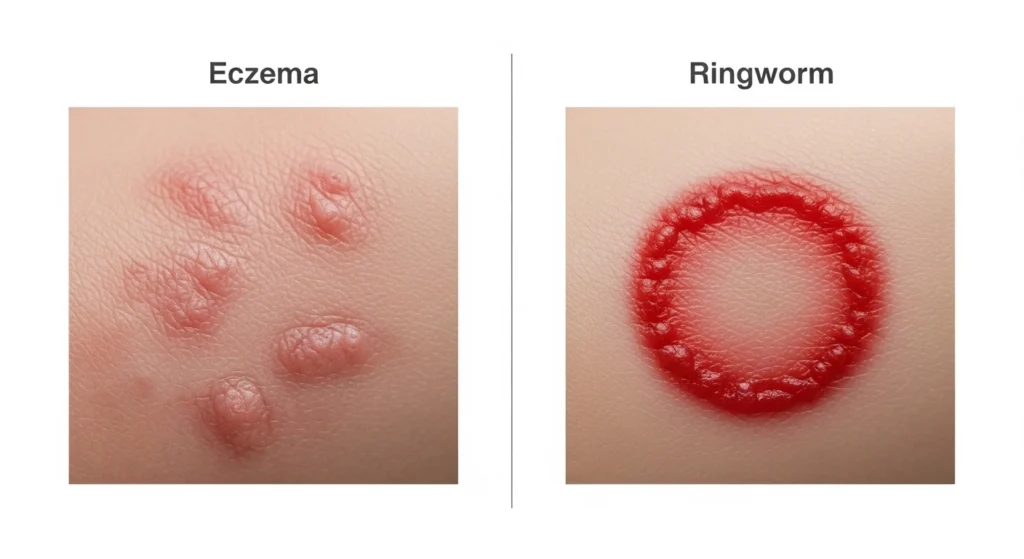
- Eczema: A non-contagious skin condition causing red, itchy, and inflamed patches. Common in children and adults. Example: “My hands are dry and itchy because of eczema.”
- Ringworm: A contagious fungal infection causing ring-shaped red rashes. Example: “The doctor confirmed I have ringworm on my arm.”
Key difference: Eczema is immune-related, while ringworm is fungal and contagious.
The Origin of Eczema and Ringworm
- Eczema: From Greek “ekzein” meaning “to boil over.” It refers to the inflamed, sometimes oozing skin condition observed historically.
- Ringworm: Despite the name, it’s not caused by worms. The term comes from the circular (ring-like) rash it produces. “Ringworm” has been in English since the 1300s.
Understanding the origin helps clarify why people confuse these terms: one sounds medical, the other sounds literal.
British English vs American English Spelling
Both terms are spelled the same in British and American English, so no variation exists here.
| Term | British English | American English |
| Eczema | Eczema | Eczema |
| Ringworm | Ringworm | Ringworm |
Note: No spelling changes, but pronunciation may slightly differ.
Which Term Should You Use?
- General audience (global): Either term works; ensure clarity.
- Medical contexts: Use precise terms: “eczema” for immune-related inflammation, “ringworm” for fungal infections.
- US audience: Same as global; no spelling difference.
- UK/Commonwealth: Same guidance.
Always prioritize clarity and medical accuracy.
Common Mistakes with Eczema or Ringworm
- Confusing eczema with fungal infections.
- Using ringworm for any itchy rash.
- Misspelling eczema as “eksema.”
- Calling ringworm “worm rash,” which is inaccurate.
Tip: Observe the rash carefully and consult a doctor for proper diagnosis.
Eczema or Ringworm in Everyday Examples
- Emails: “I need to take a few days off; I’m treating eczema on my hands.”
- News articles: “Ringworm outbreak at local school prompts hygiene measures.”
- Social media: “Has anyone else’s child had ringworm? Tips appreciated!”
- Formal writing: “The patient presented with eczema, requiring topical corticosteroids.”
Eczema or Ringworm – Google Trends & Usage Data
- Searches for eczema are higher in UK, US, and Australia, reflecting awareness of non-contagious skin issues.
- Searches for ringworm spike in tropical countries where fungal infections are common.
- “Eczema or ringworm” is a common query for people trying to self-diagnose skin rashes.
| Keyword | Popularity (Global) | Typical Search Context |
| Eczema | High | Skincare, allergy, medical advice |
| Ringworm | Medium | Contagious skin infection |
| Eczema or Ringworm | Growing | Self-diagnosis, treatment search |
FAQs
1. Can eczema turn into ringworm?
No, eczema is not contagious and cannot become ringworm.
2. Is ringworm serious?
It’s usually mild but contagious; treatment with antifungal cream is needed.
3. How do I know if it’s eczema or ringworm?
Eczema is patchy and itchy, ringworm forms circular red rings. Doctor confirmation is best.
4. Can children get both at the same time?
Yes, but treatment differs for each condition.
5. Are these conditions preventable?
Ringworm: hygiene and avoiding shared items. Eczema: triggers vary; moisturizers help.
6. Can pets spread ringworm?
Yes, animals can be a source of fungal infection.
7. Is eczema itchy all the time?
It varies; flares can be seasonal or triggered by allergens.
Conclusion
Understanding the difference between eczema and ringworm is essential for proper treatment and communication. Eczema is an immune-related, non-contagious skin condition, while ringworm is a fungal infection that is contagious. Both conditions require careful observation, correct treatment, and sometimes professional consultation.
Knowing the origin and proper use of these terms helps avoid confusion in medical, social, and written contexts. Whether you’re writing emails, posting on social media, or reading health articles, using the terms correctly ensures clarity. Remember, the terms are spelled the same in British and American English, so focus on accuracy and context rather than regional spelling differences. By distinguishing eczema from ringworm, you can protect yourself and others while communicating effectively.

Hi, I’m Henry William, the author of GrammarTribe.com. I’m passionate about the English language and have dedicated my career to helping people master grammar, spelling, and effective writing. Over the years, I’ve guided learners, writers, and professionals in understanding common mistakes, tricky rules, and nuances of English grammar in a simple and easy-to-follow way.
Through GrammarTribe.com, I aim to make grammar approachable and enjoyable for everyone. My work focuses on providing clear explanations, practical tips, and examples that readers can apply in everyday writing, whether it’s emails, essays, social media, or professional documents. I believe that strong grammar skills empower people to communicate confidently and professionally.
When I’m not writing or researching grammar, I enjoy reading, exploring language trends, and creating educational content that simplifies complex concepts. I’m committed to helping my audience write better, understand English deeply, and avoid common pitfalls, all while making learning grammar a fun and rewarding journey.