Have you ever typed “dumby” in a message or search bar and wondered if it was correct? Many people face this confusion when writing emails, social media posts, or school assignments. The words dumby and dummy look very similar, but only one of them is the correct spelling in standard English.
This confusion happens because English spelling can be tricky. Sometimes people rely on pronunciation, and sometimes autocorrect changes the word. Because of this, thousands of users search online to learn the correct spelling and how to use the word properly.
Understanding the difference between dumby or dummy is important for students, writers, bloggers, and professionals who want to write clearly. Using the wrong spelling can make writing look unprofessional or confusing.
In this article, we will explain the correct spelling, the origin of the word, differences between British and American English, common mistakes, and real-life examples. By the end, you will clearly understand which spelling to use and why.
Dumby or Dummy – Quick Answer
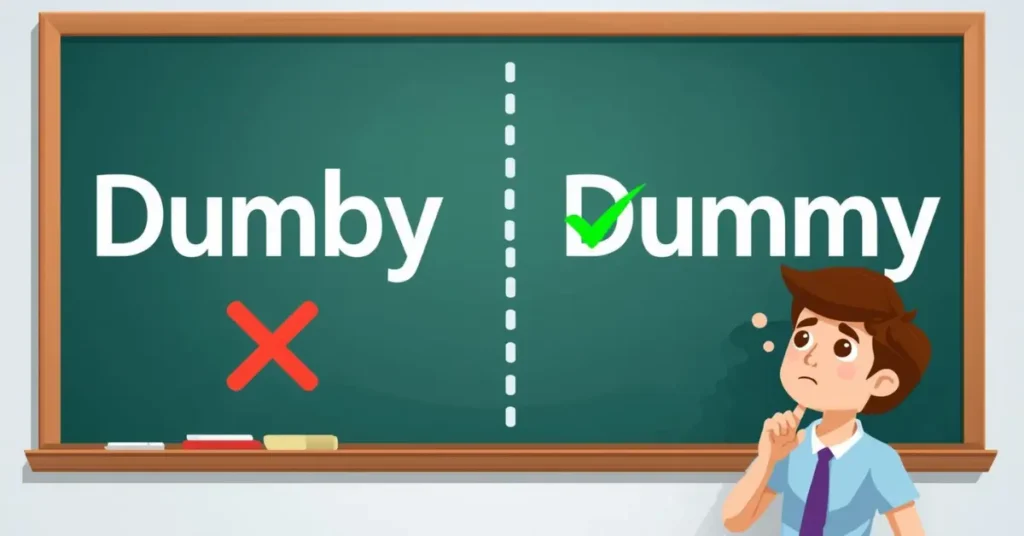
The correct spelling is dummy.
Dumby is considered a misspelling and is not accepted in standard English dictionaries.
Examples
✔ Correct: He used a dummy account for testing the website.
✔ Correct: The crash test dummy helps engineers study safety.
❌ Incorrect: He used a dumby account.
Simple rule:
If you mean a fake model, beginner guide, or a silly person, always use a dummy.
The Origin of Dumby or Dummy
The word dummy dates back to the 18th century. It originally meant a silent person or someone who cannot speak.
The word likely came from the term “dumb,” which historically referred to someone unable to talk. Over time, dummy began to have new meanings.
Today, the word has several uses:
- A model or replica used for practice (crash test dummy)
- A placeholder object in technology
- A simple guide for beginners
- Informal slang for a person acting foolish
The spelling dumby appeared later due to typing mistakes and pronunciation confusion. However, dictionaries and grammar guides recognize dummy as the only correct form.
British English vs American English Spelling
Unlike many English words, dummy has the same spelling in both British and American English.
Both language systems use dummy, and dumby is incorrect in both.
Spelling Comparison
| English Version | Correct Spelling | Example |
| British English | Dummy | Crash test dummy |
| American English | Dummy | Dummy account |
| Common Mistake | Dumby | Incorrect spelling |
Example Sentences
British English:
The mechanic used a dummy part to test the machine.
American English:
The developer created a dummy database.
Which Spelling Should You Use?
You should always use “dummy.”
Audience-Based Advice
United States:
Use a dummy in all writing.
United Kingdom / Commonwealth Countries:
Use a dummy as well.
Global or Online Writing:
The universal spelling is dummy.
Because dumby is a spelling error, it should never be used in professional writing, blogs, or academic work.
Common Mistakes with Dumby or Dummy
Many people make these mistakes when writing.
| Mistake | Correct Form |
| dumby account | dummy account |
| dumby guide | dummy guide |
| dumby variable | dummy variable |
| dumby data | dummy data |
Why the Mistake Happens
- Typing quickly
- Pronunciation confusion
- Lack of spelling awareness
Using spell-check tools usually corrects this error automatically.
Dumby or Dummy in Everyday Examples
Email Example
Please create a dummy account for testing the new login system.
News Example
Engineers tested the car using crash test dummies.
Social Media Example
I made a dummy profile to test the new feature.
Formal Writing Example
A dummy variable is used in statistics to represent categorical data.
These examples show that dummy appears in many professional and casual contexts.
Dumby or Dummy – Google Trends & Usage Data
Online search data shows that “dummy” is widely used across English-speaking countries.
Popular Regions
- United States
- United Kingdom
- Canada
- Australia
- India
People usually search “dumby or dummy” when they want to confirm the correct spelling.
In most cases, “dumby” searches come from spelling mistakes, while dummy is the standard word used in writing, education, and technology.
Keyword Comparison Table
| Word | Meaning | Correct or Incorrect |
| Dummy | Model, placeholder, or foolish person | Correct |
| Dumby | Misspelling of dummy | Incorrect |
FAQs
1. Is dumby a real word?
No. Dumby is a misspelling. The correct word is dummy.
2. Why do people write dumby?
People often type it by mistake or assume the spelling matches pronunciation.
3. Is a dummy offensive?
Sometimes it can be mildly insulting when used for a person, but it is often used casually.
4. What does dummy mean in technology?
In technology, a dummy refers to a placeholder or test object, like a dummy account or dummy data.
5. Is the spelling different in British English?
No. Both British and American English use “dummy.”
6. What is a crash test dummy?
A crash test dummy is a model used to test vehicle safety during accidents.
7. Can dumby ever be correct?
No. Standard dictionaries do not accept dumby as a correct spelling.
Conclusion
In conclusion, “dummy” is the correct spelling, while “dumby” is simply a common misspelling. The word dummy is widely used in everyday English to describe a person who lacks knowledge in a specific situation, a silent model used for practice or display, or something designed for demonstration purposes. Because of its versatility, the word appears in many contexts such as education, technology, and casual conversation.
Understanding the correct spelling helps improve your writing accuracy and ensures your content looks professional and trustworthy. Whenever you are unsure, remember that “dummy” is the standard form recognized in dictionaries and used in both American and British English.
So, if you are choosing between dumby or dummy, the clear and correct choice is dummy. Using the right spelling not only avoids confusion but also strengthens the clarity and credibility of your writing.

Hi, I’m Henry William, the author of GrammarTribe.com. I’m passionate about the English language and have dedicated my career to helping people master grammar, spelling, and effective writing. Over the years, I’ve guided learners, writers, and professionals in understanding common mistakes, tricky rules, and nuances of English grammar in a simple and easy-to-follow way.
Through GrammarTribe.com, I aim to make grammar approachable and enjoyable for everyone. My work focuses on providing clear explanations, practical tips, and examples that readers can apply in everyday writing, whether it’s emails, essays, social media, or professional documents. I believe that strong grammar skills empower people to communicate confidently and professionally.
When I’m not writing or researching grammar, I enjoy reading, exploring language trends, and creating educational content that simplifies complex concepts. I’m committed to helping my audience write better, understand English deeply, and avoid common pitfalls, all while making learning grammar a fun and rewarding journey.