
Many people stumble over whether the correct term is “disfunction” or “dysfunction.” This confusion arises because both words sound similar, but only one is widely accepted in standard English. Understanding the difference matters in professional writing, academic work, and even casual communication. If you’re drafting emails, reading medical articles, or writing essays, knowing the correct spelling ensures clarity and credibility.
People often search this keyword because they see “disfunction” online and wonder if it’s a typo, an alternative spelling, or a different word entirely. This guide will clear the confusion, explain the origins of the word, compare British vs American English usage, and provide practical examples for everyday writing. By the end, you’ll confidently know which spelling to use and avoid common mistakes that can make your writing look careless.
Disfunction or Dysfunction – Quick Answer
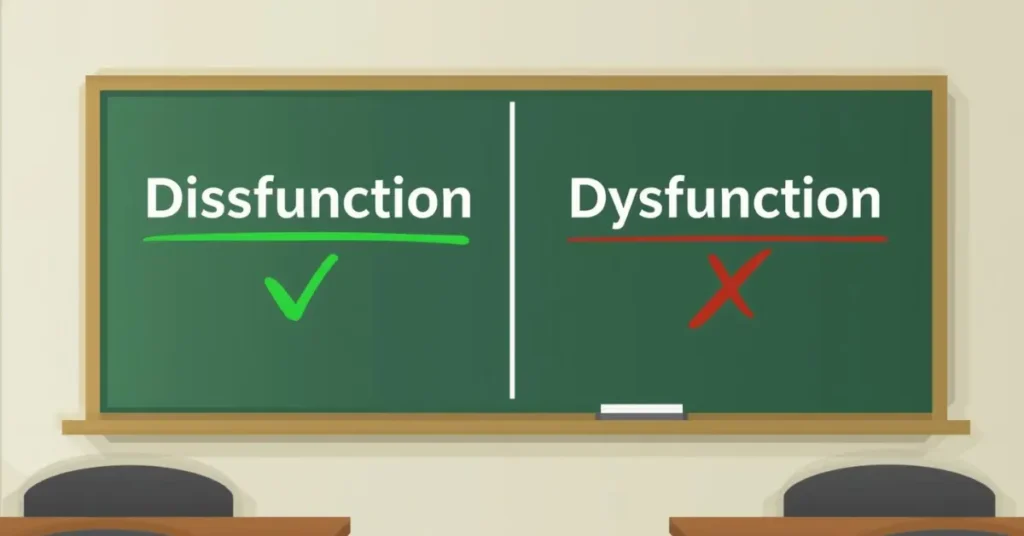
The correct spelling is “dysfunction.”
- Dysfunction (noun) → abnormal or impaired functioning of something, often used in medical, psychological, or social contexts.
Example: Chronic stress can cause sexual dysfunction. - Disfunction is generally considered incorrect in modern English and appears mostly as a misspelling.
Key Tip: Always choose dysfunction in professional and formal writing.
The Origin of Dysfunction
The word dysfunction comes from two Greek roots:
- “dys-” meaning bad, abnormal, or difficult
- “function” meaning performance or operation
It first appeared in English in the early 20th century to describe biological, psychological, or social issues. Over time, disfunction emerged as a misspelling, possibly by confusing the “dys-” prefix with “dis-” (which also means “not” or “opposite of”). However, dys- is the historically accurate prefix for medical and scientific terminology.
British English vs American English Spelling
Both British and American English use dysfunction. There is no variation in standard usage. The confusion arises when people mistakenly use disfunction.
| Feature | British English | American English |
| Correct spelling | dysfunction | dysfunction |
| Common misspelling | disfunction | disfunction |
| Usage in medical context | ✓ | ✓ |
| Usage in social context | ✓ | ✓ |
Tip: Always default to dysfunction, no matter the English variant.
Which Spelling Should You Use?
- United States: Use dysfunction in medical, professional, and everyday writing.
- United Kingdom & Commonwealth: Same recommendation, dysfunction is standard.
- Global Audience: If unsure, stick to dysfunction, as it is universally recognized.
Common Mistakes with Dysfunction
- Incorrect: The team suffers from poor disfunction.
Correct: The team suffers from poor dysfunction. - Incorrect: Disfunction of the heart is dangerous.
Correct: Dysfunction of the heart is dangerous. - Avoid replacing dys- with dis-; they have different historical and grammatical roots.
Dysfunction in Everyday Examples
- Email: “We need to address the dysfunction in our workflow immediately.”
- News article: “Researchers studied the dysfunction in the brain caused by sleep deprivation.”
- Social media: “Family dysfunction can affect mental health.”
- Formal writing: “Cardiovascular dysfunction is a leading cause of mortality worldwide.”
Dysfunction – Google Trends & Usage Data
- Popularity: Searches for dysfunction are higher than disfunction by a large margin.
- Countries: High search volume in the United States, United Kingdom, Canada, and Australia.
- Context: Commonly searched in health, psychology, and relationship-related topics.
Observation: Using disfunction may reduce credibility in content intended for a global audience.
Keyword Variations Comparison
| Variation | Correct? | Notes |
| dysfunction | ✅ | Standard, correct spelling |
| disfunction | ❌ | Considered incorrect or typo |
| dys-function | ✅ | Hyphenated form occasionally used |
| dis-function | ❌ | Rare and incorrect usage |
FAQs
1. Is “disfunction” ever correct?
No, it’s generally considered a misspelling of dysfunction.
2. Can “dysfunction” refer to anything other than medical issues?
Yes, it can describe social, organizational, or mechanical issues.
3. Why do people write “disfunction”?
Because “dis-” is a common prefix, people confuse it with the correct Greek-based “dys-.”
4. How do I remember the correct spelling?
Think: dys- = abnormal, function = performance → abnormal performance = dysfunction.
5. Is “dysfunction” used in UK English?
Yes, the spelling is identical to US English.
6. Can I hyphenate it as “dys-function”?
Rarely, and usually only in older texts. Standard usage is without a hyphen.
7. Does Google accept both spellings?
Google will show results for both, but “dysfunction” dominates search relevance and credibility.
Conclusion
In conclusion, dysfunction is the correct and universally accepted spelling, while disfunction is almost always a mistake. Its Greek roots give it credibility in medical, psychological, and social contexts. Both British and American English follow the same standard, making it easy to remember: always use dysfunction for professional, academic, or online content.
void the common trap of swapping dys- for dis-, and ensure your writing remains polished, credible, and universally understood. By understanding the origin, usage, and common errors, you can confidently write and speak without hesitation.