
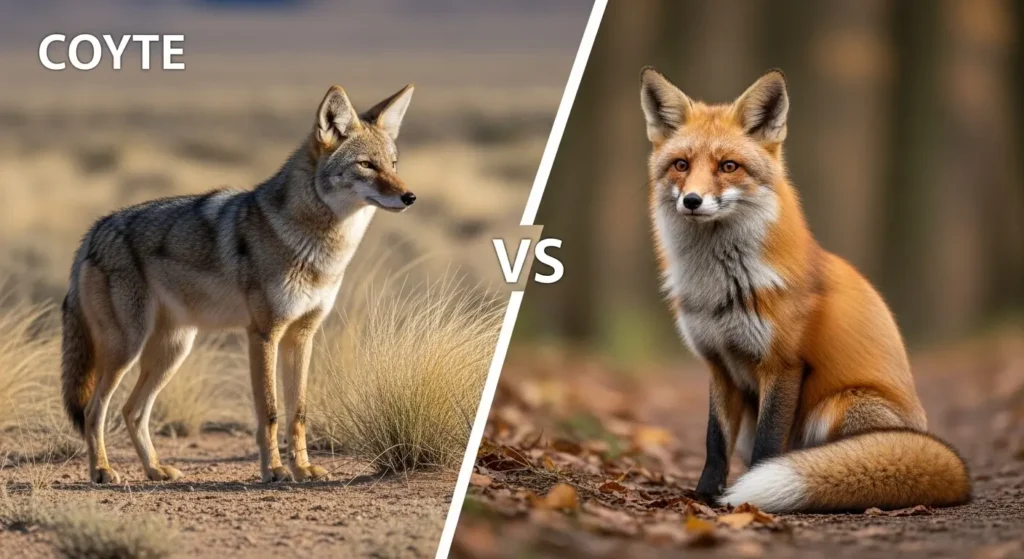
Have you ever spotted a wild animal at night and wondered, “Was that a coyote or fox?” This question is more common than you think. Many people search for coyote or fox because both animals look similar at first glance.
They are both canines, both have pointed ears, and both roam in the wild. But their size, behavior, and habitat are very different.
The keyword coyote or fox helps solve this confusion. People use it when they want a quick answer to identify an animal in their backyard, on a farm, or during a hike.
The phrase coyote or fox is also popular among wildlife lovers, photographers, and even pet owners concerned about safety. By understanding coyote or fox, you can quickly tell which animal you are dealing with and know how to react safely.
Coyote or Fox – Quick Answer
A coyote is larger, taller, and more aggressive than a fox.
- Coyotes look like lean wolves.
- Foxes are smaller, lighter, and have bushier tails.
Example:
- If the animal is big like a medium dog → likely a coyote.
- If it is small and cat-sized with a fluffy tail → likely a fox.
The Origin of Coyote or Fox
- Coyote comes from the Aztec word “coyotl.” Spanish settlers used it in North America.
- Fox comes from Old English “fox”, used for centuries in Europe.
There is no spelling confusion like British vs American English here. The difference is not in spelling but in species.
British English vs American English Spelling
Unlike words like “color” vs “colour,” coyote or fox has no spelling differences.
| Feature | American English | British English |
| Coyote | Coyote | Coyote |
| Fox | Fox | Fox |
| Difference | None | None |
Which Spelling Should You Use?
You can use coyote or fox the same way worldwide. There is no regional spelling change. Whether your audience is in the US, UK, or anywhere else, the words remain the same.
Common Mistakes with Coyote or Fox
Here are common errors people make:
- Mistake: Calling a fox a baby coyote
- Correction: Foxes are a different species
- Mistake: Thinking coyotes only live in deserts
- Correction: Coyotes live in cities, forests, and farms
- Mistake: Assuming foxes are always red
- Correction: Foxes can be gray, white, or black
Coyote or Fox in Everyday Examples
Email:
“I saw a coyote or fox near the farm last night. It looked too big to be a fox.”
News:
“Residents report increased sightings of coyotes in urban areas.”
Social Media:
“Spotted a fox today! So small and cute 🦊”
Formal Writing:
“The study compares behavioral patterns between coyotes and foxes in suburban regions.”
Coyote or Fox – Google Trends & Usage Data
The keyword coyote or fox is popular in countries like the United States, Canada, and parts of Europe.
- Searches increase in winter (more sightings).
- Farmers and hikers search it the most.
- Urban users search for it when animals appear in cities.
People usually search for this term when they want fast identification.
Comparison Table: Coyote vs Fox
| Feature | Coyote | Fox |
| Size | Large (dog-like) | Small (cat-like) |
| Weight | 7–20 kg | 2–7 kg |
| Tail | Less bushy | Very bushy |
| Behavior | Bold, social | Shy, solitary |
| Sound | Howls | High-pitched barks |
| Habitat | Cities, जंगल, deserts | Forests, fields |
| Danger Level | Moderate | Low |
FAQs
1. How can I tell a coyote or fox at night?
Look at size and movement. Coyotes are bigger and move like dogs. Foxes are smaller and quick.
2. Which is more dangerous, coyote or fox?
Coyotes are more dangerous. Foxes usually avoid humans.
3. Do coyotes and foxes live together?
Sometimes, but coyotes may chase foxes away.
4. Can a fox attack pets?
Rarely, only small pets. Coyotes are a bigger risk.
5. Are foxes friendly?
They look cute but are still wild animals.
6. Do both animals make noise?
Yes. Coyotes howl, foxes scream or bark.
7. Where are coyotes more common?
North America, especially the USA.
Conclusion
Understanding coyote or fox is simple once you know the key differences. Coyotes are larger, stronger, and more adaptable to cities and open land. Foxes are smaller, quieter, and prefer to stay hidden. While both animals belong to the same canine family, their behavior and appearance make them easy to tell apart with practice.
People search for coyotes or fox mainly to identify animals quickly and stay safe. This article helps solve that confusion by giving clear and simple explanations. Whether you are a hiker, farmer, or just curious, knowing the difference helps you react wisely.
In short, size, tail, and behavior are your best clues. The next time you see a wild canine, you’ll know exactly whether it’s a coyote or fox.

Hi, I’m Henry William, the author of GrammarTribe.com. I’m passionate about the English language and have dedicated my career to helping people master grammar, spelling, and effective writing. Over the years, I’ve guided learners, writers, and professionals in understanding common mistakes, tricky rules, and nuances of English grammar in a simple and easy-to-follow way.
Through GrammarTribe.com, I aim to make grammar approachable and enjoyable for everyone. My work focuses on providing clear explanations, practical tips, and examples that readers can apply in everyday writing, whether it’s emails, essays, social media, or professional documents. I believe that strong grammar skills empower people to communicate confidently and professionally.
When I’m not writing or researching grammar, I enjoy reading, exploring language trends, and creating educational content that simplifies complex concepts. I’m committed to helping my audience write better, understand English deeply, and avoid common pitfalls, all while making learning grammar a fun and rewarding journey.