
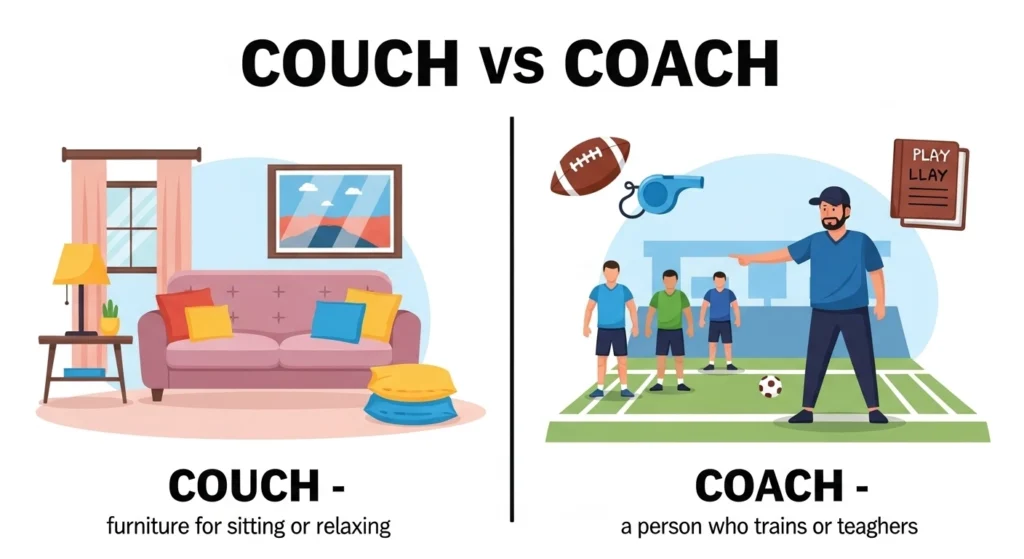
Have you ever typed “couch” when you actually meant “coach”? Or read a sentence and wondered why it didn’t make sense? This is a very common confusion in English. The words couch and coach look and sound similar, but they mean completely different things.
Many English learners, bloggers, and writers search for “couch or coach” because spelling mistakes can change the meaning of a sentence. Imagine writing “The football couch trained the team” — it sounds funny because the correct word should be coach.
Search engines show thousands of searches every month for this comparison because people want to know the correct spelling, meaning, and usage. Understanding the difference helps improve grammar, writing clarity, and professional communication.
In this guide, you will learn the quick difference between couch and coach, their history, British vs American usage, common mistakes, examples, and usage data. By the end, you will know exactly when to use each word confidently.
Couch or Coach – Quick Answer
The words couch and coach have different meanings.
| Word | Meaning | Example |
| Couch | A piece of furniture used for sitting or lying down | I slept on the couch. |
| Coach | A person who trains or teaches a team or individual | The coach trained the football team. |
Simple rule
- Couch = furniture
- Coach = trainer, teacher, or bus
Example Sentences
- She bought a new couch for the living room.
- The basketball coach gave helpful advice.
- The dog jumped on the couch.
- Our coach prepared us for the match.
The Origin of Couch or Coach
Origin of Couch
The word couch comes from the Old French word “couche”, meaning to lie down. It entered English in the 14th century and was used to describe furniture designed for resting.
Over time, it became a common word for a sofa or long seat used in homes.
Origin of Coach
The word coach has a very different history. It came from the Hungarian word “kocsi”, meaning a carriage or wagon from the village of Kocs in Hungary.
Later, the word evolved to mean:
- a carriage
- a train carriage
- a sports trainer
- a teacher or mentor
Today, coach is widely used in sports, education, and transportation.
British English vs American English Spelling
Interestingly, couch and coach are spelled the same in both British and American English. The confusion does not come from spelling differences but from similar pronunciation.
However, the usage context can differ slightly.
| Word | American English | British English | Meaning |
| Couch | Common | Less common (sofa often used) | Furniture |
| Coach | Common | Common | Trainer or bus |
Example
American English
- I bought a new couch.
British English
- I bought a new sofa.
But both countries still understand the word couch.
Which Spelling Should You Use?
Choosing between couch and coach depends entirely on meaning, not region.
Use couch when talking about:
- Furniture
- Living room seating
- A place to rest
Example
- Please sit on the couch.
Use coach when talking about:
- Sports trainers
- Teachers or mentors
- Buses or train compartments
Example
- The coach helped improve my skills.
Audience Advice
| Audience | Recommended Usage |
| US readers | Couch and coach are both standard |
| UK readers | Sofa is more common than couch |
| Global readers | Use couch for furniture, coach for trainer |
Common Mistakes with Couch or Coach
Many writers confuse these two words because they sound similar.
Mistake 1
❌ The football couch guided the players.
✔ The football coach guided the players.
Mistake 2
❌ I slept on the coach.
✔ I slept on the couch.
Mistake 3
❌ The team sat on the coach.
✔ The team sat on the couch.
Tip to Remember
Think of this trick:
Coach trains people.
Couch holds people.
Couch or Coach in Everyday Examples
Emails
- Please relax on the couch while you wait.
- Our coach will contact you about practice.
News
- The national coach announced the team lineup.
Social Media
- Movie night on the couch tonight! 🍿
- Our coach inspired us to win.
Formal Writing
- The coach provided strategic guidance for the players.
- The patient rested comfortably on the couch.
Couch or Coach – Google Trends & Usage Data
Search data shows that both words are popular but used in different contexts.
Couch
Most searches relate to:
- furniture
- home décor
- interior design
Popular countries searching for couch:
- United States
- Canada
- Australia
Coach
Search interest often relates to:
- sports coaching
- life coaching
- buses and transport
Popular countries searching for coach:
- United States
- United Kingdom
- India
Usage Comparison
| Word | Main Context | Popular Searches |
| Couch | Furniture | couch vs sofa |
| Coach | Sports/transport | life coach meaning |
Comparison Table: Couch vs Coach
| Feature | Couch | Coach |
| Word Type | Noun | Noun |
| Meaning | Furniture for sitting or lying | Trainer or instructor |
| Usage | Home furniture | Sports, teaching |
| Example | Sit on the couch | Talk to the coach |
FAQs
1. Is it couch or coach for furniture?
The correct word is couch. A couch is a piece of furniture used for sitting or lying down.
2. What does coach mean?
A coach is a person who trains or teaches others, especially in sports or personal development.
3. Why do people confuse couch and coach?
They look and sound similar, especially when spoken quickly.
4. Is couch American or British English?
The word couch is more common in American English, while sofa is often used in British English.
5. Can coach mean a bus?
Yes. In British English, coach can also mean a long-distance bus.
6. Is couch the same as sofa?
Yes, they are similar. Both refer to a long seat for multiple people.
7. How can I remember the difference?
Remember this simple rule:
Coach teaches.
Couch relaxes.
Conclusion
The difference between couch and coach is simple once you understand their meanings. A couch is a piece of furniture used for sitting or lying down, while a coach is a person who trains, teaches, or guides others. Although the two words look similar, they belong to completely different contexts.
The confusion usually happens because the words sound alike when spoken quickly. However, remembering the basic rule — couch for furniture and coach for trainer — makes it easy to use the correct word every time.
Both words are spelled the same in British and American English, but their usage varies slightly. Americans often say couch, while British speakers may prefer sofa. The word coach, however, is widely used in sports, education, and transport across English-speaking countries.
By understanding the meanings, origins, and examples shared in this guide, you can confidently choose the correct word in writing, conversation, emails, and professional communication.

I am James Wilson, an author at GrammarTribe.com, specializing in English grammar and clear communication.
I create expert, reliable content to help learners write with confidence and accuracy.