Many English learners and even native speakers often get confused between “calf” and “calve.” These two words look very similar, but they have completely different meanings and uses.
This confusion is common in writing, farming terms, biology, and even in everyday conversation. People search this keyword when they want to know whether they should use calf or calve in sentences about animals, muscles, or grammar rules.
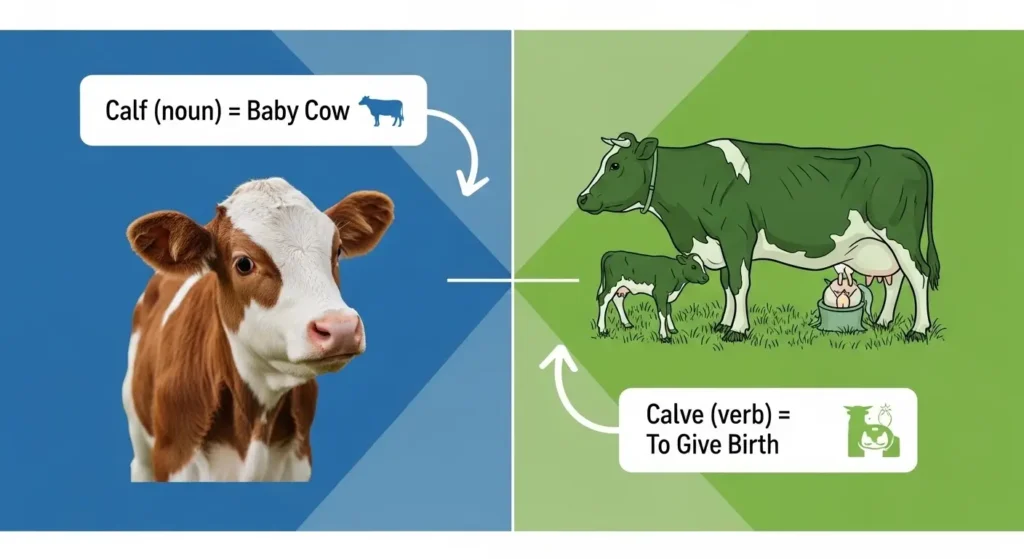
The word “calf” usually refers to a baby cow or the lower part of your leg. On the other hand, “calve” is a verb that means to give birth to a calf (used for cows and whales). Because they are spelled almost the same, many writers mix them up and create grammar mistakes.
This article will clear all confusion in a simple way. You will learn the correct meaning, origin, spelling differences, usage rules, and real-life examples. By the end, you will know exactly when to use calf and when to use calve without making errors.
Calf or Calve – Quick Answer
Calf is a noun. It means:
- A baby cow
- The back part of your lower leg
Example:
- The farmer bought a new calf.
- He hurt his calf while running.
Calve is a verb. It means:
- To give birth to a calf (cow or whale)
Example:
- The cow will calve in spring.
👉 Simple rule:
- Calf = thing (noun)
- Calve = action (verb)
The Origin of Calf and Calve
Skis or Skiis: Which Spelling Is Correct and Why It Matters?
The word “calf” comes from Old English “cealf,” meaning a young cow or animal. It has been used for hundreds of years in farming and animal care.
The verb “calve” comes from the same root but developed later in English to describe the action of giving birth. Over time, English created two forms:
- Calf (noun) = the baby animal
- Calve (verb) = the act of giving birth
This is why they look similar but work differently in grammar.
British English vs American English Spelling
Coyote or Fox: What’s the Real Difference
Good news: there is no spelling difference between British and American English for calf and calve.
Both regions use:
- Calf (noun)
- Calve (verb)
However, usage frequency can vary:
- Farming communities use calve more often
- General English uses calf more commonly in daily talk
Comparison Table
| Word | Type | Meaning | Example Sentence |
| Calf | Noun | Baby cow / lower leg muscle | The calf is running in the field |
| Calve | Verb | To give birth | The cow will calve soon |
Which Spelling Should You Use?
It depends on your audience:
- USA English: Use both correctly in farming, medical, or general writing
- UK English: Same rules apply
- Commonwealth countries (India, Pakistan, etc.): British-style usage is common
- Global writing: Use grammar context, not region
👉 Best rule: Focus on meaning, not region.
Common Mistakes with Calf or Calve
Many learners make these errors:
❌ The cow gave birth a calf
✔ The cow calved
❌ The cow will calf soon
✔ The cow will calve soon
❌ He injured his calve muscle
✔ He injured his calf muscle
👉 Remember:
- “Calf” = noun (thing)
- “Calve” = verb (action)
Calf or Calve in Everyday Examples
Farming Example:
- The cow is about to calve in the barn.
- The newborn calf is healthy.
Medical Example:
- He pulled a calf muscle during exercise.
News Example:
- The zoo reported a whale calving event.
Social Media Example:
- “Look at this cute baby calf 🐄”
Formal Writing:
- The herd will calve during the spring season.
Calf or Calve – Google Trends & Usage Data
Search behavior shows:
- “calf” is searched more often worldwide
- “calve” has lower but specialized search volume
- Most confusion comes from:
- Students
- ESL learners
- Farmers and veterinary learners
Top regions searching this keyword:
- United States
- India
- United Kingdom
- Pakistan
👉 Insight: Most users want grammar clarity, not farming knowledge.
Comparison Table: Calf vs Calve Variations
| Form | Type | Usage Area | Example |
| Calf | Noun | Animal/Body part | Baby cow / leg muscle |
| Calve | Verb | Animal birth | Cow will calve soon |
| Calves | Plural | Multiple calves | The calves are grazing |
| Calving | Verb form | Process | The cow is calving |
FAQs
1. What is the difference between calf and calve?
Calf is a noun. Calve is a verb.
2. Is the calf used for human body parts?
Yes, calf means the back part of your lower leg.
3. Can we say “cow calves a baby”?
No. The correct form is “cow calves.”
4. Is calve a real English word?
Yes, it is a verb used in animal birth contexts.
5. What is the plural of calf?
The plural is calves.
6. Is calve used in medical writing?
Yes, but mostly in veterinary science.
7. Why do people confuse calf and calve?
Because they look and sound similar but have different grammar roles.
Conclusion
The confusion between calf and calve is very common, but now it is easy to understand. The word calf is always a noun. It refers to a baby cow or the lower part of the leg. The word calve is always a verb. It describes the action of giving birth in animals like cows and whales.
The key to mastering these words is simple: focus on grammar, not spelling similarity. If you see a thing or object, use a calf. If you see an action, use a calve. This rule works in all types of English writing, including academic, farming, and everyday communication.
By learning this difference, you can avoid one of the most common English mistakes and write more clearly and professionally. Keep practicing with examples, and soon it will become natural. Correct usage improves both writing confidence and communication skills in any context.

Hi, I’m Henry William, the author of GrammarTribe.com. I’m passionate about the English language and have dedicated my career to helping people master grammar, spelling, and effective writing. Over the years, I’ve guided learners, writers, and professionals in understanding common mistakes, tricky rules, and nuances of English grammar in a simple and easy-to-follow way.
Through GrammarTribe.com, I aim to make grammar approachable and enjoyable for everyone. My work focuses on providing clear explanations, practical tips, and examples that readers can apply in everyday writing, whether it’s emails, essays, social media, or professional documents. I believe that strong grammar skills empower people to communicate confidently and professionally.
When I’m not writing or researching grammar, I enjoy reading, exploring language trends, and creating educational content that simplifies complex concepts. I’m committed to helping my audience write better, understand English deeply, and avoid common pitfalls, all while making learning grammar a fun and rewarding journey.