
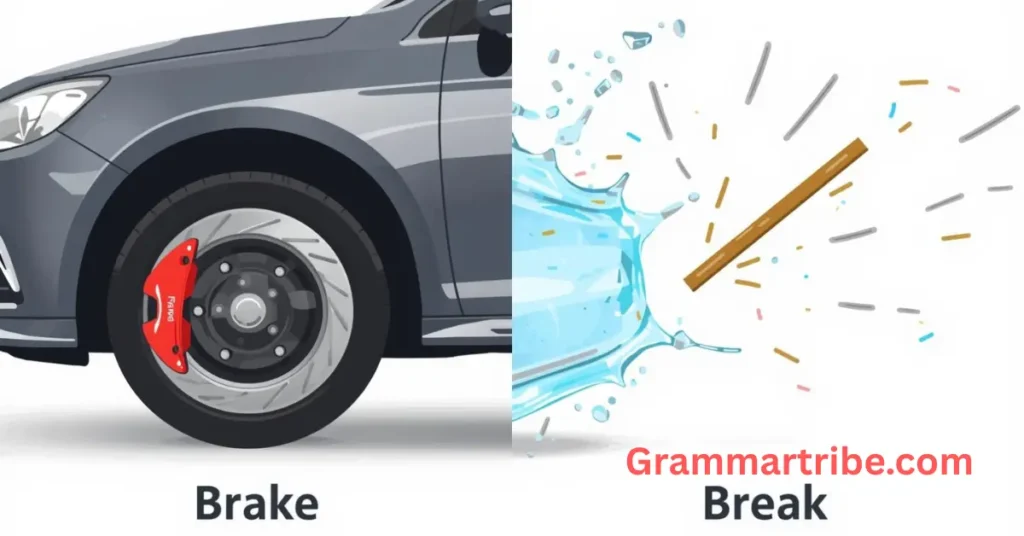
Many people get confused between “brake” and “break” because they sound the same but have completely different meanings. This common mistake can make your writing unclear, whether in emails, schoolwork, or social media posts. Knowing the difference is crucial for clear communication.
Brake is usually a noun or verb related to stopping a vehicle or motion, while break refers to separating something, causing damage, or taking a pause. People often search “brake or break” to quickly understand which word fits their sentence and avoid embarrassing errors.
This guide will clarify the difference, provide examples, compare British and American usage, and give practical advice on proper spelling.
By the end of this article, you’ll confidently know which word to use in any situation and learn tips to avoid common mistakes.
Brake or Break – Quick Answer
- Brake → To slow down or stop something. Example: “Please brake before the intersection.”
- Break → To separate into pieces, damage, or take a pause. Example: “Be careful not to break the glass.”
Quick Tip: If it relates to stopping, use brake. If it relates to damage or a pause, use break.
The Origin of Brake and Break
- Brake comes from Middle English brak, meaning “a device for slowing a vehicle.”
- Break comes from Old English brecan, meaning “to shatter or separate.”
- Despite sounding the same, their spellings have diverged due to their different meanings and historical roots.
British English vs American English Spelling
Both brake and break are spelled the same in British and American English, but context matters. There’s no variation in spelling for this pair—unlike words such as “colour/ color” or “centre/ center.”
| Word | Meaning | Example (UK) | Example (US) |
| Brake | Stop or slow down | Brake before the roundabout. | Brake before the intersection. |
| Break | Damage, separate, pause | Don’t break the vase. | Don’t break the vase. |
Which Spelling Should You Use?
- Use based on meaning, not region.
- Brake → Always used when referring to stopping something (vehicle or motion).
- Break → Used for damage, separating objects, or taking a pause.
- Whether you write for a US, UK, or global audience, the meaning drives the correct spelling.
Common Mistakes with Brake and Break
- “I need to break the car!” ❌ → Correct: “I need to brake the car!”
- “She braked her leg during the hike.” ❌ → Correct: “She broke her leg during the hike.”
- Mixing up the words in idioms: “Take a brake” ❌ → Correct: “Take a break.”
Tip: If it involves stopping motion → brake. If it involves damage or pause → break.
Brake or Break in Everyday Examples
- Emails: “Let’s take a short break before the meeting.”
- News: “The driver failed to brake in time, causing an accident.”
- Social media: “Don’t break your phone by dropping it!”
- Formal writing: “The company will break its contract if terms aren’t met.”
Brake or Break – Google Trends & Usage Data
- Searches for “brake or break” spike during school terms and exams.
- Countries with high searches: United States, United Kingdom, Canada, Australia.
- People mostly look for clarification in writing and texting.
| Keyword Variation | Popularity (Global) |
| Brake | Medium |
| Break | High |
| Brake or break | Very High |
FAQs
1. Can you use brake and break interchangeably?
No. Brake is for stopping motion; break is for damage, separation, or a pause.
2. What is the easiest way to remember the difference?
Think: Brake → stop; Break → damage/pause.
3. Is “take a brake” correct?
No. Correct phrase: “take a break.”
4. Can brake be used as a noun?
Yes. Example: “The car’s brakes need checking.”
5. Why do they sound the same?
They are homophones—words that sound alike but have different meanings and spellings.
6. Which is more common in writing?
“Break” is more frequent because it appears in everyday language, idioms, and news.
7. Does British vs American English change the meaning?
No. Both words have the same meaning across English variants; context is key.
Conclusion
Understanding brake vs break is simple once you know their meanings. Brake always involves stopping motion, especially vehicles, while break refers to damage, separation, or taking a pause. By focusing on context rather than trying to memorize rules, you can avoid common mistakes in emails, essays, and social media posts.
Whether you are writing for a US or UK audience, clarity comes from using the correct word, not changing spelling. Remember: Brake → stop; Break → damage/pause. Practicing this distinction will improve your writing, make communication clearer, and prevent embarrassing errors.

Hi, I’m Henry William, the author of GrammarTribe.com. I’m passionate about the English language and have dedicated my career to helping people master grammar, spelling, and effective writing. Over the years, I’ve guided learners, writers, and professionals in understanding common mistakes, tricky rules, and nuances of English grammar in a simple and easy-to-follow way.
Through GrammarTribe.com, I aim to make grammar approachable and enjoyable for everyone. My work focuses on providing clear explanations, practical tips, and examples that readers can apply in everyday writing, whether it’s emails, essays, social media, or professional documents. I believe that strong grammar skills empower people to communicate confidently and professionally.
When I’m not writing or researching grammar, I enjoy reading, exploring language trends, and creating educational content that simplifies complex concepts. I’m committed to helping my audience write better, understand English deeply, and avoid common pitfalls, all while making learning grammar a fun and rewarding journey.