Many English learners and even native speakers get confused between “below” and “bellow.” They look similar, sound slightly alike, and are often mistyped in emails, assignments, and online writing. This confusion leads people to search for “below or bellow” to understand which spelling is correct and when to use each word.
The truth is simple: these are two completely different words with different meanings. “Below” is used for position, level, or ranking. “Bellow” means to shout loudly or a deep roar sound. Mixing them can change the meaning of your sentence entirely.
This article clears all confusion in a simple way. You will learn the correct usage, origin, spelling differences, common mistakes, and real-life examples. By the end, you will confidently know when to use “below” and when “bellow” is correct. Let’s make this confusion easy forever.
Below or Bellow – Quick Answer
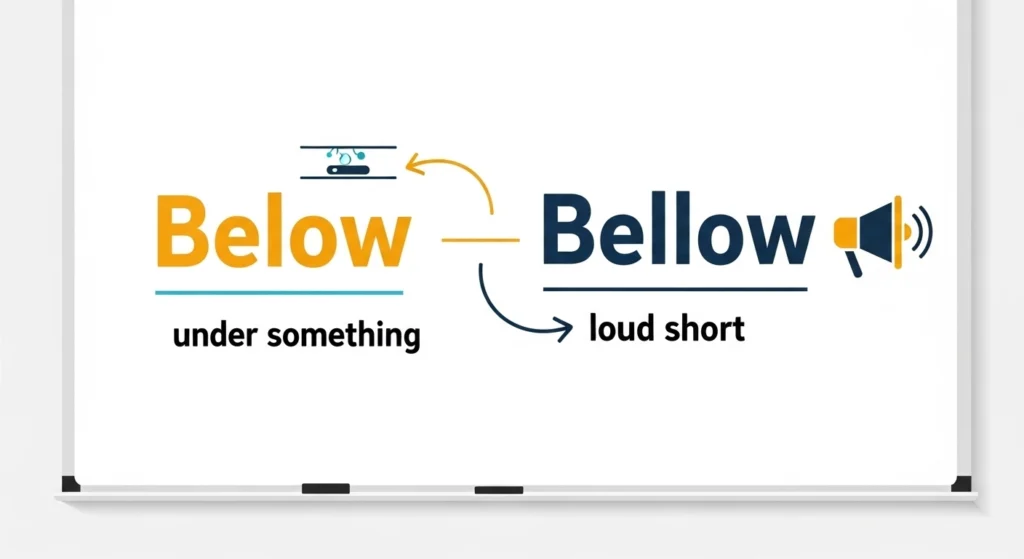
“Below” and “bellow” are not spelling variations of the same word. They are two separate words.
- Below → means “under,” “lower than,” or “less than.”
- Example: The temperature is below 10°C.
- Bellow → means “to shout loudly” or “a deep roar.”
- Example: The lion bellowed in the jungle.
👉 Quick trick:
If it’s about position or level → below
If it’s about sound or shouting → bellow
The Origin of Below or Bellow
The word “below” comes from Old English “bi lowe”, meaning “by the lower place.” Over time, it became “below,” used to describe something at a lower position or rank.
The word “bellow” comes from Old Norse “belja”, meaning “to roar or shout.” It was used to describe loud animal sounds, especially cattle and lions.
Even though they look similar, they evolved from completely different language roots. That’s why their meanings are unrelated, even if spelling confuses learners today.
British English vs American English Spelling
Unlike words such as “colour/color,” below and bellow do NOT have British or American spelling differences. Both English forms use the same spellings.
Comparison Table
| Word Type | British English | American English | Meaning |
| Below | below | below | lower than / under |
| Bellow | bellow | bellow | loud shout / roar |
👉 Key point: No spelling variation exists between UK and US English for these words.
Steer or Stear: Correct Spelling, Meaning, and Easy Guide?
Which Spelling Should You Use?
Your choice depends only on meaning, not region:
- If you are writing about position, ranking, or temperature, use below.
- If you are describing sound, shouting, or animal noise, use bellow.
Simple Guide:
- Academic writing → below (almost always)
- Creative writing → both (depending on context)
- Storytelling → bellow (for dramatic sound effects)
Below or Bellow in Everyday Examples
Emails:
- Please see the details below.
- (Not: Please see the details bellow ❌)
News Writing:
- Temperatures dropped below freezing.
- The leader bellowed during the speech.
Social Media:
- Drop your comments below 👇
- The coach bellowed at the referee during the match.
Formal Writing:
- Refer to the section below for more information.
- The lion bellowed across the valley.
Skied or Skiied: Which Spelling Is Correct and Why?
Below or Bellow – Google Trends & Usage Data
Search behavior shows that:
- “Below or bellow” is mostly searched by students and ESL learners.
- Highest search volume comes from countries like India, Pakistan, Bangladesh, and Nigeria.
- The confusion increases during exams, essay writing, and email learning.
- “Below” is far more commonly used in academic and professional writing.
- “Bellow” appears mainly in literature and storytelling content.
👉 Insight: Most users search this keyword to confirm spelling accuracy in formal writing.
Comparison Table: Below vs Bellow
| Feature | Below | Bellow |
| Part of Speech | Preposition / Adverb | Verb / Noun |
| Meaning | Lower position | Loud shout / roar |
| Usage Context | Academic, formal | Storytelling, expressive |
| Example | Below the line | Lion bellowed loudly |
| Frequency | Very common | Less common |
FAQs
1. Is it “below” or “bellow” the table?
Correct: below the table
2. What does “bellow” mean?
It means to shout loudly or make a deep roaring sound.
3. Is “below” only used for position?
No, it is also used for rank, level, and quantity.
4. Can “bellow” be used in formal writing?
Rarely. It is mostly used in creative or descriptive writing.
5. Why do people confuse below and bellow?
Because they look similar and sound slightly alike.
6. Are they British or American spelling differences?
No, both words are spelled the same in all English varieties.
7. Which word is more common?
“Below” is far more common in everyday English.
Conclusion
The confusion between “below” and “bellow” is very common, but once you understand their meanings, it becomes easy to avoid mistakes .“Below” is used for anything related to position, level, or ranking. “Bellow” is used for loud sounds, shouting, or animal roars. These words are not spelling variations, they are completely different in meaning and origin.
There is no British or American spelling difference, so your choice depends only on context. If you are writing academic, professional, or everyday content, you will mostly use “below.” “Bellow” appears mainly in storytelling or expressive writing.
By remembering the simple rulebelow = location, bellow = soundyou can avoid confusion forever. Always double-check your sentence’s meaning before writing, and you will never mix them again.

Hi, I’m Henry James, the author behind GrammarTribe.com. I’m passionate about the English language and specialize in grammar, helping readers understand complex rules in a simple, clear way. Over the years, I’ve dedicated myself to creating content that makes learning grammar practical, fun, and accessible for everyone. If you’re a student, professional, or language enthusiast.
Through GrammarTribe.com, I share tips, guides, and examples to help people write confidently and correctly. My goal is to make grammar less intimidating and more useful in everyday writing, emails, social media, and professional communication. Writing and teaching grammar isn’t just my profession — it’s my passion.
When I’m not writing, I enjoy reading, exploring language trends, and discovering new ways to make English learning engaging and easy. My mission is to empower readers to communicate clearly and confidently, one grammar tip at a time.