Confused between bare and bear? You’re not alone. Many English learners and even native speakers struggle with these two words because they sound the same but have completely different meanings.
Using the wrong one can change the meaning of a sentence entirely imagine telling someone to “bear your soul” versus “bare your soul”! This guide explains the difference, shows correct usage in everyday situations, and provides tips for British and American English spelling.
People often search for “bare or bear” to clarify spelling mistakes, improve writing, or understand idiomatic expressions. If you’re writing emails, school essays, or social media posts, knowing the right word will make your communication precise and professional. By the end of this article, you’ll confidently know when to use bare and when to use bear, avoiding common pitfalls that confuse even seasoned writers.
Bare or Bear – Quick Answer
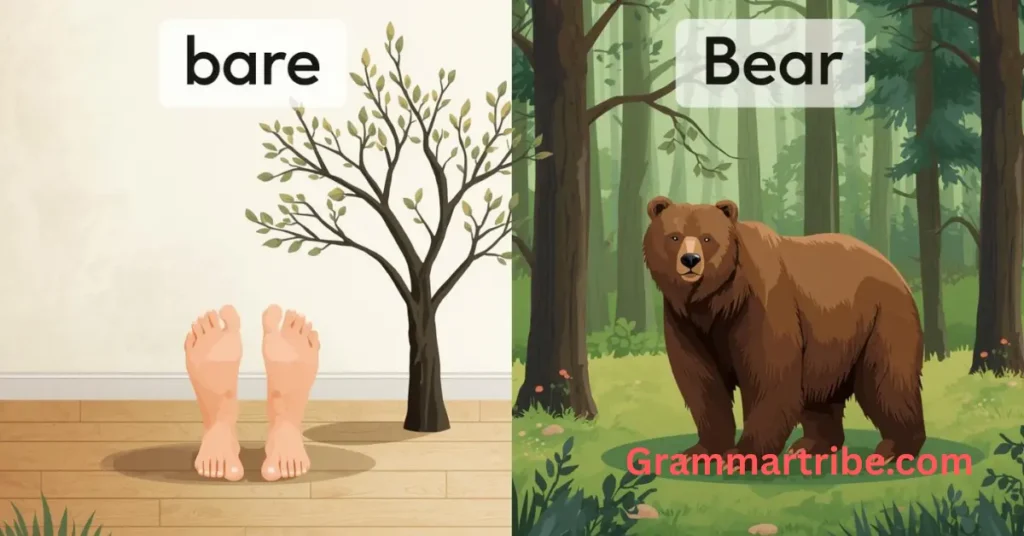
- Bare → means uncovered, empty, or exposed.
Example: He walked on the bare floor without shoes. - Bear → means to carry, endure, or refers to the animal.
Example: She couldn’t bear the pain. or A bear roamed the forest.
Quick tip: Bare = exposed / Bear = carry or endure (or the animal).
The Origin of Bare or Bear
- Bare comes from Old English bær, meaning uncovered or naked.
- Bear comes from Old English bera, meaning the animal, and from beran, meaning to carry or endure.
The confusion arises because over centuries, pronunciation stayed similar while spelling and meaning diverged. English homophones like these are common, making context essential for correct usage.
Read more; Supercede or Supersede – Which Spelling Is Correct?
British English vs American English Spelling
Interestingly, bare and bear are spelled the same in both British and American English. There’s no difference in spelling, but some usage differences can occur with idioms.
| Word | Meaning | Example (UK) | Example (US) |
| Bare | Exposed, empty | His feet were bare. | His feet were bare. |
| Bear | Carry, endure, animal | I cannot bear this noise. | I cannot bear this noise. |
| Bear | Animal | A bear appeared near the campsite. | A bear appeared near the campsite. |
Tip: Focus on context rather than geography for correct usage.
Which Spelling Should You Use?
- For both UK and US audiences, spelling is consistent.
- Ensure bare is used for physical exposure or emptiness.
- Ensure bear is used for endurance, responsibility, or the animal.
- For global audiences, the same rules apply; clarity is key.
Common Mistakes with Bare or Bear
- Incorrect: I can’t bare this noise.
Correct: I can’t bear this noise. - Incorrect: He decided to bear his feet on the floor.
Correct: He decided to bare his feet on the floor. - Incorrect: The bear floor was cold.
Correct: The bare floor was cold. - Incorrect: She bore the gift from her friend. (if meaning exposed)
Correct: She bore the responsibility from her friend.
Bare or Bear in Everyday Examples
Emails:
- Please bare with me while I review the document. ❌ → Please bear with me while I review the document. ✅
News Headlines:
- The polar bear population is declining in the Arctic. ✅
- Workers bare their concerns to the manager. ✅
Social Media:
- I can’t bear Monday mornings! ✅
- She went barefaced today! ✅
Formal Writing:
- Students must bear the responsibility of completing assignments on time. ✅
- The room was bare of furniture. ✅
Bare or Bear – Google Trends & Usage Data
- Searches peak in English-speaking countries: US, UK, Canada, Australia.
- Bear is more common in idiomatic expressions (bear the burden, bear witness).
- Bare often appears in lifestyle and fashion contexts (bare feet, bare walls).
- Global usage data shows rising confusion among students and online writers, which explains the frequent searches for this topic.
Keyword Variations Comparison
| Variation | Meaning | Example |
| Bare | Exposed, empty | Bare hands, bare walls |
| Bear | Endure, carry | Bear the pain, bear responsibility |
| Bear | Animal | A bear in the forest |
FAQs
1. Can I use bare instead of bear?
No, they have different meanings. Bare = exposed, Bear = endure/carry/animal.
2. Is bear a verb or a noun?
It can be both. Verb: I can’t bear the noise. Noun: A bear in the forest.
3. Is bare used in idioms?
Yes, e.g., bare your soul, meaning to reveal your true feelings.
4. Are bare and bear pronounced the same?
Yes, they are homophones. Context determines meaning.
5. Which is more common in writing?
Both are common; it depends on context. Bear appears more in figurative or idiomatic language.
6. Can bare refer to animals?
No, only bear refers to the animal.
7. Can bear mean something positive?
Yes, as in bear fruit, meaning produce results.
Conclusion
Understanding the difference between bare and bear is essential for clear, professional communication. Bare refers to exposure, emptiness, or physical nudity, while bear can mean to endure, carry, or refer to the animal. Both words are spelled the same in British and American English, so context is your guiding tool. Avoid common mistakes by remembering: bare = uncovered, bear = endure or the animal.
In emails, social media posts, formal writing, or news articles, correct usage enhances clarity and prevents confusion. Using these words accurately also demonstrates mastery of English idioms and writing precision. By keeping this guide handy, you’ll never mix up bare and bear again, whether writing for school, work, or global audiences.

Hi, I’m Henry James, the author behind GrammarTribe.com. I’m passionate about the English language and specialize in grammar, helping readers understand complex rules in a simple, clear way. Over the years, I’ve dedicated myself to creating content that makes learning grammar practical, fun, and accessible for everyone. If you’re a student, professional, or language enthusiast.
Through GrammarTribe.com, I share tips, guides, and examples to help people write confidently and correctly. My goal is to make grammar less intimidating and more useful in everyday writing, emails, social media, and professional communication. Writing and teaching grammar isn’t just my profession — it’s my passion.
When I’m not writing, I enjoy reading, exploring language trends, and discovering new ways to make English learning engaging and easy. My mission is to empower readers to communicate clearly and confidently, one grammar tip at a time.