Do you ever get confused when writing authorised or authorized? Many people wonder which spelling to use, especially in professional emails, legal documents, or academic writing.
The confusion comes from differences between British English and American English, and even seasoned writers often make mistakes. Choosing the right spelling is important to maintain credibility and avoid appearing careless.
This article will clarify the difference between authorised and authorized, explain the history behind these spellings, show practical examples, and help you decide which form to use based on your audience. By the end, you’ll confidently know when to use each spelling, prevent common errors, and improve your writing in both casual and formal contexts.
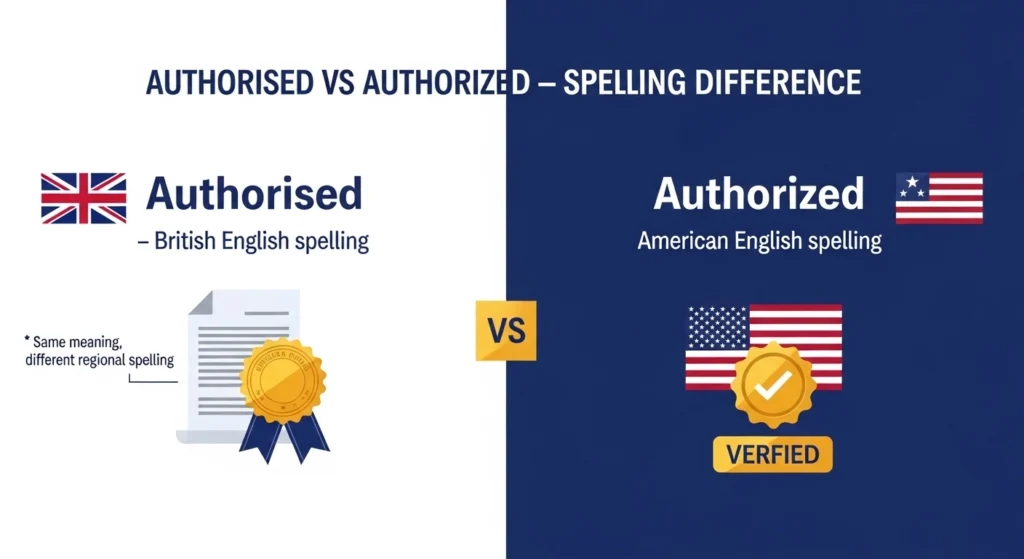
Authorised or Authorized – Quick Answer
The difference is simple:
- Authorised → British English spelling
- Authorized → American English spelling
Example sentences:
- British English: “Only authorised personnel may enter this room.”
- American English: “Only authorized personnel may enter this room.”
Both mean the same thing: someone has official permission or approval.
The Origin of Authorised/Authorized
The word authorize comes from the Latin word auctorizare, meaning “to give authority or permission.” Over time, English adopted the spelling with -ize, which is standard in American English.
In the UK, the Oxford English Dictionary prefers -ise endings (authorise, organise, realise), although -ize is technically correct in formal British writing. The variation grew from historical preferences in printing and education between the US and UK.
British English vs American English Spelling
The main difference is the -ise vs -ize ending:
| Feature | British English | American English |
| Spelling | Authorised | Authorized |
| Common Examples | Organise, Realise, Recognise | Organize, Realize, Recognize |
| Usage Context | UK, Australia, Canada, New Zealand | USA, Philippines, some international companies |
| Formal Preference | -ise often preferred in UK style guides | -ize standard in US style guides |
Which Spelling Should You Use?
- Use “authorised” if your audience is primarily in the UK, Australia, New Zealand, or Commonwealth countries.
- Use “authorized” for American readers or US-based companies.
- For global audiences, either spelling works, but consider consistency in the same document.
Common Mistakes with Authorised/Authorized
- Mixing UK and US spelling in one document:
❌ The document was authorized by the authorised manager.
✅ The document was authorized by the authorized manager. (US consistency) - Confusing similar words:
❌ He authorise the event yesterday.
✅ He authorised the event yesterday. - Forgetting proper tense or agreement: Always match spelling with verb form.
Authorised/Authorized in Everyday Examples
Emails:
- “Please ensure all authorised signatures are collected before submission.”
News Articles:
- “The authorized dealer confirmed the product’s authenticity.”
Social Media:
- “Only authorised users can access this feature.”
Formal Writing:
- “The committee authorized the new policy after thorough review.”
Authorised or Authorized – Google Trends & Usage Data
- Authorized dominates in the US and countries using American English influence.
- Authorisation is more common in the UK, Australia, and New Zealand.
- Google Trends shows spikes in searches for “authorised vs authorized” around exams, legal discussions, and professional writing queries.
Keyword Comparison Table
| Keyword | Region | Meaning | Example |
| Authorised | UK/Commonwealth | Given permission | “Authorised personnel only.” |
| Authorized | US | Given permission | “Authorized personnel only.” |
FAQs
1. Are authorised and authorized the same?
Yes, they mean the same thing; the difference is only regional spelling.
2. Which is correct in UK English?
“Authorised” is preferred in UK English.
3. Which is correct in US English?
“Authorized” is standard in US English.
4. Can I mix the spellings in one document?
No, keep your spelling consistent for professionalism.
5. Is -ize ever acceptable in UK English?
Yes, some UK style guides accept “-ize,” but “-ise” is more common.
6. How do I remember which to use?
Think “s” for British spelling and “z” for American.
7. Is there a difference in meaning?
No, meaning stays the same across regions.
Conclusion
Understanding the difference between authorised and authorized is essential for clear and professional writing. While the meaning remains identical, spelling varies by region: -ise endings suit British English readers, and -ize endings suit American audiences. Consistency matters mixing them in one document can confuse readers or appear careless.
By following these simple rules and checking your audience, you can confidently use the correct spelling in emails, reports, news articles, or social media. Remember, this small detail can enhance credibility and ensure your writing resonates with readers worldwide.

Hi, I’m Henry William, the author of GrammarTribe.com. I’m passionate about the English language and have dedicated my career to helping people master grammar, spelling, and effective writing. Over the years, I’ve guided learners, writers, and professionals in understanding common mistakes, tricky rules, and nuances of English grammar in a simple and easy-to-follow way.
Through GrammarTribe.com, I aim to make grammar approachable and enjoyable for everyone. My work focuses on providing clear explanations, practical tips, and examples that readers can apply in everyday writing, whether it’s emails, essays, social media, or professional documents. I believe that strong grammar skills empower people to communicate confidently and professionally.
When I’m not writing or researching grammar, I enjoy reading, exploring language trends, and creating educational content that simplifies complex concepts. I’m committed to helping my audience write better, understand English deeply, and avoid common pitfalls, all while making learning grammar a fun and rewarding journey.