
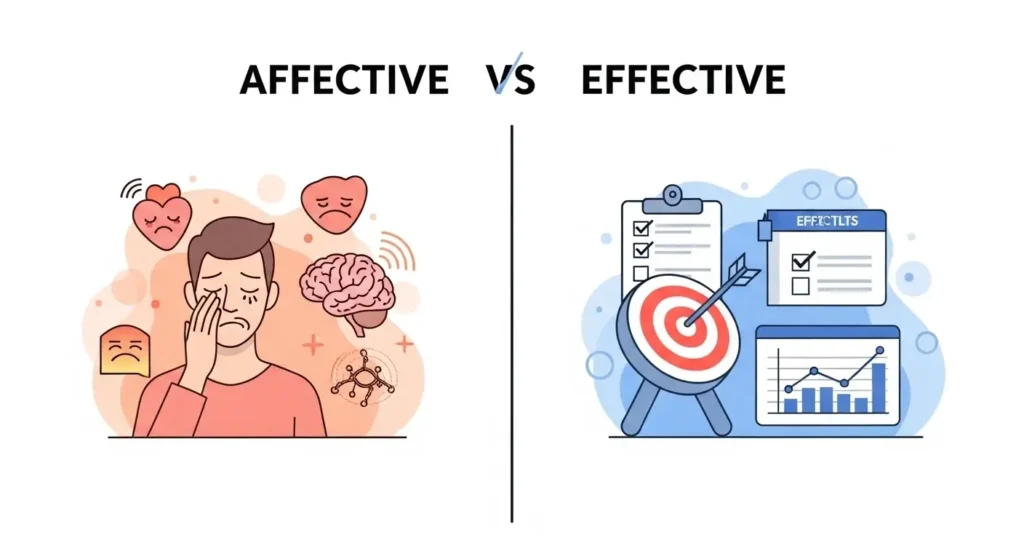
Many English learners get confused between “affective or effective” because both words look similar but mean completely different things. This confusion often leads people to search for “affective or effective” when writing emails, assignments, or professional documents.
In reality, these two words are not interchangeable, and using the wrong one can change the entire meaning of a sentence.
For example, saying “The medicine is effective” means it works well, while “The medicine is affective” is usually incorrect in most contexts and refers to emotions rather than results. This is why understanding affective or effective is important for students, writers, job seekers, and professionals. Many people search for affective or effective to avoid grammar mistakes, improve writing clarity, and sound more professional in communication.
The confusion mainly happens because both words come from similar Latin roots and are pronounced almost the same. However, their meanings are very different. One relates to emotions, while the other relates to results or success. This article will clearly explain the difference between affective or effective, when to use each, and how to avoid common mistakes.
Affective or Effective – Quick Answer
Effective means something produces a result or works successfully.
Affective relates to emotions, feelings, or emotional response.
Examples:
- The new teaching method is effective. (It works well)
- Her speech was affective, making people emotional. (It affects emotions)
👉 In simple terms:
- Effective = result-based
- Affective = emotion-based
The Origin of Affective or Effective
Both words come from Latin roots:
- Effective comes from Latin effectivus, meaning “producing results.”
- Affective comes from Latin affectus, meaning “feeling or emotion.”
Over time, English adopted both words but kept their meanings separate. However, because they look and sound similar, learners often mix them up. This is especially common in writing, where small spelling differences can completely change meaning.
British English vs American English Spelling
Unlike words such as “colour/color,” affective and effective do NOT differ in UK and US spelling. They are spelled the same in both English types. The confusion is purely based on meaning, not region.
Comparison Table
| Word | Meaning (UK & US) | Usage Type | Example |
| Effective | Producing results | Performance/result | The plan is effective |
| Affective | Related to emotion | Psychology/emotion | The film was affective |
Which Spelling Should You Use?
There is no regional spelling difference, so the choice depends on meaning:
- Use effective in business, education, and technical writing when talking about results.
- Use affective in psychology, literature, or emotional contexts.
Advice:
- US writers → Use both correctly based on meaning
- UK/Commonwealth → Same rule applies
- Global English → Focus on clarity, not region
Common Mistakes with Affective or Effective
❌ The medicine is affective (wrong in most cases)
✔ The medicine is effective
❌ This strategy is affective for sales
✔ This strategy is effective for sales
❌ The system is very effective emotionally
✔ The system has an affective impact
Most mistakes happen when people assume both words mean “good” or “powerful.”
Affective or Effective in Everyday Examples
Emails:
- “This solution is highly effective for reducing errors.”
News Writing:
- “The policy was effective immediately after approval.”
Social Media:
- “That movie was so affective, I cried.”
Formal Writing:
- “The treatment plan proved effective in patient recovery.”
Affective or Effective – Google Trends & Usage Data
- Effective is far more popular globally.
- It is widely used in business, education, healthcare, and technology.
- Affective is less common and mostly used in psychology, emotional studies, and literature.
Country Usage Insight:
- USA → High usage of “effective” in business writing
- UK → Similar pattern
- South Asia → Frequent confusion between both words
- Academic fields → “affective” used in psychology studies
Comparison Table: Affective vs Effective
| Feature | Effective | Affective |
| Meaning | Produces results | Related to emotions |
| Usage | Business, education | Psychology, feelings |
| Popularity | Very high | Low |
| Example | Effective plan | Affective response |
FAQs
1. What is the main difference between affective and effective?
Effective means producing results; affective relates to emotions.
2. Can I use affective instead of effective?
No, they are not interchangeable.
3. Which word is more common?
Effective is much more commonly used.
4. Is affective only used in psychology?
Mostly yes, especially in emotional and behavioral studies.
5. Why do people confuse these words?
Because they look and sound similar.
6. Is effective used in formal writing?
Yes, it is widely used in all formal contexts.
7. Does spelling change in UK and US English?
No, spelling is the same in both.
Conclusion
Understanding the difference between affective or effective is important for clear and professional English writing. While both words come from similar roots and sound alike, their meanings are completely different. Effective is used when something produces a result or works well, while affective is used when discussing emotions or feelings. Many learners confuse these words, but once you remember the simple rules vs emotions the difference becomes easy.
In academic writing, business communication, and everyday English, using the correct word improves clarity and prevents misunderstandings. Whether you are a student, writer, or professional, mastering affective or effective helps you communicate more confidently and accurately. Always double-check your sentence’s meaning before choosing between the two words.

Hi, I’m Henry William, the author of GrammarTribe.com. I’m passionate about the English language and have dedicated my career to helping people master grammar, spelling, and effective writing. Over the years, I’ve guided learners, writers, and professionals in understanding common mistakes, tricky rules, and nuances of English grammar in a simple and easy-to-follow way.
Through GrammarTribe.com, I aim to make grammar approachable and enjoyable for everyone. My work focuses on providing clear explanations, practical tips, and examples that readers can apply in everyday writing, whether it’s emails, essays, social media, or professional documents. I believe that strong grammar skills empower people to communicate confidently and professionally.
When I’m not writing or researching grammar, I enjoy reading, exploring language trends, and creating educational content that simplifies complex concepts. I’m committed to helping my audience write better, understand English deeply, and avoid common pitfalls, all while making learning grammar a fun and rewarding journey.