English learners, writers, and even native speakers often get confused between whose and who’s. It’s one of the most commonly searched grammar questions online. Using the wrong word can change the meaning of a sentence or make your writing look unprofessional.
The confusion comes from the fact that who’s sounds exactly like whose, but they are used differently. Whose is a possessive word, showing ownership, while who’s is a contraction for who is or who has. Misusing them is a common mistake in emails, social media posts, and formal writing.
This article will help you quickly understand the difference, show real-life examples, highlight common mistakes, and give audience-based advice for using the correct form. By the end, you’ll be able to confidently choose between whose or who’s in any context, whether writing for school, work, or online content.
Whose or Who’s – Quick Answer
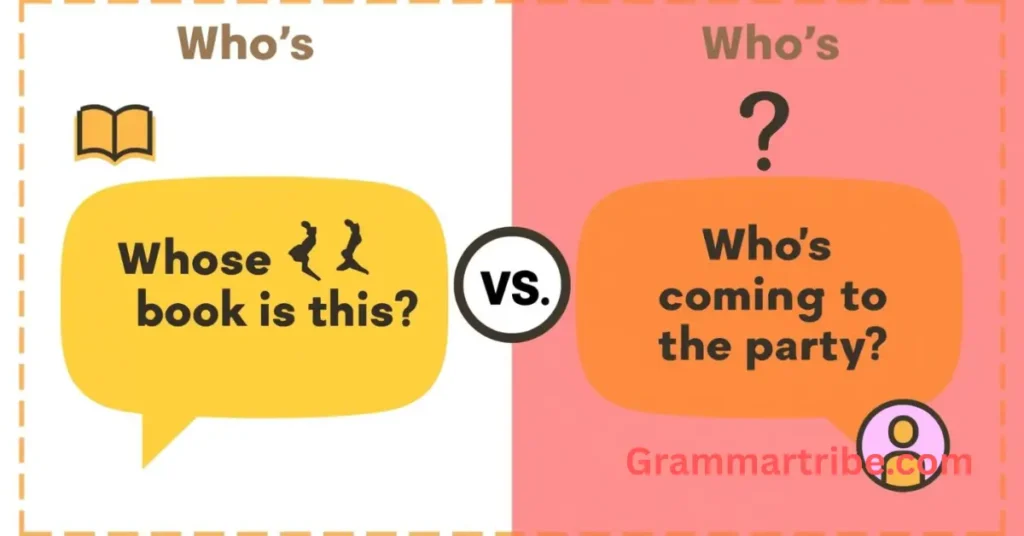
- Whose → shows possession.
Example: Whose book is this? - Who’s → contraction for who is or who has.
Example: Who’s coming to the party? (Who is coming…)
Example: Who’s finished their homework? (Who has finished…)
✅ Quick tip: If you can replace it with who is or who has, use who’s. If showing ownership, use whose.
The Origin of Whose / Who’s
- Whose comes from Old English hwæs, meaning “of whom.” It has always indicated possession.
- Who’s is a modern contraction of who is / who has, formed by combining the words with an apostrophe for simplicity in speech and writing.
The similarity in pronunciation has caused confusion for centuries, even among professional writers.
Read more: Niece or Neice: Spelling, Usage, and Common Mistakes Explained
British English vs American English Spelling
The usage of whose and who’s is the same in both British and American English. Unlike words like colour/color or behaviour/behavior, there is no spelling difference—only the context matters.
Comparison Table
| Word | Type | Usage Example | English Variant |
| whose | Possessive | Whose phone is ringing? | UK & US |
| who’s | Contraction | Who’s going to the meeting? | UK & US |
Which Form Should You Use?
Use whose whenever you are showing ownership or possession.
Use who’s when you mean who is or who has.
For global audiences, the rule is universal: the difference is context, not region. For both American and British English, correct usage depends entirely on the sentence.
Read more: Wholistic or Holistic: Understanding the Difference / Correct Usage
Common Mistakes with Whose / Who’s
❌ Who’s coat is this? → wrong
✔️ Whose coat is this? → correct
❌ Whose coming to dinner? → wrong
✔️ Who’s coming to dinner? → correct
❌ Mixing the two in professional emails or social media posts
✔ ️ Always double-check by replacing who’s with who is / who has.
Whose or Who’s in Everyday Examples
Emails:
- Whose report is due today?
- Who’s responsible for this task?
News:
- Whose idea was the new policy?
- Who’s leading the team this week?
Social Media:
- Who’s excited for the concert tonight?
- Whose photos are these?
Formal Writing:
- Whose contribution influenced the final decision?
- Who’s attended the annual conference this year?
Whose or Who’s – Google Trends & Usage Data
- Who’s is slightly more common in casual writing (social media, emails).
- Whose appears more in formal writing, academic articles, and journalism.
- Global search shows peaks in countries learning English, like India, Pakistan, and non-native English speakers.
Keyword Comparison Table
| Variation | Correct Usage | Example |
| whose | Possessive | Whose bag is this? |
| who’s | Who is / Who has | Who’s ready for the test? |
| whos | ❌ Incorrect | Whos ready for the test? |
FAQs – Whose or Who’s
1. Is “whose” or “who’s” correct in emails?
Both can be correct depending on the context. Use whose for possession, who’s for “who is/has.”
2. Can I use “who’s” in formal writing?
Yes, if the meaning is “who is” or “who has.” Avoid contractions in very formal academic papers.
3. How do I remember the difference?
Try replacing who’s with who is / who has. If it makes sense, use who’s; otherwise, use whose.
4. Is “whose” only for people?
No, it can show possession for objects too: Whose keys are these?
5. Are there spelling differences in British and American English?
No, both forms are used identically worldwide.
6. Can I mix “whose” and “who’s” in one paragraph?
Yes, if each word fits its proper context, but don’t use them interchangeably incorrectly.
7. Is “whos” correct?
No, always include the apostrophe for the contraction: who’s.
Conclusion:
The difference between whose or who’s is simple once you understand the context. Whose always shows ownership or possession, while who’s is a contraction of who is or who has. Misusing them is a very common grammar mistake that can make writing look careless or confusing.
The key is to check the sentence carefully. Ask yourself: “Can I replace this with who is or who has?” If yes, it’s who’s. If not, it’s whose. This rule works globally, in both American and British English, and across formal and casual writing.
For writers, students, and professionals, mastering this small but important distinction improves clarity, credibility, and communication. Whether in emails, social media, academic papers, or content writing, choosing the right form of whose or who’s ensures your audience reads your message the way you intended. Consistency is key.
Remember: ownership → whose | contraction → who’s. Keep this simple guide handy, and you’ll never mix them up again.

Hi, I’m Henry James, the author behind GrammarTribe.com. I’m passionate about the English language and specialize in grammar, helping readers understand complex rules in a simple, clear way. Over the years, I’ve dedicated myself to creating content that makes learning grammar practical, fun, and accessible for everyone. If you’re a student, professional, or language enthusiast.
Through GrammarTribe.com, I share tips, guides, and examples to help people write confidently and correctly. My goal is to make grammar less intimidating and more useful in everyday writing, emails, social media, and professional communication. Writing and teaching grammar isn’t just my profession — it’s my passion.
When I’m not writing, I enjoy reading, exploring language trends, and discovering new ways to make English learning engaging and easy. My mission is to empower readers to communicate clearly and confidently, one grammar tip at a time.