
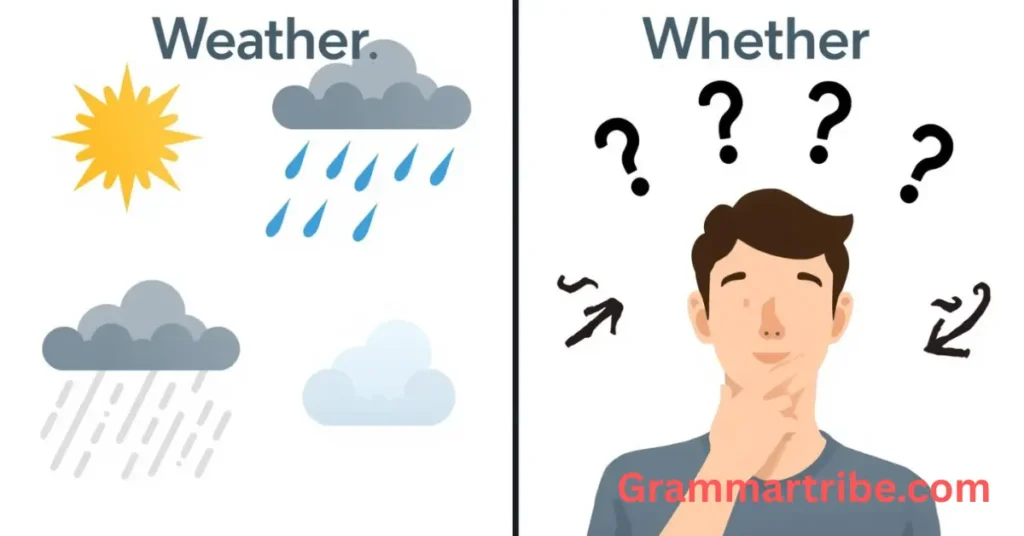
Confused about weather or whether? You’re not alone. Many people mix these two words because they sound the same but have completely different meanings. Using the wrong one can make your writing look careless or confusing.
Understanding the difference is important for school, work emails, social media posts, or even casual conversations.Weather refers to the state of the atmosphere rain, sun, snow, or storms.
Whether is used to introduce choices, possibilities, or alternatives for example, deciding between two options.
This article will clear up the confusion, explain the origin of each word, compare British and American English usage, highlight common mistakes, and provide real-life examples. By the end, you’ll know exactly when to use weather and when whether is correct and you’ll write confidently every time.
Weather or Whether – Quick Answer
- Weather = atmospheric conditions (rain, sun, snow).
Example: “The weather is sunny today.” - Whether = choice, possibility, or condition.
Example: “I don’t know whether I should go to the party.”
Tip: If it’s about climate, storms, or temperature → weather. If it’s about decisions or options → whether.
The Origin of Weather and Whether
- Weather comes from Old English weder, meaning “air, sky, or storm.” Its roots trace back over a thousand years in English, always linked to climate conditions.
- Whether comes from Old English hwæðer, used to indicate alternatives or choices. Its meaning has remained largely unchanged.
The confusion arises because over time, pronunciation evolved, making weather and whether sound almost identical in modern English.
British English vs American English Spelling
Both weather and whether are spelled the same in British and American English. There’s no difference in spelling, unlike other words like colour/color. However, pronunciation might slightly vary depending on accent.
| Word | British English | American English | Meaning |
| Weather | Weather | Weather | Atmospheric conditions |
| Whether | Whether | Whether | Choice, possibility, option |
✅ Key takeaway: The spelling is identical across both English variants. Context matters, not location.
Which Spelling Should You Use?
- US audiences: Use weather for climate, whether for choices.
- UK & Commonwealth: Same rules apply.
- Global writing: Always rely on context. If it’s about rain, sun, or storms → weather. If it’s about alternatives → whether.
Common Mistakes with Weather or Whether
- Incorrect: “I don’t know weather I can join.”
Correct: “I don’t know whether I can join.” - Incorrect: “The whether is sunny today.”
Correct: “The weather is sunny today.” - Mixing in formal writing: Avoid using weather when discussing possibilities.
Pro tip: Read the sentence aloud. If you’re talking about climate → weather. If it’s about options → whether.
Weather or Whether in Everyday Examples
- Emails: “Please let me know whether you can attend the meeting.”
- News: “The weather forecast predicts rain this weekend.”
- Social media: “Not sure whether I should try this new cafe.”
- Formal writing: “Whether you agree or not, the policy will take effect.”
Weather or Whether – Google Trends & Usage Data
- Weather is searched far more frequently globally, likely due to daily forecasts.
- Whether sees spikes around academic months or in decision-making contexts.
- Countries with high confusion: India, UK, USA users often check “weather or whether meaning.”
| Keyword | Average Monthly Searches | Popularity Region |
| Weather | 550,000+ | Global |
| Whether | 135,000+ | English-speaking countries |
FAQs – Weather or Whether
Q1: Can I use whether for weather?
A1: No. Whether is never about climate; that’s always weather.
Q2: Is there a spelling difference between British and American English?
A2: No, both spellings are identical. Context is what changes meaning.
Q3: How do I remember the difference?
A3: “Weather” → climate. “Whether” → choice/possibility.
Q4: Can they be used together in a sentence?
A4: Yes: “I’m unsure whether the weather will improve tomorrow.”
Q5: Why do people confuse them?
A5: They are homophones sound the same but have different meanings.
Q6: Is “wether” correct?
A6: No, wether is a different word (a castrated sheep).
Q7: Which is more common in daily use?
A7: Weather appears more frequently due to daily forecasts and news.
Conclusion
Mixing up weather or whether is a common mistake, but it’s easy to fix. Remember: weather = climate conditions, whether = choice or possibility. Context is the key. Using them correctly improves your writing, emails, and social posts, making you sound professional and accurate. British and American English spell them the same way, so focus on meaning, not location. When in doubt, read the sentence aloud and ask: “Am I talking about the sky or a decision?”
Mastering this small distinction boosts clarity and avoids embarrassing errors. Next time, you’ll know exactly whether you’re discussing the weather or weighing your options.

Hi, I’m Henry James, the author behind GrammarTribe.com. I’m passionate about the English language and specialize in grammar, helping readers understand complex rules in a simple, clear way. Over the years, I’ve dedicated myself to creating content that makes learning grammar practical, fun, and accessible for everyone. If you’re a student, professional, or language enthusiast.
Through GrammarTribe.com, I share tips, guides, and examples to help people write confidently and correctly. My goal is to make grammar less intimidating and more useful in everyday writing, emails, social media, and professional communication. Writing and teaching grammar isn’t just my profession — it’s my passion.
When I’m not writing, I enjoy reading, exploring language trends, and discovering new ways to make English learning engaging and easy. My mission is to empower readers to communicate clearly and confidently, one grammar tip at a time.