
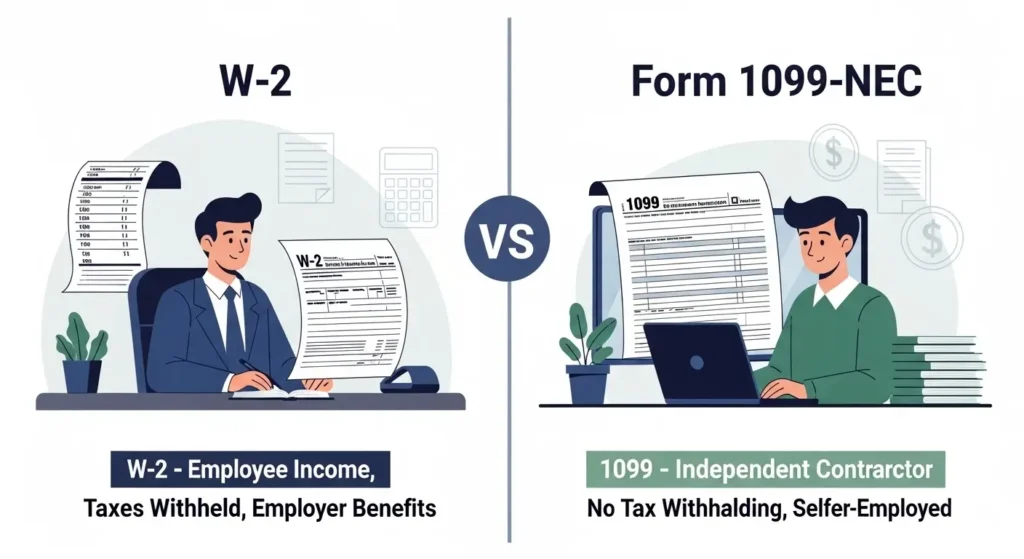
If you’ve ever started a new job, freelanced online, or worked with a U.S. company, you’ve likely searched “W2 or 1099”. This keyword is popular because people are confused about one big question: Am I an employee or an independent contractor? The answer affects your taxes, benefits, paycheck, and legal rights.
Many workers don’t know if they should receive a W-2 form or a 1099 form at tax time. Some think it’s just paperwork. In reality, it can change how much tax you owe, who pays Social Security, and whether you get benefits like health insurance or paid leave. Employers also get confused and sometimes classify workers incorrectly.
This article clears that confusion. You’ll get a quick answer, real-life examples, and simple explanations—no tax jargon. Whether you’re a U.S. employee, a freelancer, or someone working remotely for an American company, this guide will help you understand W2 or 1099, choose the right one for your situation, and avoid costly mistakes.
W2 or 1099 – Quick Answer
W-2 is for employees. 1099 is for independent contractors.
- W-2 example: You work full-time for a company. Taxes are taken from your paycheck.
- 1099 example: You freelance or do contract work. You pay your own taxes.
If your employer controls how and when you work, you’re usually W-2. If you control your work, you’re usually 1099.
The Origin of W2 or 1099
The terms W-2 and 1099 come from U.S. Internal Revenue Service (IRS) tax forms.
- W-2 was created to report wages paid to employees.
- 1099 dates back to the early 1900s and reports income paid to non-employees.
These are form numbers, not words. That’s why there are no spelling variations. The confusion exists because both forms report income, but they apply to very different work relationships.
British English vs American English Spelling
There is no British or American spelling difference for W2 or 1099. These are official U.S. tax form names.
| Term | American English | British English |
| W-2 | W-2 | W-2 |
| 1099 | 1099 | 1099 |
| Tax form | Tax form | Tax form |
In the UK, similar concepts exist, but the forms are completely different.
Which Spelling Should You Use?
Always use W-2 and 1099 exactly as written.
- US audience: Use W-2 and 1099
- UK/Commonwealth audience: Explain them as U.S. tax forms
- Global audience: Add short explanations with each term
Never add spaces or change the numbers.
Common Mistakes with W2 or 1099
Here are frequent errors people make:
- Thinking 1099 workers don’t pay taxes ❌
- Assuming freelancers get benefits ❌
- Mixing “employee” with “contractor” ❌
- Using 1099 to avoid taxes (illegal) ❌
Correction:
Your work relationship—not your preference—decides W2 or 1099.
W2 or 1099 in Everyday Examples
- Email: “Will I receive a W-2 or 1099 for this role?”
- News: “Gig workers debate W2 or 1099 status.”
- Social media: “Freelancers on 1099—save for taxes!”
- Formal writing: “Employees receive Form W-2 annually.”
W2 or 1099 – Google Trends & Usage Data
Searches for W2 or 1099 spike during tax season.
- United States: Very high usage
- Canada & UK: Moderate (remote work)
- Global freelancers: Growing interest
People search this term when starting jobs, freelancing, or filing taxes.
W2 vs 1099 Comparison Table
| Feature | W-2 | 1099 |
| Worker type | Employee | Contractor |
| Taxes withheld | Yes | No |
| Benefits | Often included | Not included |
| Tax filing | Simpler | Self-managed |
| IRS form | W-2 | 1099-NEC |
FAQs About W2 or 1099
1. Can I choose W2 or 1099?
No. Your work conditions decide it.
2. Is 1099 better than W2?
Not always. 1099 offers freedom but higher tax responsibility.
3. Do 1099 workers pay more tax?
Often yes, because they pay self-employment tax.
4. Can one person have both W2 and 1099 income?
Yes, in the same year.
5. Is misclassification illegal?
Yes. Employers can face penalties.
6. Do remote workers outside the US get W2 or 1099?
Usually 1099, but it depends on contracts and laws.
Conclusion
Understanding W2 or 1099 is essential for anyone earning income from U.S.-based work. These forms are not just paperwork—they define your taxes, rights, and responsibilities. A W-2 worker is an employee with taxes withheld and possible benefits. A 1099 worker is independent and must manage taxes alone.
Many problems start when people assume both forms are similar. They are not. Misclassification can lead to fines, back taxes, and stress. That’s why it’s important to look at how the work is done, not just what the contract says.
If you’re unsure, ask the employer early. Keep records. Plan your taxes ahead of time—especially if you’re on a 1099. With the right knowledge, W2 or 1099 becomes a simple decision, not a costly mistake.

Hi, I’m Henry James, the author behind GrammarTribe.com. I’m passionate about the English language and specialize in grammar, helping readers understand complex rules in a simple, clear way. Over the years, I’ve dedicated myself to creating content that makes learning grammar practical, fun, and accessible for everyone. If you’re a student, professional, or language enthusiast.
Through GrammarTribe.com, I share tips, guides, and examples to help people write confidently and correctly. My goal is to make grammar less intimidating and more useful in everyday writing, emails, social media, and professional communication. Writing and teaching grammar isn’t just my profession — it’s my passion.
When I’m not writing, I enjoy reading, exploring language trends, and discovering new ways to make English learning engaging and easy. My mission is to empower readers to communicate clearly and confidently, one grammar tip at a time.