Choosing between an SSD or HDD is a common question for anyone looking to buy a computer, upgrade their laptop, or improve storage performance. Many users are confused about the difference, wondering which is faster, more reliable, or better for their needs.
This confusion often leads to wasted money or poor performance if the wrong choice is made.The good news is that understanding the difference is simpler than it seems. SSDs (Solid State Drives) are faster and more durable, while HDDs (Hard Disk Drives) are cheaper and offer more storage for the price.
People search for “SSD or HDD” to make informed decisions about their devices, whether for gaming, work, or everyday use. In this guide, we’ll break down the key differences, common mistakes, and usage advice so you can confidently choose the best storage option for your needs.
SSD or HDD – Quick Answer
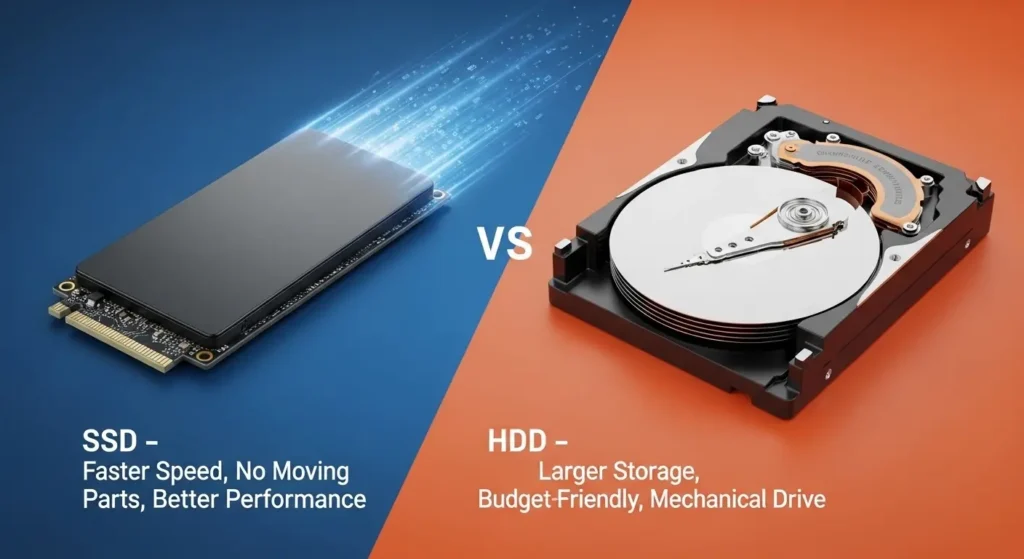
- SSD (Solid State Drive): Uses flash memory, no moving parts, faster read/write speeds, quieter, more durable. Example: Booting Windows in 15–20 seconds.
- HDD (Hard Disk Drive): Uses spinning magnetic disks, slower, more affordable, larger storage options. Example: Storing large video libraries or backups.
Quick takeaway: Choose SSD for speed and HDD for cost-effective storage.
The Origin of SSD or HDD
- HDD: Invented in 1956 by IBM, originally used in large computers. Spinning disks store data magnetically.
- SSD: Emerged in the 1990s, uses flash memory chips to store data electronically. Over time, SSDs became mainstream due to affordability and performance gains.
The term SSD emphasizes solid-state technology (no moving parts), while HDD highlights the mechanical disk design.
British English vs American English Spelling
Interestingly, SSD or HDD does not change spelling between British and American English. Both abbreviations are universal.
| Term | UK Usage | US Usage | Notes |
| SSD | SSD | SSD | Same in both regions |
| HDD | HDD | HDD | Same in both regions |
Since these are technical abbreviations, spelling is standardized worldwide.
Which Spelling Should You Use?
You can confidently use SSD and HDD globally.
- US audiences: Familiar with both abbreviations.
- UK/Commonwealth audiences: Also widely recognized.
- Global audience: No confusion, abbreviations are industry standard.
Common Mistakes with SSD or HDD
- Confusing speed and capacity – SSDs are faster, but HDDs often store more data.
- Thinking SSDs wear out quickly – Modern SSDs are durable and last years.
- Ignoring hybrid options – Some laptops use both SSD + HDD for balance.
- Buying wrong size – SSDs are more expensive per GB; plan storage based on usage.
SSD or HDD in Everyday Examples
- Emails: “I need to upgrade my SSD for faster email search.”
- News articles: “Gamers prefer SSDs for quicker load times.”
- Social media posts: “Just installed a 1TB HDD, huge storage upgrade!”
- Formal writing: “The company upgraded its server storage from HDDs to SSDs to improve efficiency.”
SSD or HDD – Google Trends & Usage Data
According to Google Trends:
- United States: SSD searches peak during Black Friday and back-to-school seasons.
- UK: HDD remains popular for budget-conscious users, SSD for tech enthusiasts.
- Global: SSD interest is growing, driven by laptops, gaming PCs, and cloud storage adoption.
Comparison Table
| Feature | SSD | HDD |
| Speed | Fast (0.1–0.3ms access) | Slower (5–10ms access) |
| Durability | High (no moving parts) | Medium (mechanical parts) |
| Price per GB | Higher | Lower |
| Noise | Silent | Can be noisy |
| Typical Use | OS, apps, games | Backups, media storage |
FAQs About SSD or HDD
- Which is better for gaming?
SSD, for faster load times and smoother gameplay. - Can I use both SSD and HDD in one computer?
Yes, many systems use SSD for OS and HDD for storage. - Do SSDs wear out faster than HDDs?
Modern SSDs last several years under normal use. - Which is cheaper per GB?
HDDs are generally cheaper for larger storage. - Is SSD noiseless?
Yes, no moving parts means silent operation. - Can HDD fail easily?
HDDs are more prone to mechanical failure than SSDs. - Should I upgrade my old laptop to SSD?
Yes, it significantly improves speed and performance.
Conclusion
Choosing between SSD or HDD depends on your priorities. If you want speed, durability, and quiet operation, an SSD is ideal. For large storage needs at a lower cost, an HDD is still a solid choice. Many modern setups combine both, using SSD for operating systems and applications, and HDD for bulk storage.
Understanding these differences helps you avoid mistakes, plan purchases wisely, and optimize your computing experience. Whether for personal laptops, gaming PCs, or enterprise servers, knowing when to use SSD or HDD ensures better performance, longevity, and cost-efficiency.
By keeping these tips in mind, you can confidently decide on the storage that best fits your needs, saving both time and money.

I am James Wilson, an author at GrammarTribe.com, specializing in English grammar and clear communication.
I create expert, reliable content to help learners write with confidence and accuracy.