
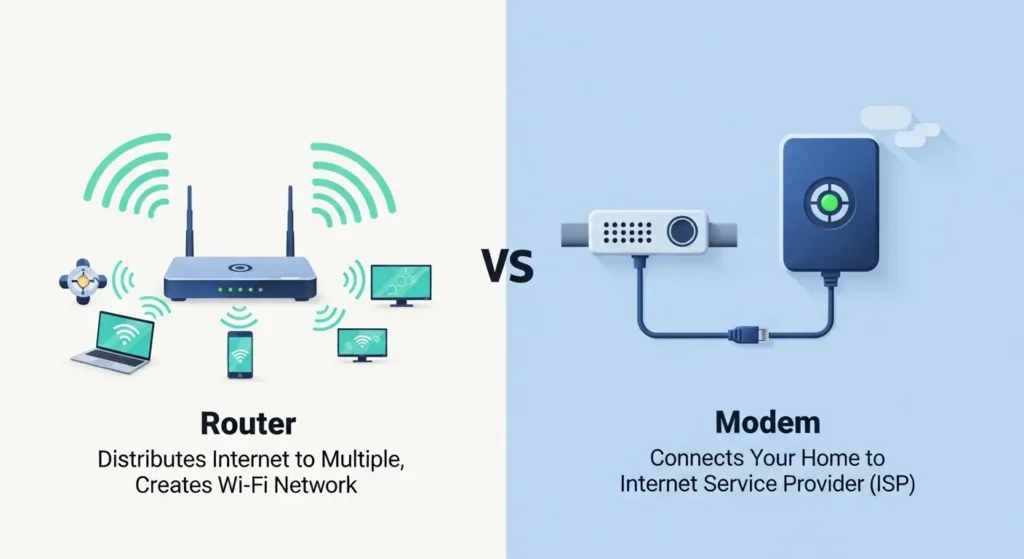
When it comes to setting up the internet at home, many people get confused between a router and a modem. Searching “Router or Modem” shows that users often want a quick answer:
which device do they need? Both devices are essential for internet connectivity, but they serve different purposes. A modem connects your home to the internet, while a router shares that connection with multiple devices. Understanding the difference can save you time, money, and frustration.
This article will explain Router vs Modem clearly, show common mistakes, and provide examples of usage in real life. Whether you’re in the US, UK, or anywhere else, this guide will help you choose the right device and use the correct terminology in emails, social media, or tech articles.
Router or Modem – Quick Answer
A modem connects your home network to your Internet Service Provider (ISP). Without it, there is no internet connection. A router, on the other hand, distributes that internet connection to multiple devices like laptops, smartphones, and smart TVs.
Example:
- Modem only → One device can access the internet.
- Router + Modem → Multiple devices can access the internet wirelessly.
The Origin of Router and Modem
The term modem comes from “modulator-demodulator”, describing its role in converting digital signals from your devices to analog signals for the telephone line or cable and back.
The word router originates from “route”, meaning to direct traffic. In networking, a router directs data packets between devices on a network and the internet. These terms are standard in technology globally, though their usage sometimes differs depending on country and context.
British English vs American English Spelling
Both router and modem are spelled the same in British and American English. However, subtle tech vocabulary differences exist between the two variants:
| Term | US English Usage | UK English Usage |
| Router | Common in home networks | Same usage, standard |
| Modem | Standard | Standard |
| Broadband | High-speed internet | Same term, sometimes “BT Broadband” in UK |
Unlike words like “color/colour,” router and modem have consistent spelling worldwide.
Which Spelling Should You Use?
Since there is no spelling difference for router or modem, you can use the same form globally. Focus instead on context:
- US audience → Emphasize home Wi-Fi setup and internet plans.
- UK/Commonwealth → Include terms like broadband and ISP names familiar to the region.
- Global audience → Use simple descriptions and include both terms for clarity.
Common Mistakes with Router or Modem
Many people confuse the two devices or their functions:
- ❌ Using “modem” when you mean “router.”
- ❌ Thinking a router alone connects to the ISP.
- ❌ Placing the modem and router in the wrong order, causing poor connectivity.
Correct use: Modem connects to ISP → Router distributes internet to devices.
Router or Modem in Everyday Examples
- Email: “Please reboot your modem to restore internet.”
- News: “ISP upgrades routers for faster speeds.”
- Social Media: “Which modem should I buy for gaming?”
- Formal Writing: “The office network requires both a modem and a router for optimal performance.”
Router or Modem – Google Trends & Usage Data
Search trends show that users frequently search “Router vs Modem” before buying internet equipment. Popularity is highest in countries with high broadband adoption:
| Country | Interest Level (High → Low) |
| USA | High |
| UK | Medium |
| Canada | Medium |
| Australia | Medium |
| India | Growing |
This indicates global curiosity about choosing the correct device.
Router vs Modem Comparison Table
| Feature | Router | Modem |
| Function | Distributes internet | Connects to ISP |
| Devices Connected | Multiple | Usually one |
| Required for Internet | No (needs modem) | Yes |
| Wireless Capability | Often Wi-Fi enabled | Rarely Wi-Fi |
| Setup Location | Home network | Between ISP and router |
FAQs
1. Can I use a router without a modem?
No, the router requires a modem to access the internet.
2. Can a modem replace a router?
No, a modem cannot distribute internet to multiple devices wirelessly.
3. Do all routers have Wi-Fi?
Most modern routers do, but some are wired-only.
4. What’s a modem-router combo?
A single device that functions as both a modem and a router.
5. How do I know if I need a new modem or router?
Check internet speed issues, outdated hardware, or ISP recommendations.
6. Are router and modem spelled differently in the UK?
No, spelling is the same worldwide.
7. Which is more important, modem or router?
Both are essential: modem for internet connection, router for sharing it.
Conclusion
Understanding the difference between a router and a modem is essential for anyone setting up home or office internet. A modem connects to your ISP, while a router distributes that connection to devices, often with Wi-Fi.
Remember, both devices complement each other, and confusing them can lead to slow or lost internet. Globally, the spelling is consistent, but context may differ depending on your audience. By using the correct terminology and setup, you ensure fast, reliable internet for your home or office. Next time someone asks, “Router or Modem?” you can give a clear, confident answer and avoid common mistakes.

Hi, I’m Henry James, the author behind GrammarTribe.com. I’m passionate about the English language and specialize in grammar, helping readers understand complex rules in a simple, clear way. Over the years, I’ve dedicated myself to creating content that makes learning grammar practical, fun, and accessible for everyone. If you’re a student, professional, or language enthusiast.
Through GrammarTribe.com, I share tips, guides, and examples to help people write confidently and correctly. My goal is to make grammar less intimidating and more useful in everyday writing, emails, social media, and professional communication. Writing and teaching grammar isn’t just my profession — it’s my passion.
When I’m not writing, I enjoy reading, exploring language trends, and discovering new ways to make English learning engaging and easy. My mission is to empower readers to communicate clearly and confidently, one grammar tip at a time.