Many English learners and even native speakers often get confused between “lets” and “let’s”. Both words sound the same when spoken, but they have very different meanings and uses. People search for “Lets or Let’s: Which Is Correct? Meaning & Examples” because they want to avoid common mistakes in emails, social media posts, or formal writing.
This guide will explain the difference, provide examples, highlight common errors, and show you exactly when to use each form. By the end, you’ll confidently know which one fits your sentence, keeping your writing professional and clear.
Lets or Let’s – Quick Answer
- Lets → Verb, means allows or permits.
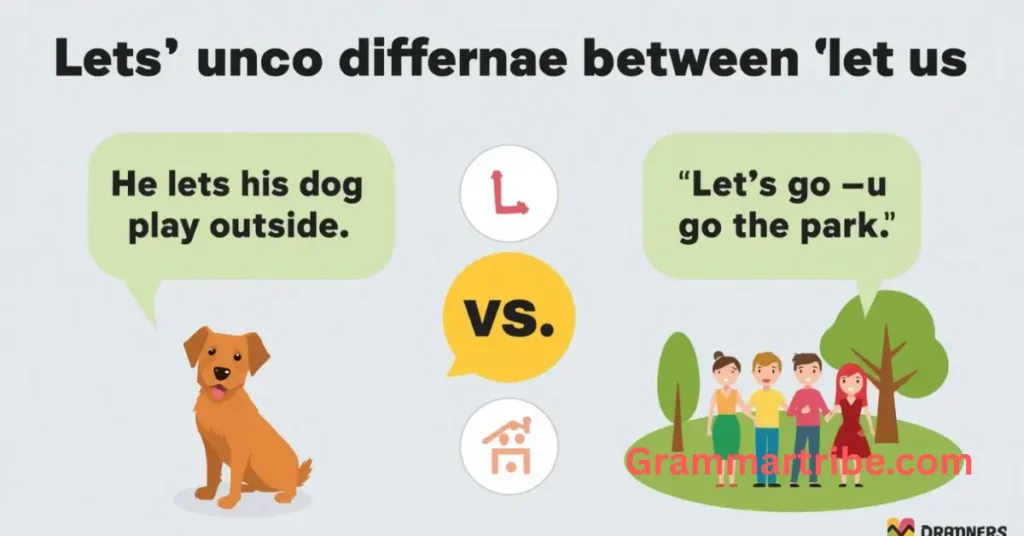
Example: The teacher lets students leave early. - Let’s → Contraction of let us, used for suggestions.
Example: Let’s go to the movies tonight.
Quick tip: If you can replace it with let us and it makes sense, use let’s.
The Origin of Lets / Let’s
The word let comes from Old English lǣtan, meaning to allow, permit, or leave. Over time, English grammar added contractions for smoother speech.
- Lets is the third-person singular present form of let.
- Let’s became common in English writing in the 16th century as a contraction of let us, making sentences faster and more natural.
The apostrophe is essential—it shows letters are omitted. Without it, the meaning changes entirely.
Read more: Kindergarten or Kindergarden: Everything You Need to Know
British English vs American English Spelling
Unlike behaviour / behavior, the difference between lets and let’s is not regional. Both British and American English use the same rules. The confusion is purely grammatical, not a spelling variation.
Comparison Table
| Word | Type | Meaning | Example | Region |
| lets | Verb | Allows or permits | He lets his dog play outside. | US & UK |
| let’s | Contraction | Let us (suggestion) | Let’s start the meeting. | US & UK |
Which Spelling Should You Use?
- Lets → Use when showing permission.
- Let’s → Use when making a suggestion.
Global advice: Always follow the apostrophe rule. Misplacing it confuses readers, regardless of region.
Read more: Kindergarten or Kindergarden: Everything You Need to Know
Common Mistakes with Lets / Let’s
❌ Writing lets when you mean let’s.
✔️ Always check: can you expand it to let us?
❌ Forgetting the apostrophe in contractions.
✔️ Let’s = let us
❌ Using let’s for third-person verbs.
✔️ Only use lets for “he/she/it allows”.
❌ Mixing them in one text.
✔️ Stick to one rule per sentence.
Lets or Let’s in Everyday Examples
Emails:
- The manager lets employees work from home.
- Let’s finalize the report today.
News Articles:
- City council lets residents vote online.
- Let’s explore the new policy changes.
Social Media:
- He lets his dog off the leash sometimes.
- Let’s check out the new cafe!
Formal Writing:
- The law lets citizens appeal decisions.
- Let’s discuss the proposed changes in detail.
Lets or Let’s – Google Trends & Usage Data
- let’s is searched slightly more often worldwide due to casual writing and social media.
- lets appears in formal and academic contexts where permission is discussed.
- Search engines treat them as separate queries, so optimizing your content for both is useful.
Keyword Comparison Table
| Variation | Correct | Meaning | Example |
| lets | ✅ | allows or permits | He lets his kids watch TV. |
| let’s | ✅ | let us (suggestion) | Let’s take a break now. |
| let | ✅ | base verb | I will let you know tomorrow. |
| lets’ | ❌ | incorrect | — |
FAQs – Lets or Let’s
1. Is lets or let’s correct?
Both are correct but have different meanings.
2. What does lets mean?
“Allows or permits” – third-person singular verb.
3. What does let’s mean?
Contraction of “let us,” used for suggestions.
4. Can I use let’s in formal writing?
Yes, but only for suggestions; for permissions, use lets.
5. How do I remember the difference?
Try expanding let’s to let us—if it makes sense, use an apostrophe.
6. Is it a US vs UK difference?
No, grammar rules are the same worldwide.
7. Are there common mistakes to avoid?
Yes—mixing lets and let’s or omitting the apostrophe changes the meaning.
Conclusion:
Understanding lets or let’s is simple once you know the rule: lets shows permission, let’s is a suggestion. The apostrophe is crucial because it changes meaning entirely. Confusing the two can lead to grammatical mistakes and miscommunication, especially in professional writing or online content.
Always check if you can expand let’s to let us. If it works, the apostrophe belongs there. If not, use lets for “allows or permits.” This simple check avoids most errors. Remember, this rule applies globally—there’s no US vs UK difference.
For content creators and SEO writers, optimizing for the right form improves clarity and search relevance. Whether you are writing emails, blog posts, social media updates, or formal reports, using lets and let’s correctly shows professionalism and attention to detail. Keep sentences clear, check your apostrophes, and your writing will be polished and confident.

I am James Wilson, an author at GrammarTribe.com, specializing in English grammar and clear communication.
I create expert, reliable content to help learners write with confidence and accuracy.