Understanding whether to use compliment or complement can be confusing. These two words sound almost identical, but they have very different meanings. Using the wrong one can make your writing seem careless, especially in emails, social media, or professional communication.
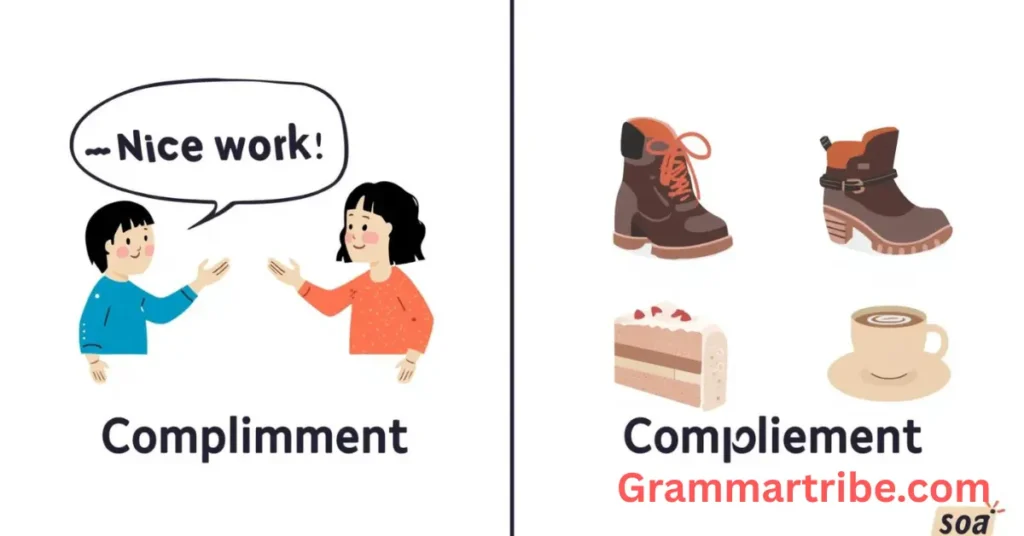
People often search for “compliment or complement” because they hear these words in conversation but aren’t sure which fits the context. A compliment is praise or admiration, while a complement is something that completes or enhances another thing. Knowing the difference is crucial for clear and professional writing.
This article will give you a simple explanation, historical context, common mistakes, and practical examples to ensure you never mix them up again.
Compliment or Complement – Quick Answer
- Compliment → Praise or admiration.
Example: She gave me a nice compliment on my dress. - Complement → Something that completes or improves something else.
Example: This wine is the perfect complement to the cheese platter.
Tip: If you are praising someone, use a compliment. If you are enhancing or completing something, use complement.
The Origin of Compliment and Complement
Both words come from Latin but entered English differently:
- Compliment comes from complēmentum, meaning “expression of courtesy or praise.”
- Complement also comes from complēmentum, but evolved to mean “something that fills up or completes.”
Over time, the meanings diverged, even though the pronunciation remained very similar. This historical overlap is why people often confuse them today.
British English vs American English Spelling
The spelling of compliment and complement is the same in both British and American English. Unlike other confusing words, the difference here is strictly meaning, not spelling.
| Word | Meaning | Example |
| Compliment | Praise or admiration | He complimented her cooking. |
| Complement | Something that completes | The scarf complements her outfit. |
Key Point: Both spellings are consistent across English dialects.
Which Spelling Should You Use?
- US audiences: Use compliment for praise and complement for things that complete or enhance.
- UK/Commonwealth audiences: Same rules apply; meanings do not change.
- Global writing: Stick to meaning rather than dialect; readers understand the difference better through context.
Common Mistakes with Compliment and Complement
- ❌ “This wine compliments the cheese.” → Wrong; should be complements.
- ❌ “She wore a dress that complemented her beauty.” → Wrong if you meant praise; should be complimented.
- ✅ Always remember: Praise = Compliment, Enhance/Complete = Complement.
Compliment or Complement in Everyday Examples
Emails:
- Compliment: “I wanted to compliment you on your presentation.”
- Complement: “Your insights complement the team’s strategy perfectly.”
Social Media:
- Compliment: “You look amazing! Love your style .”
- Complement: “This background music really complements the video.”
Formal Writing:
- Compliment: “The author deserves compliments for her research.”
- Complement: “The new policy will complement existing regulations.”
Compliment or Complement – Google Trends & Usage Data
According to Google Trends:
- Compliment is more commonly searched in contexts of praise, social interaction, and personal messages.
- Complement is more common in professional, technical, or design contexts.
- Searches peak in countries like the US, UK, Canada, and Australia, showing global relevance.
| Keyword | Popularity by Context |
| Compliment | Social, casual, personal |
| Complement | Professional, design, food |
FAQs
1. Can I use compliment and complement interchangeably?
No. They have different meanings: praise vs. complete/enhance.
2. How do I remember the difference?
Think: i = praise (compliment), e = complete/enhance (complement).
3. Which is more common in emails?
Compliment is common for praise; complement appears in professional or teamwork contexts.
4. Are there any spelling differences between UK and US English?
No. Both words are spelled the same in all English dialects.
5. Can complement be used for people?
Yes, when describing someone who completes or enhances a team or partnership.
6. Can compliment be used in business writing?
Absolutely! Especially for acknowledging work, effort, or achievements.
7. Is there a pronunciation difference?
Slightly, but in everyday English, they sound almost identical. Context clarifies meaning.
Conclusion
Using compliment and complement correctly improves clarity and professionalism in writing. Compliment always refers to praise, while complement refers to something that completes or enhances. Remembering the simple trick—i for praise, e for complete/enhance—can save confusion.
Check your context carefully: social, casual, or professional writing may require different usage. Use compliment in emails or social media when praising, and complement when discussing design, teamwork, or combinations. Both words are consistent across British and American English, so focus on meaning rather than location.
By mastering these two words, your writing will appear polished, clear, and confident. You’ll never mix them up again.

Hi, I’m Henry James, the author behind GrammarTribe.com. I’m passionate about the English language and specialize in grammar, helping readers understand complex rules in a simple, clear way. Over the years, I’ve dedicated myself to creating content that makes learning grammar practical, fun, and accessible for everyone. If you’re a student, professional, or language enthusiast.
Through GrammarTribe.com, I share tips, guides, and examples to help people write confidently and correctly. My goal is to make grammar less intimidating and more useful in everyday writing, emails, social media, and professional communication. Writing and teaching grammar isn’t just my profession — it’s my passion.
When I’m not writing, I enjoy reading, exploring language trends, and discovering new ways to make English learning engaging and easy. My mission is to empower readers to communicate clearly and confidently, one grammar tip at a time.