Are you confused about whether to write “canon” or “cannon”? You’re not alone. Many people stumble on this common English pair because they sound the same but have completely different meanings. Choosing the wrong word can change the meaning of your sentence and make your writing look unprofessional.
In this guide, we’ll break down the difference between canon and cannon, explain their origins, show when to use each, and highlight common mistakes. Whether you’re writing emails, social media posts, news articles, or academic papers, knowing the correct usage will make your writing precise and clear.
By the end of this article, you’ll not only know the difference but also understand which spelling works best for your audienceh. If in the US, UK, or globally. Let’s clear up the confusion once and for all.
Canon or Cannon – Quick Answer
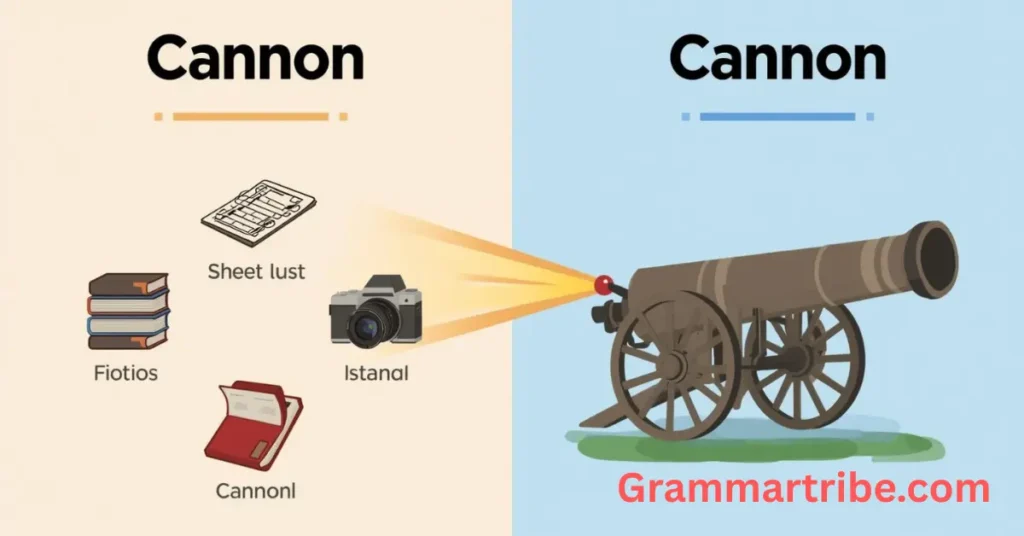
- Canon → Refers to a set of accepted works, rules, or principles.
Example: Shakespeare’s plays are part of the literary canon. - Cannon → A large heavy gun used in war, or metaphorically for something powerful.
Example: The museum displayed an ancient cannon from the 1800s.
Quick Tip: If it’s about rules, works, or official texts → canon. If it’s about artillery or weapons → cannon.
The Origin of Canon and Cannon
- Canon comes from the Greek word kanon, meaning “rule” or “measuring rod.” Over time, it came to mean an accepted standard or authoritative collection of works, such as religious texts or literary works.
- Cannon originated from the Old Italian word cannone, meaning “large tube,” which referred to a type of firearm. This word entered English around the 14th century during the era of artillery development.
The similar pronunciation led to confusion, but their meanings remained distinct.
British English vs American English Spelling
Both canon and cannon are spelled the same in British and American English, but usage context may vary slightly.
| Word | British English Usage | American English Usage |
| Canon | Literary canon, church canon | Literary canon, church canon |
| Cannon | Military cannon, historical references | Military cannon, historical references |
✅ Note: Unlike words like “colour/color,” spelling does not change between US and UK for these words. The key difference is understanding context.
Which Spelling Should You Use?
- US Audience: Stick to the same rules: canon for accepted works, cannon for artillery.
- UK/Commonwealth Audience: Same as US; usage is consistent.
- Global Audience: Avoid misusing these words in professional writing. Use canon for principles and cannon for guns to ensure clarity.
Common Mistakes with Canon or Cannon
- Using cannon when referring to literary works.
❌ Wrong: Shakespeare’s cannon includes Hamlet and Macbeth.
✅ Correct: Shakespeare’s canon includes Hamlet and Macbeth. - Using canon to describe a weapon.
❌ Wrong: The army fired the canon at dawn.
✅ Correct: The army fired the cannon at dawn. - Confusing pronunciation with spelling in formal writing.
Canon or Cannon in Everyday Examples
- Emails:
Please review the company’s marketing canon before submitting ideas. - News:
A historic cannon was discovered at the battlefield site. - Social Media:
This fan theory is officially canon! - Formal Writing:
The canon of classical literature remains influential today.
Canon or Cannon – Google Trends & Usage Data
- Canon is often searched in the context of literature, movies, and fandom discussions.
- Cannon is frequently searched in historical, military, and gaming contexts.
Trend Insight: Fans of movies, comics, or books are more likely to search “canon” when debating official storylines.
Keyword Comparison Table
| Keyword | Meaning | Example Usage |
| Canon | Accepted works, rules, principles | The Harry Potter books are considered canon. |
| Cannon | Artillery, heavy gun | The fort displayed a 17th-century cannon. |
FAQs About Canon or Cannon
- Q: Can “canon” refer to a gun?
A: No, “canon” refers to rules, works, or principles. Use “cannon” for guns. - Q: Is “cannon” ever used metaphorically?
A: Yes, e.g., She came out like a cannon in the debate. - Q: Do British and American English differ in spelling?
A: No, both spellings are identical; the key is understanding context. - Q: Can “canon” refer to movies or comics?
A: Yes, it refers to official storylines or accepted works. - Q: How do I remember the difference?
A: Think: Canon = rules/works, Cannon = gun/firepower. - Q: Is “cannon” used in sports?
A: Sometimes metaphorically to describe strong throws or shots. - Q: Can “canon” refer to religious texts?
A: Yes, church canon refers to official sacred texts.
Conclusion
Confused between canon and cannon? Remember this: canon is about rules, works, or accepted principles, while cannon refers to artillery or anything powerful. Their pronunciation may be similar, but meanings are entirely different.
Using the right word makes your writing clear and professional, whether in emails, social media, news articles, or academic papers. Stick to canon for literature, movies, fandoms, and official collections, and cannon when discussing weapons or historical artillery.
Always consider your audience. US, UK, and global readers understand the distinction as long as context is correct. By mastering these words, you’ll write with confidence and avoid common errors that make your content confusing.

I am James Wilson, an author at GrammarTribe.com, specializing in English grammar and clear communication.
I create expert, reliable content to help learners write with confidence and accuracy.