When it comes to neurodevelopmental conditions, many people get confused between autism and ADHD. Parents, teachers, and even adults often search “autism or ADHD” to understand which condition best explains certain behaviors, such as difficulty focusing, social challenges, or hyperactivity.
Clarifying the differences can reduce confusion, help in seeking proper support, and improve awareness.This article explains the differences between autism and ADHD in simple terms, explores the origins of the terms, compares usage in British and American English, and offers practical advice for writing, communication, and daily usage.If you’re a parent, educator, student, or professional, this guide provides a clear understanding of these two common conditions.
Autism or ADHD – Quick Answer
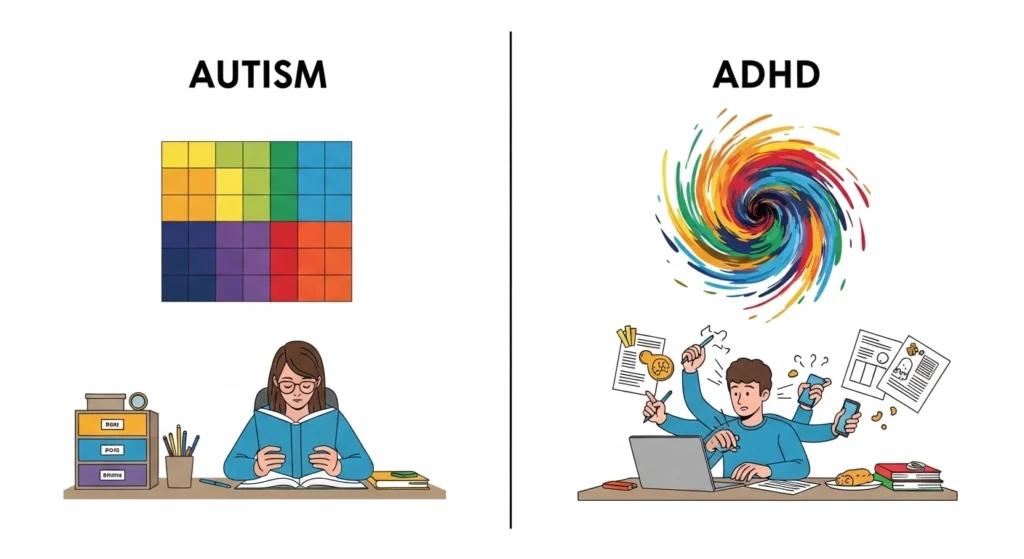
Autism (Autism Spectrum Disorder) is a developmental condition affecting communication, social interactions, and behavior patterns.
ADHD (Attention-Deficit/Hyperactivity Disorder) primarily affects attention, focus, and impulse control.
Example:
- A child struggling to focus in class but highly social may have ADHD.
- A child avoiding eye contact and following strict routines may have autism.
Both conditions can overlap, but symptoms and interventions differ, which is why people search “autism or ADHD.”
The Origin of Autism and ADHD
- Autism: The term was coined from the Greek word autos, meaning “self.” First used in psychiatry in the early 20th century, it described social withdrawal patterns.
- ADHD: Initially called “hyperkinetic disorder,” ADHD emerged in the 20th century to describe attention difficulties and hyperactive behavior in children.
Why the confusion exists: Both conditions affect behavior and focus, but the causes and treatments differ. Awareness campaigns often highlight both together, increasing searches for “autism or ADHD.”
British English vs American English Spelling
The spelling of autism and ADHD is consistent across English variants. However, British English often uses “disorder” as part of official names differently:
| Term | American English | British English | Notes |
| Autism | Autism Spectrum Disorder (ASD) | Autism Spectrum Disorder (ASD) | Spelling same, but NHS often shortens to “autism” |
| ADHD | Attention-Deficit/Hyperactivity Disorder | Attention-Deficit/Hyperactivity Disorder | Hyphenation is consistent, minor punctuation differences |
Which Spelling Should You Use?
- US audience: Always use Autism Spectrum Disorder and ADHD.
- UK/Commonwealth audience: Same terms apply, but official documents may drop “disorder” or use NHS-friendly shorthand.
- Global content: Use standard forms; clarity is more important than minor spelling differences.
Common Mistakes with Autism or ADHD
- Confusing the two as identical conditions.
- Using “attention deficit disorder” (ADD) interchangeably with ADHD (ADD is now outdated).
- Oversimplifying autism as only social awkwardness.
- Ignoring co-occurring conditions (autism and ADHD can exist together).
Correct usage: Always specify the condition and its symptoms for clarity.
Autism or ADHD in Everyday Examples
- Emails: “We should provide support for children with autism or ADHD in class.”
- News articles: “Research shows that autism or ADHD diagnoses have risen in the past decade.”
- Social media: “Do you know the difference between autism or ADHD?”
- Formal writing: “Participants were assessed for autism or ADHD following DSM-5 guidelines.”
Autism or ADHD – Google Trends & Usage Data
- Searches for ADHD peak during back-to-school months in the US.
- Autism sees spikes around World Autism Awareness Day (April 2).
- Globally, searches for “autism or ADHD” come from parents, educators, and healthcare professionals seeking clear guidance.
| Keyword Variation | Popularity Region | Notes |
| Autism | US, UK, Canada | Mostly in awareness campaigns |
| ADHD | US, Australia | Focus on school-aged children |
| Autism or ADHD | US, UK | Clarifying differences |
FAQs – Autism or ADHD
1. Can a person have both autism and ADHD?
Yes, many people show traits of both conditions, requiring tailored interventions.
2. Is ADHD easier to treat than autism?
ADHD often responds to behavioral strategies and medication; autism requires long-term support plans.
3. How early can autism or ADHD be diagnosed?
Symptoms may appear before age 3 for autism and around age 4–6 for ADHD.
4. Are autism and ADHD inherited?
Genetics play a role in both conditions, though environment and development also matter.
5. Can adults be diagnosed with autism or ADHD?
Yes, many adults are diagnosed later in life after recognizing lifelong patterns.
6. Are autism and ADHD equally common?
ADHD is more frequently diagnosed in childhood; autism prevalence is increasing due to awareness.
7. What is the main difference between autism and ADHD?
Autism affects social communication and repetitive behaviors; ADHD affects attention, focus, and hyperactivity.
Conclusion
Understanding the difference between autism or ADHD is essential for parents, educators, and professionals. While both conditions impact behavior and learning, they are distinct, requiring specific approaches for support and intervention.
Always use clear, standardized terms, and tailor your language to your audience—whether US, UK, or global readers. Awareness, accurate communication, and early support make a significant difference in managing these conditions effectively. Remember, searching “autism or ADHD” helps people find clarity and practical guidance for real-life situations.

Hi, I’m Henry William, the author of GrammarTribe.com. I’m passionate about the English language and have dedicated my career to helping people master grammar, spelling, and effective writing. Over the years, I’ve guided learners, writers, and professionals in understanding common mistakes, tricky rules, and nuances of English grammar in a simple and easy-to-follow way.
Through GrammarTribe.com, I aim to make grammar approachable and enjoyable for everyone. My work focuses on providing clear explanations, practical tips, and examples that readers can apply in everyday writing, whether it’s emails, essays, social media, or professional documents. I believe that strong grammar skills empower people to communicate confidently and professionally.
When I’m not writing or researching grammar, I enjoy reading, exploring language trends, and creating educational content that simplifies complex concepts. I’m committed to helping my audience write better, understand English deeply, and avoid common pitfalls, all while making learning grammar a fun and rewarding journey.