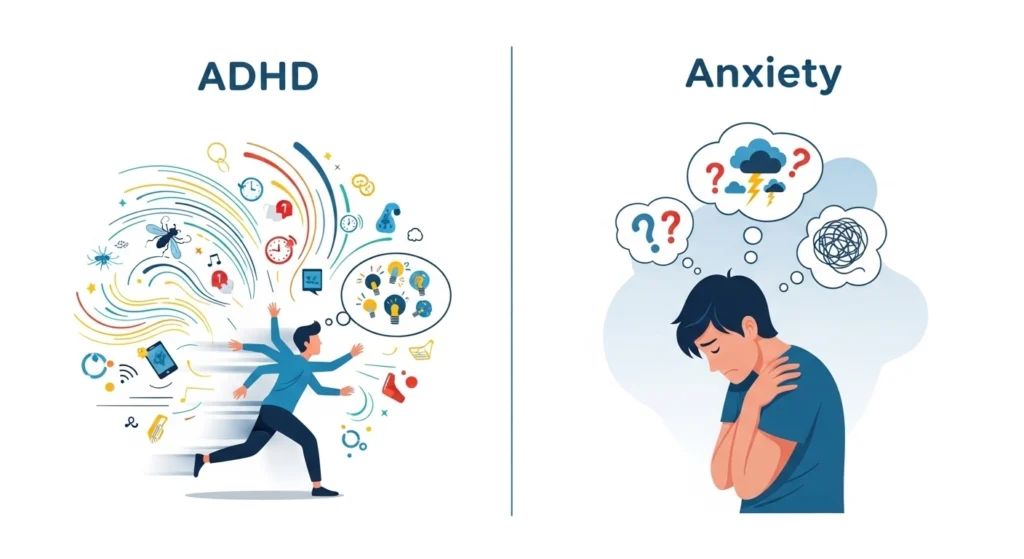
Many people often confuse ADHD (Attention Deficit Hyperactivity Disorder) with anxiety, leading to misunderstandings in both diagnosis and daily communication. ADHD and anxiety can share symptoms like restlessness, difficulty focusing, and sleep problems, but they are distinct conditions.
People frequently search for “ADHD or anxiety” to clarify their symptoms, understand treatment options, and communicate their experiences accurately. This article explains the difference, usage in writing, common mistakes, and proper contexts. By the end, you’ll know exactly when to use each term, how to write it correctly in British and American English, and how to communicate it clearly in daily life and professional settings.
ADHD or Anxiety – Quick Answer
ADHD is a neurodevelopmental disorder marked by inattention, hyperactivity, and impulsivity.
Anxiety is a mental health condition characterized by excessive worry, nervousness, and fear.
Example:
- ADHD: “She often forgets to submit her assignments due to ADHD.”
- Anxiety: “He felt intense anxiety before giving the presentation.”
While both can affect focus and behavior, ADHD is primarily about attention regulation, whereas anxiety is emotional and physiological.
The Origin of ADHD and Anxiety
ADHD was first described in the early 20th century as “hyperkinetic disorder” in children. The term evolved into ADHD in the 1980s to reflect attention deficits beyond hyperactivity.
Anxiety comes from the Latin word anxietas, meaning “unease or distress,” and has been studied in psychology since the 19th century.
The terms are not interchangeable, but public confusion arises because overlapping symptoms—like restlessness and difficulty concentrating—can appear in both conditions.
British English vs American English Spelling
Both “ADHD” and “anxiety” are spelled the same in British and American English. However, contextual usage and phrasing may vary.
| Term | American English Example | British English Example |
| ADHD | “He was diagnosed with ADHD at age 8.” | “He was diagnosed with ADHD at age 8.” |
| Anxiety | “She suffers from social anxiety.” | “She suffers from social anxiety.” |
Tip: No spelling change exists, but punctuation, date formats, and supporting phrases may differ.
Which Spelling Should You Use?
Since ADHD and anxiety have identical spellings in US and UK English, focus on:
- Audience: Use simple, clear language for general readers.
- Context: In academic or medical writing, use formal definitions: “Attention Deficit Hyperactivity Disorder (ADHD)” and “generalized anxiety disorder (GAD).”
- Global Writing: Maintain consistency in style; avoid mixing American and British punctuation or phrasing in the same document.
Common Mistakes with ADHD or Anxiety
- Mixing conditions: “He has anxiety ADHD.” ❌ → Correct: “He has ADHD and experiences anxiety.”
- Misspelling ADHD: “ADHDH” ❌ → Correct: ADHD ✅
- Using anxiety interchangeably: “ADHD causes anxiety.” ⚠️ → Clarify: ADHD may co-occur with anxiety, but it does not automatically cause it.
- Overgeneralization: “All kids with ADHD are hyperactive.” ❌ → Correct: “Some children with ADHD show hyperactivity; others may be primarily inattentive.”
ADHD or Anxiety in Everyday Examples
- Email: “I have ADHD, so I may need extended deadlines for tasks.”
- News Article: “Recent studies show anxiety affects 18% of adults annually.”
- Social Media: “Does anyone else with ADHD struggle to stay focused during meetings?”
- Formal Writing: “The patient exhibits ADHD symptoms alongside signs of generalized anxiety disorder.”
ADHD or Anxiety – Google Trends & Usage Data
Search interest for “ADHD or anxiety” peaks during school enrollment periods, exam seasons, and mental health awareness campaigns.
Top countries searching:
- United States
- United Kingdom
- Canada
- Australia
The trend shows growing public awareness about mental health distinctions, especially among parents, educators, and young adults.
Keyword Variations Comparison Table
| Variation | Example | Usage Tip |
| ADHD | “ADHD affects attention span.” | Use for neurodevelopmental context. |
| Anxiety | “Anxiety may interfere with work.” | Use for emotional/psychological context. |
| ADHD or anxiety | “She wonders if it’s ADHD or anxiety causing restlessness.” | Use when comparing symptoms or clarifying conditions. |
FAQs
1. Can ADHD cause anxiety?
Yes, ADHD can co-occur with anxiety, but one does not automatically cause the other.
2. How do I know if I have ADHD or anxiety?
Consult a licensed healthcare professional for proper evaluation and diagnosis.
3. Are the terms spelled differently in UK and US English?
No, both ADHD and anxiety are spelled the same.
4. Can children have both ADHD and anxiety?
Yes, comorbidity is common, and symptoms should be assessed individually.
5. How should I write about ADHD or anxiety in professional emails?
Use clear, concise language and avoid mixing the two terms unless clarifying co-occurring conditions.
6. Is anxiety part of ADHD?
Anxiety can be a symptom experienced alongside ADHD but is not part of the core diagnostic criteria.
7. Are ADHD and anxiety hereditary?
Both conditions have genetic and environmental components, though patterns vary individually.
Conclusion
Understanding the difference between ADHD and anxiety is crucial for accurate communication, diagnosis, and treatment. While ADHD focuses on attention and hyperactivity, anxiety emphasizes excessive worry and fear. The terms are spelled identically in British and American English, but clear context is key to avoid misunderstandings.
By using precise language, proper context, and recognizing overlapping symptoms, you can communicate confidently in emails, social media, academic, or professional writing. Awareness of usage trends, common mistakes, and audience expectations ensures your writing is correct and impactful. Remember, when in doubt, clarify whether a behavior stems from ADHD, anxiety, or both, to respect individual experiences and professional guidelines.
.

Hi, I’m Henry James, the author behind GrammarTribe.com. I’m passionate about the English language and specialize in grammar, helping readers understand complex rules in a simple, clear way. Over the years, I’ve dedicated myself to creating content that makes learning grammar practical, fun, and accessible for everyone. If you’re a student, professional, or language enthusiast.
Through GrammarTribe.com, I share tips, guides, and examples to help people write confidently and correctly. My goal is to make grammar less intimidating and more useful in everyday writing, emails, social media, and professional communication. Writing and teaching grammar isn’t just my profession — it’s my passion.
When I’m not writing, I enjoy reading, exploring language trends, and discovering new ways to make English learning engaging and easy. My mission is to empower readers to communicate clearly and confidently, one grammar tip at a time.